|
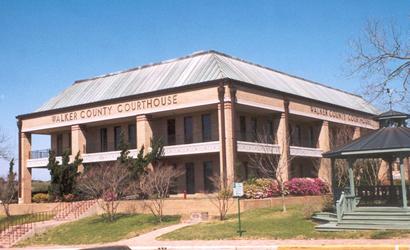
The 1970 Walker
County courthouse today.
Photo courtesy Terry
Jeanson, March 2005 |
The Current
Walker County Courthouse
- Huntsville,
Texas
Date - 1970
Architect - Joiner, Coburn & King
Style - Modern
Material - Brick & steel |
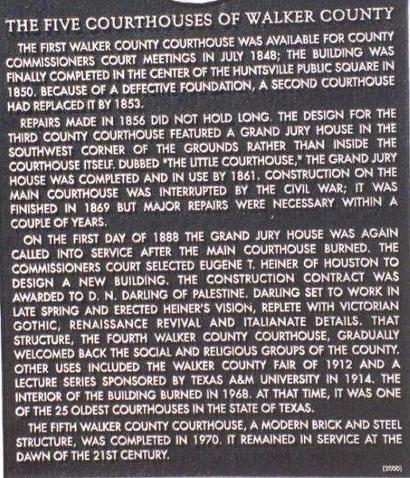
Walker County
courthouse historical marker
Photo courtesy Terry
Jeanson, March 2005 |
Historical
Marker Text
The Five
Courthouses of
Walker County
The first Walker
County Courthouse was available for county commissioners court meetings
in July 1848; the building was finally completed in the center of
the Huntsville public square in
1850. Because of a defective foundation, a second courthouse had replaced
it by 1853.
Repairs made in 1856 did not hold long. The design for the third county
courthouse featured a grand jury house in the southwest corner of
the grounds rather than inside the courthouse itself. Dubbed "The
Little Courthouse," the grand jury house was completed and in use
by 1861. Construction on the main courthouse was interrupted by the
Civil War; it was finished in 1869 but major repairs were necessary
within a couple of years.
On the first day of 1888 the grand jury house was again called into
service after the main courthouse burned. The commissioners court
selected Eugene
T. Heiner of Houston
to design a new building. The construction contract was awarded to
D. N. Darling of Palestine.
Darling set to work in late spring and erected Heiner's
vision, replete with Victorian Gothic, Renaissance revival and Italianate
details. That structure, the fourth
Walker County Courthouse, gradually welcomed back the social and
religious groups of the county. Other uses included the Walker County
Fair of 1912 and a lecture series sponsored by Texas A & M University
in 1914. The interior of the building burned in 1968. At that time,
it was one of the 25 oldest courthouses in the state of Texas.
The fifth
Walker County Courthouse, a modern brick and steel structure,
was completed in 1970. It remained in service at the dawn of the 21st
century. |
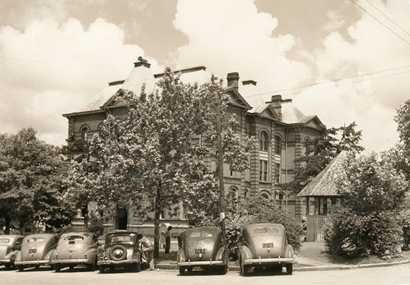 |
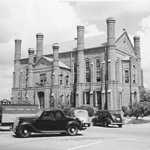
The 1888 (fourth)
Walker County Courthouse, burned.
1939 photo courtesy TXDoT |
|
|
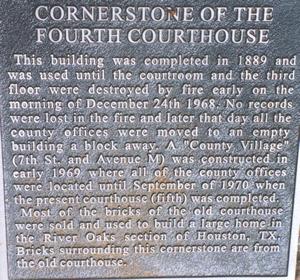
Historical
Marker on the 1888 Walker County courthouse cornerstone.
Photo courtesy Terry
Jeanson, March 2005 |
| |
|
|
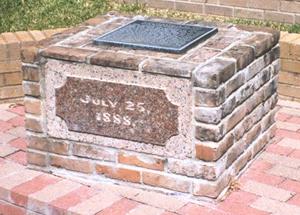
Cornerstone
of the 1888 Walker County courthouse, on the grounds of the current
courthouse.
Photo courtesy Terry
Jeanson, March 2005 |
| |
|
|
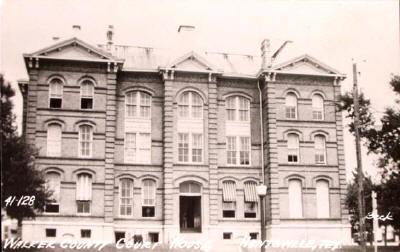
A
close up of the fourth courthouse, without the trees
Photo courtesy texasoldphotos.com |
|
|
 HOME
HOME