|
One
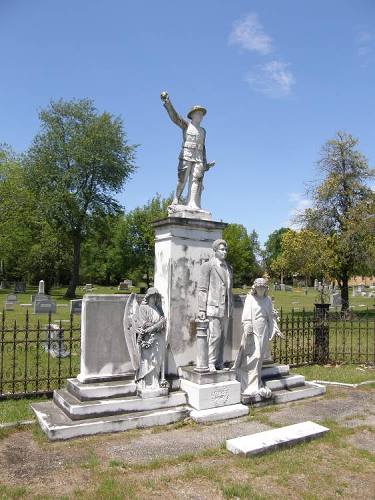
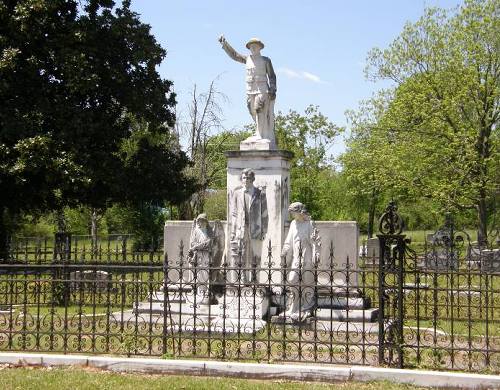
of the most arresting WWI
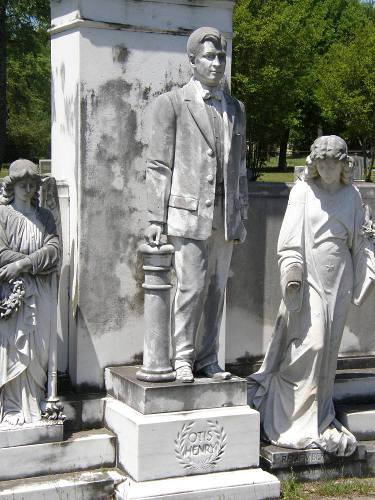
statues in Texas is a four-figured
marble memorial for Corporal Otis Henry.
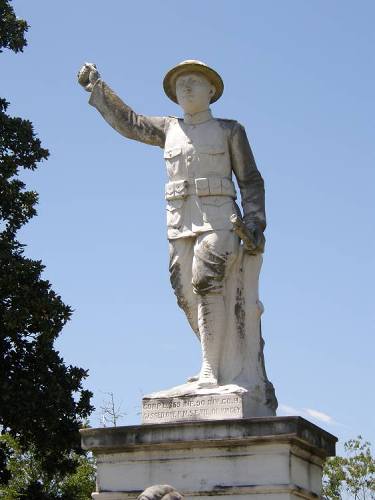
A generic statue of a soldier throwing a grenade stands above a statue
of the civilian Otis Henry flanked by two angels.
The Corporal died a mere 35 days from the signing of the armistice.
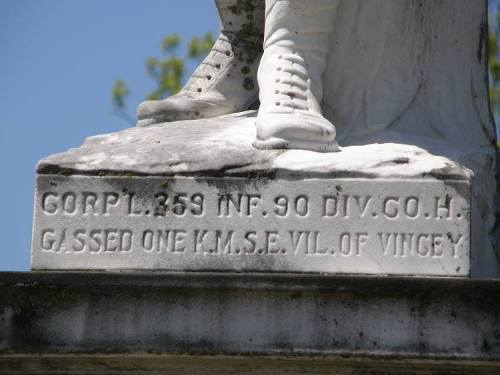
The inscriptions furnish the cause of death, the location of the event,
and the soldier’s unit. |
Corporal
359th Infantry 90th Division Co. H
Gassed one kilometer SE (Village) of Vincey
B. June 22, 1894 in Denison,
Texas
Died October 6th 1918 |
 |
Dulce et Decorum
est
by Wilfred Owen
Bent double, like old beggars under sacks,
Knock-kneed, coughing like hags, we cursed through sludge,
Till on the haunting flares we turned our backs,
And towards our distant rest began to trudge.
Men marched asleep. Many had lost their boots,
But limped on, blood-shod. All went lame, all blind;
Drunk with fatigue; deaf even to the hoots
Of gas-shells dropping softly behind.
Gas! GAS! Quick, boys! -- An ecstasy of fumbling
Fitting the clumsy helmets just in time,
But someone still was yelling out and stumbling
And flound'ring like a man in fire or lime. --
Dim through the misty panes and thick green light,
As under a green sea, I saw him drowning.
In all my dreams before my helpless sight
He plunges at me, guttering, choking, drowning.
If in some smothering dreams, you too could pace
Behind the wagon that we flung him in,
And watch the white eyes writhing in his face,
His hanging face, like a devil's sick of sin,
If you could hear, at every jolt, the blood
Come gargling from the froth-corrupted lungs
Bitter as the cud
Of vile, incurable sores on innocent tongues, --
My friend, you would not tell with such high zest
To children ardent for some desperate glory,
The old Lie: Dulce et decorum est
Pro patria mori. |
|
|
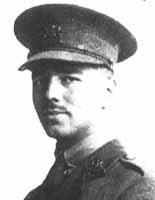
The
author of the poem, British soldier Wilfred Owen, was killed
a week before the armistice - his mother receiving the bad news
on Armistice Day.
Photo courtesy Wikipedia |
|
| From A Comprehensive
Guide to Outdoor Sculpture in Texas by Carrol Morris Little: “The
grief that motivated Corporal Henry’s mother, a lady of modest means,
to erect such a monument to her son inspires a deep sense of appreciation
for all WWI veterans
and their families.” |
 |
 |
Historical Marker:
Rose Hill Cemetery
One of the oldest
cemeteries in Texarkana.
Founded as "City Cemetery" in 1874, shortly after the town
was established in December, 1873. Here lie the remains of some of
the city's first citizens-- plantation owners, the livery stable owner,
country doctors, lawyers, the cabinet maker, and 2 known members of
the Texas legislature. About 70 Confederate soldiers and 3 known Union
soldiers are also interred here. Other burials include victims of
the 1882 Paragon Saloon disaster, which occurred when a storm caused
a nearby building to collapse, thus starting a fire. In 1889 the Rose
Hill Cemetery Association was formed to beautify and maintain the
tract. A very impressive monument marks the grave of Otis Henry, a
young World War I
soldier. The grave of Captain Francis Marion Henry, one of the city
fathers and a great-great-grandson of American Patriot Patrick Henry,
is marked by a Texas historical marker. The center-drive lots are
reserved for designated soldiers and veterans of World
Wars I and II
from Bowie County, Texas and Miller County, Arkansas. Many of the
older graves are placed in cement "cradles", a surviving custom of
earlier times, as is the secluded atmosphere of this heart-of-town
plot. |
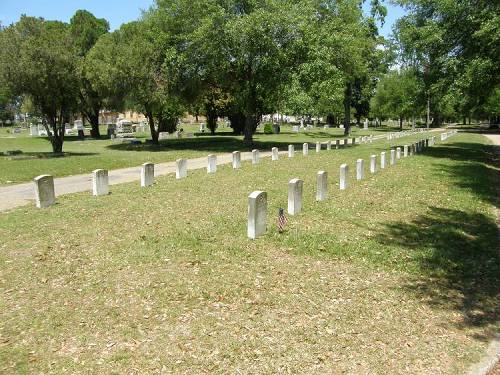 |
"The center-drive
lots are reserved for designated soldiers and veterans of World
Wars I and II
from Bowie County, Texas and Miller County, Arkansas."
Photo courtesy Barclay
Gibson, 2010 |
| Texas
Escapes, in its purpose to preserve historic, endangered and vanishing
Texas, asks that anyone wishing to share their local history, stories,
landmarks and recent or vintage photos, please contact
us. |
|
|
 HOME
HOME