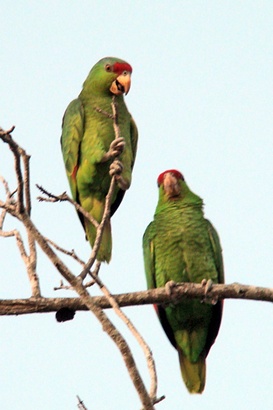
|
As
a child I visited my grandmother’s land in East
Texas where I observed chickens roosting. They slept in a persimmon
tree near the house. Without much commotion the chickens would fly
up into the tree as soon as daylight began to fade. By dark the tree
would be full.
The chickens slept all night but began leaving the tree at the first
light of day. This is the source of the sayings “Getting up with the
chickens” and “Going to bed with the chickens”. These Rio Grande Valley
parrots roost much like chickens except they are very noisy and occupy
many trees. |
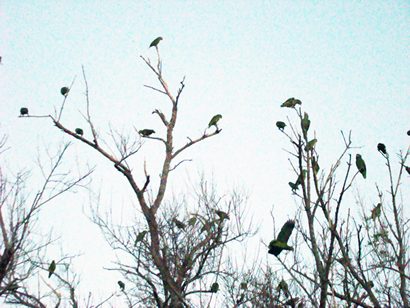
Parrots Arriving
To Roost
Photo courtesy Ken
Rudine, November 2009 |
Over
the last several years we have enjoyed finding roosting areas. We
have found them from Brownsville
to McAllen. We usually
stay in Weslaco
where our motel has a caged pair of parrots in the lobby. These parrots
are generally quiet in the lobby, but when their cage is rolled outside
their calls are loud and raucous, which reminds us of how parrots
sound in the wild.
Mercedes is where
we see the most parrots. Groups often roost there in or near the same
place. By asking various people you can find those current locations.
Most of the commotion is caused by the parrots trying to pair up with
their preferred roosting partner. Noisy brawls break out when they
are not happy. Wing flapping, chattering and flying about is the way
the birds show their frustration. Some residents of the houses come
out to watch the goings on. We have talked to many folks as we photographed
parrots. Their story is always the same. “Lately this happens everyday”.
|
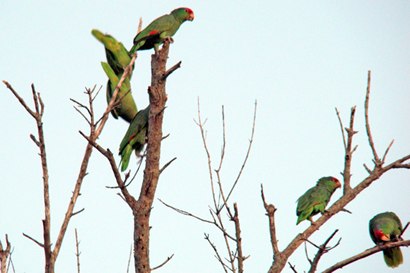 |
Looking For A
Perch
Photo courtesy Ken
Rudine, November 2009 |
We have also
seen this event enough to know what is happening. At roosting time
the ~200 or so birds, want to sleep on the same limb next to a certain
bird. Many species of birds have lifetime mates, but we don’t know
if these parrots are in this group. There are many disagreements over
perches and it is all must be settled within 15 minutes. By dark all
becomes eerily quiet, with only an occasional squawk.
Parrots
have many choices but the photographer has only a few minutes to shoot
photos. From the time the parrots arrive to last available light is
usually only about 15 minutes. They circle the area and land and then
fly again wasting precious remaining light. But on the day of the
included photos the parrots were already there. |
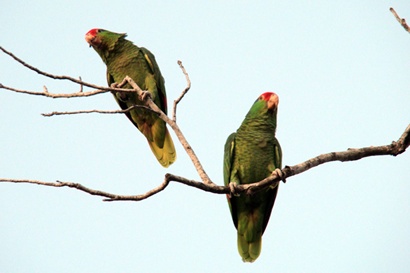 |
They have picked
a few blocks to try to roost in and we located them by their tremendous
noise. They like bare trees, densely leafed trees and the tallest
palm trees. All this calamity is occurring while the sun is setting.
We were able to park within fifty feet or less of them in a tree with
no foliage. Luckily we were positioned with the sun at our back, the
only way to see any color on the bird photos.
Still photography of these birds can be difficult. For sure you must
know your camera and its abilities in order to even come close to
capturing a snapshot, much less a PHOTO. When you are fortunate
enough to be parked in the midst of the roosting trees, you are shooting
straight up. Besides keeping from tumbling over, you need to calmly
take a picture. You might consider lying on the ground. |
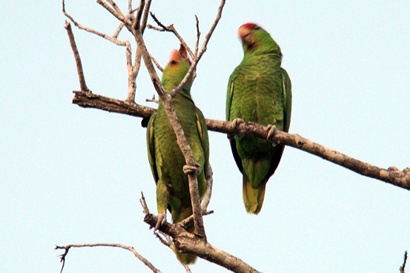
Paired Parrots
Settling On A Perch
Photo courtesy Ken
Rudine, November 2009 |
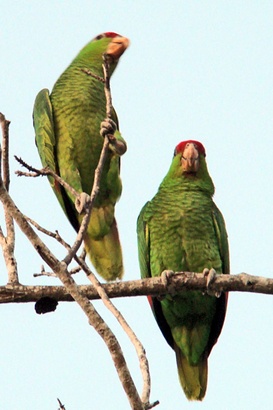
Activity Difference
Between The Sexes
Photo courtesy Ken
Rudine, November 2009 |
Female Still
Talking And Male Asleep
Photo courtesy Ken
Rudine, November 2009 |
If you are observant
you may find two birds to concentrate on for a couple of minutes like
those shown here. Apparently a mated pair, the female is talkative
and animated while the male is stoic or already asleep. Not an uncommon
human condition. The interaction between these two birds is possibly
representative of the whole group.
Many years ago commentator Paul Harvey reported that birds communicate
about only three things: Food, Sex and Danger. Since hearing that
report everything I have seen confirms that observation.
© Ken
Rudine, January
20, 2010 Column
More Traveling Team Rudine
| Texas
Birds | Texas
Animals |
Forum:
Subjects: Parrot Pictures
I happen to come
across your website with the pictures of the parrots and was very
excited to see it. The parrots are Red Headed Mexican Amazons, sometimes
called Green Cheeked Amazons. They are native to the northeastern
coast of Mexico and are very endangered due to habitat loss and poaching.
I have one as a pet and am totally smitten with the breed. Everything
you described about their behavior is totally true. They are raucous,
happy birds. I had no idea they were living in the wild in that area
but would like to visit Mercedes
and Weslaco to
observe them. Do you remember specific sites that I can visit to find
them? I'm a teacher and would like to visit during Spring Break for
a couple of days. Do you remember the hotel you mentioned in Weslaco?
Thank you so much. - Shannah Perry, Cable Elementary
Author's reply:
We are pleased to help you. We like to stay in the Bestwestern Palm
Aire Motel, 415 S. International Blvd (also known as 1015). (Book
here) They have 2 of these parrots in a cage in the lobby. They
will speak to you and their cage is rolled outside most mornings and
they yell and call just like in the wild. We do not know where they
spend the daytime. They usually fly in to a roost area maybe 10 minutes
before they go quiet and asleep. As you know they are loud and jockey
for position next to their favorite partner for that 10 minutes or
so. Usually after they are paired off one will go to sleep while the
other is still busy moving and squawking some. At dark all goes quiet.
We have pursued these parrots for years and have most often found
them at sundown in Mercedes
at or near S. Ohio & 14th St. We usually check the internet for the
time of sundown for that day and go to the area about 1/2 hour ahead
of time. However they usually arrive just as the sun drops below the
horizon. If you can maneuver your position to have the sundown at
your back it is the best light to capture any color in the birds.
The reason we go early is so we can get use to the ambient noises
so we won't miss the parrots arriving with their raucous noises.
In Weslaco you
should also try S. Illinois & 11th st. That is adjacent to the Cemetery
which may have some Great Kiskadees or parrots. We have been told
to check 1204 Fair Park Blvd, Harlingen;
10th & Dove, McAllen
but never made contact there. There are many in the old cemetery in
Brownsville
but we don't go there anymore - too risky. The first pictures we made
of these parrots was in Brownsville
as they flew over. But most of the pictures in Mercedes
are made at 15X magnification so they are usually in high trees. But
one time they landed in a tree over our car only 15 feet away. Pictures
no good - I wasn't prepared for that close an encounter. Good luck.
- Ken
Rudine, March 03, 2012
Book Hotel Here:
Weslaco Hotels |
McAllen Hotels |
Mercedes Hotels
|
| Texas
Escapes, in its purpose to preserve historic, endangered and vanishing
Texas, asks that anyone wishing to share their local history, stories,
landmarks and vintage or recent photos, please contact
us. |
|
|
 HOME
HOME