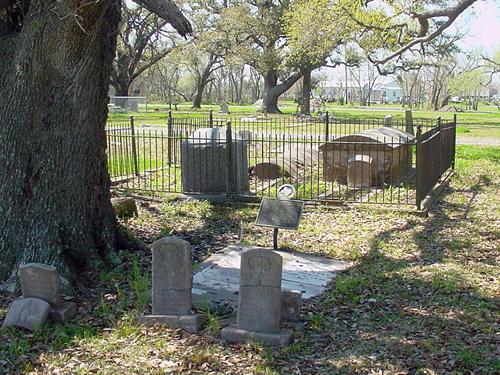
|
She
stood only 4 feet 10 inches, but folks learned quickly not to cross
Catherine “Kate” Magill Dorman -- a little known Texas heroine of
the Civil War.
Born in Georgia on Oct. 7, 1828, Kate married Arthur Magill in 1844.
Seven years later, the couple came to Texas, settling at Sabine
Pass. They brought with them the disinterred remains of their
five-year-old daughter, reburying her near their new home.
In 1852 they built an inn they called the Catfish Hotel. With a
wharf extending into Sabine Lake from the front of the two-story
hotel, customers did not have far to walk. Capable of accommodating
24 guests, the Catfish soon acquired a reputation for good food
as well as comfortable beds.
Kate also had
a reputation. She set a fine table, but she did not brook any guff
from her guests or acquaintances, be they rowdy sailors or sharp-tongued
women. People talked for years about the time a local woman known
as “Dutch Margaret” stormed into the dining room at the Catfish
and assailed Kate in “blackguard language.”
The diminutive hostess let “Dutch Margaret” have it right back,
settling the matter as far as she was concerned. But some time later,
three of Kate’s lady friends confronted “Dutch Maraget” on the street
and took to her with their parasols.
“Dutch Margaret” filed a lawsuit alleging she had suffered a miscarriage.
The lawsuit got tossed out of court, and three months later “Dutch
Maraget” bore a healthy son who would have been Exhibit A for the
defense had the matter gone to trial.
In addition to helping out at the hotel, Kate’s husband served as
the engineer on the steamer T.J. Smith, a mail packet operating
out of the pass. The 100-foot vessel cut through the water “like
lightning with a thunderbolt after it,” but on Nov. 2, 1859, the
packet’s boiler exploded. Magill died in the accident, leaving Kate
and her two young daughters alone in the small coastal community.
Kate mourned the death of her husband, but in 1860 she married John
Dorman, captain of a cotton steamed named the Doctor Massie.
Through it all, Kate had continued to operate the Catfish Hotel.
The Civil War, what with blockade runners and the establishment
of a Confederate coastal artillery installation called Fort Griffin,
at first improved Kate’s business.
But life soon got harder. Yellow fever struck Sabine
Pass in the late summer of 1862, killing at least 100 people
and afflicting scores more. Most of the other residents fled the
area, praying they and their families would not come down with the
dread disease. Kate and two of her friends, Sarah Ann King and Sarah
Vosburg, stayed behind to care for the sick Confederate soldiers.
Not long after, three Yankee gunboats appeared and fired a few shells
at the town. A shore party burned the Confederate barracks and stable,
appropriating from the Dormans a horse and cart to mount a howitzer
they had carried ashore. Kate saw what happened and didn’t like
it a bit. As the Houston Tri-Weekly Telegraph later reported, “Mrs.
Dorman...became perfectly enraged and...gave them just such a tongue-lashing
as only a brave woman would dare do.”
Kate shook her fist at the bluecoats, saying she hoped the Rebels
killed them. She’d do it herself, she went on, if she had 25 able
men. Whether intimated or just being polite, the federal soldiers
returned the confiscated horse and cart. Still, they had a warning
for Captain Dorman: “Keep his damned wife’s mouth shut, [or] they
would hang him.”
The Yankees left the area, but a year later they returned, intending
to land 4,000 troops in Texas. A four-vessel flotilla bombarded
the Confederate fort, located only about 300 yards from the Catfish.
During the battle, with federal shells exploding all around, Kate
and her friend Sarah Vosburg worked over a hot stove in the hotel’s
kitchen, brewing coffee and frying meat and doughnuts for the defenders.
As the fight continued, she hitched up the same horse and cart the
Yankees had “borrowed” the year before and went to the fort to feed
the artillerymen. Hoping to further fortify the fortifiers, Kate
delivered a gallon of whiskey in addition to the food and coffee.
Bolstered by a strong sense of duty and stronger whiskey, 47 Irishmen
under Houston bartender Dick
Dowling out-gunned the federals, putting two gunboats out of
action and forcing the other two to make a course for New Orleans.
The battle didn’t win the war for the Confederacy, but in thwarting
the invasion, Dowling
and his boys prevented a lot of bloodshed in Texas.
The woman who contributed to that victory stayed at Sabine
Pass the rest of her life, surviving a devastating hurricane
in 1886. She died on Christmas Eve in 1897, having outlived her
second husband by more than a decade.
In February 1900, a Galveston
newspaper columnist raised money to buy train tickets for two old
rebels living at the Confederate Home in Austin.
Among the last survivors of the men who had participated in the
battle, they wanted to visit the scene of their victory one last
time.
Arriving in Sabine
Pass, the first thing the two elderly Irishmen said was, “Where’s
Kate? We want to see Kate!”
© Mike Cox
"Texas
Tales"
May
19, 2004 column, modified May 21, 2015
|
 HOME
HOME