|
The
woman from Tennessee left no letters or diary to provide future generations
with any insight into her thinking, but it’s not hard to imagine her
feelings when she opened the envelope from Austin.
The communication came from Comptroller James B. Shaw. The state’s
chief financial official begged leave to inform her that under the
provisions of “An Act to provide for ascertaining the Debt of the
late Republic of Texas,” approved by the Legislature on Feb. 7, 1853,
her claim for the services rendered by her late husband had been audited
and authenticated. Enclosed she would find a warrant on the State
of Texas in payment of that service “in par funds, as having been
at that rate so available to the Government.”
That wording must have been about as easy for the 65-year-old widow
to understand as it is today, but Texas had finally reimbursed her
family for its loss. The widow’s name was Elizabeth Patton Crockett.
Her husband went by David. And he died hard.
It happened on the morning of March
6, 1836. Historians continue to debate whether the former U.S.
Congressman from Tennessee went down in the heat of battle swinging
his trusty rifle “Old Betsy” or faced summary execution after surrendering
to the Mexicans who had besieged the old mission for 13 days.
Eight weeks before, writing his children from San
Augustine on Jan. 9, 1836, Crockett had proclaimed Texas
“the garden spot of the world.” He said he intended to settle in the
northern part of Texas and “am in hopes
of making a fortune for myself and family bad as has been my prospects.”
Indeed, the celebrated frontiersman had never had much luck with money.
Nor had he fared a whole lot better in politics, having famously told
his former constituents, “Since you have chosen to elect a man with
a timber toe to succeed me, you may all go to hell and I will go to
Texas.”
Official proof of the return Crockett’s estate realized on his ultimate
investment can be found in the State Archives, where Second Class,
“B.” certificate No. 6127 remains on file. After Comptroller Shaw
signed the document on Dec. 2, 1854, his office sent Mrs. Crockett
a check from the grateful State of Texas for $24.
Though Crockett’s paycheck came 17 years late, on Dec. 23, 1837 the
Republic of Texas had issued Bounty Warrant No. 1295 to his heirs.
That certificate entitled Mrs. Crockett to 1,280 acres in North Texas
in return for her late husband’s government service, but the Comanches
who roamed the area saw the land as theirs.
Finally, eight years after Texas became
a state, Mrs. Crockett left Tennessee in 1853 with her two children
– a grown, married son named Robert Patton Crockett and a daughter,
Matilda, to claim her land. The Crocketts stayed in Waxahachie
until a surveyor could determine the boundaries of her land, a job
he undertook in exchange for half the property. What Elizabeth ended
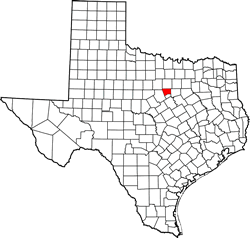
up with was 640 acres on Rucker’s Creek, about six miles from present
Granbury. |
 |
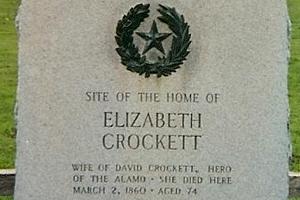 |
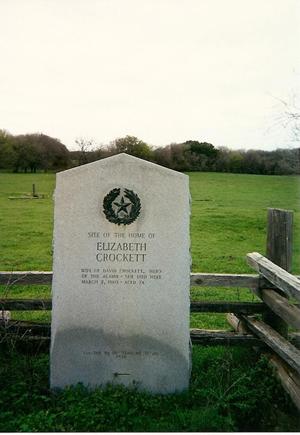
Site of the Home
of Elizabeth Crockett
Centennial Marker
Photo
courtesy Ruth Cade, 2008
See Texas Centennial |
Living in a log
cabin built by her son, Elizabeth spent the last six years of her
life in the place her husband had come to make his fortune. On the
morning of Jan. 31, 1860, wearing the widow’s black she had worn since
first learning of her husband’s death, Elizabeth left her cabin to
take a walk and shortly fell dead at the age of 72.
Elizabeth
was buried at the small community of Acton.
Four years later her daughter died and was buried near her.
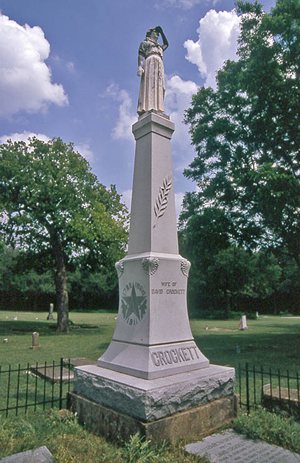
In 1911, Senators O. S. Lattimore and Pierce Ward introduced legislation
appropriating $2,000 for “the erection of a monument over the remains
of Mrs. Elizabeth Crockett.” |
 |
Explaining the
bill to his senate colleagues, Sen. Ward said he first learned of
the Crockett family’s Hood
County connection while a student at Granbury Methodist College
in the fall of 1880. By that time, of course, the only direct survivor
was Robert Crockett.
“Naturally I felt like making his acquaintance and I found him residing
near the banks of the Brazos River, manager and keeper of the toll
bridge that spans the river,” the senator said. “I would often visit
him.”
Ward recalled that Crockett took “great pleasure” entertaining “college
boys” and would “relate many incidents of his father’s career as he
had learned them when a boy.”
If Ward ever wrote down any of the stories he heard from Robert Crockett,
who died in 1889, they are not known today. But the senator’s bill
made it through the Legislature, and the monument was unveiled in
May 1913 by the widow Crockett’s namesake, her great-granddaughter.
|
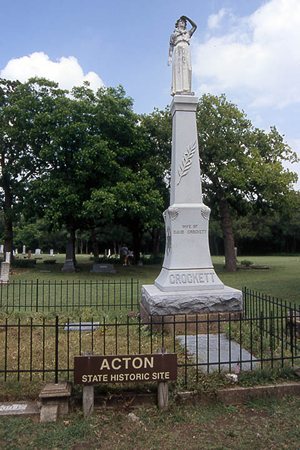 |
Note the "Acton
State Historic Site" sign by the burial plot
Photo courtesy Sam
Fenstermacher, June 2005 |
Since 1949, the 12 by 21-foot burial plot at
Acton has
been a state park – Texas’ smallest.
The 28-foot marble monument features a statue of a bonneted
pioneer woman standing on a pedestal, her hand forever shading her
eyes as she looks to the west, eternally wondering when her husband
will come home.
© Mike Cox
"Texas Tales" - March
8, 2005 column |
Forum:
Subject: Crockett
Descendants
Elizabeth Gose Crockett (and we have photos) is my great, great grandmother...
more
- Melissa (Lisa) Jemison Roberts, August 14, 2007 |
Acton State
Historic Site Contact Information
c/o Cleburne State Park
5800 Park Rd 21
Cleburne
TX 76031
817/645-4215
http://www.tpwd.state.tx.us
Book Hotel Here > Granbury
Hotels |
|
|
 HOME
HOME