|
|
When
74-year-old Dr. Henry North Graves died that summer morning in Dallas,
the solution to one of Texas’ enduring
mysteries may have died with him.
Though no irrefutable evidence has been found, some historians believe
that Graves had a hand in the burial of the most famous pieces of
artillery in Texas history – the Twin Sisters.
The two guns had been donated to the Texas cause by the citizens
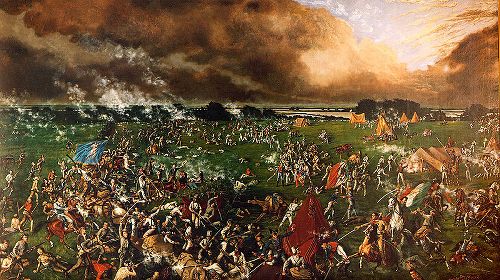
of Cincinnati in 1836. On April 21 that year, with devastating effectiveness,
the six-pounders helped Sam Houston
defeat Gen. Antonio Lopez de Santa Anna in the rout that came to
be called the Battle
of San Jacinto.
|
Battle
of San Jacinto Painting 1895 by Henry Arthur
McArdle
Courtesy Texas State Library and Archives Commission.
Wikimedia Commons |
|
During
the near-decade of Texas’ sovereignty
as an independent republic, the Sisters served only occasional ceremonial
roles at the capitol. When Texas joined
the Union in 1845, the guns became the property of the U.S. government,
and the Army removed them to a federal arsenal in Baton Rouge, La.
As Texas and 10 other Southern states
moved toward secession in 1861, the guns barely escaped being recycled
at a Louisiana foundry. At the request of then Texas Gov. Houston,
the Louisiana state legislature voted $700 to restore the guns and
return them to Texas. They arrived on April 20, 1861.
The old guns later sent cannonballs whizzing toward Yankee gunboats
during the Battle of Galveston.
The federals briefly took the island city, but either were not interested
in the vintage field pieces or the guns had been withdrawn to the
Houston area. In February
1864, Lt. Walter W. Blow wrote John S. “Rip” Ford that he was getting
ready to send the guns to San
Antonio. Whether that ever happened is not known.
The Handbook of Texas says a Union soldier, M.A. Sweetman, wrote
in his diary that he had seen the guns near Houston’s
Market Square on July 30 that year.
This is when Graves finally enters the story. Even though the war
ended in 1865, die-hard Texas rebs did not want the historic guns
again ending up as federal property. Graves later said that he and
four other men buried the guns in a field near Harrisburg. The men
made careful mental notes on where they had hidden the artillery
and went on about their lives.
Graves soon married and began studying medicine. He practiced at
Gonzales, Seguin
and Georgetown,
an early authority on the therapeutic use of antitoxins. In 1916,
he moved from Georgetown
to Dallas to live with
one of his three daughters.
An article in the Dallas Times-Herald noted that in his old
age, Dr. Graves “expressed a desire that he would live long enough
to make a trip to Harrisburg and aid in recovering the Twin Sisters.”
Graves attended a Confederate reunion in Houston
in 1920 and, as the Dallas
newspaper reported, “escorted a group of veterans to the field where
the guns are concealed, but made no effort to determine the exact
spot where they were buried.”
The doctor had hoped to return to the area “if financial aid could
be extended him.”
But on June 27, 1921, Graves died. His obituary noted that the doctor
“breathed his last Tuesday morning at 8:30 o’clock without designating
the place where the cannon were buried.” Whether someone in his
family made a last ditch effort to get the information out of him
went unreported.
As the Dallas newspaper
reported, “plans were being made to introduce a resolution in the
Texas legislature at the time of his death asking the necessary
appropriation” to recover and restore the cannons. But that movement
seems to have died with Graves.
|
 |
|
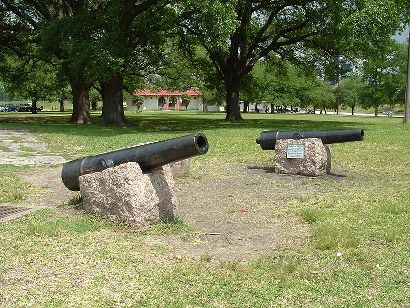
Replicas of
the famous cannons.
Wikimedia
Commons
|
The
whereabouts of the real Twin Sisters remain a mystery, but the boom
of two cannons still occasionally is heard at the San
Jacinto battleground. In 1985, two graduates of the University
of Houston’s College of Technology oversaw the making of replicas
of the famous cannons.
Of course, replica is a relative term. No one knows exactly what the
Twin Sisters looked like. In the mid-1980s, the Cinncinnati foundry
that manufactured the guns still existed, but it had no record detailing
the specifications of the Twin Sisters.
“There are several descriptions of the cannon left by people who actually
saw or used them,” Austin
historian and Republic of Texas reenactor Charles Yates said at the
rededication of the Twin Sisters in 2001. “But as is the case with
multiple eyewitness accounts of the same event, they seldom agree
on all points.”
Unless the real Twin Sisters are found, the replicas will have to
do.
© Mike Cox
- April
5, 2005 column
More "Texas Tales" |
Battle of San
Jacinto - Related Articles
The
Battle of San Jacinto by Jeffery Robenalt
The
Battle of San Jacinto, April 21, 1836 by Murrary Montgomery
San
Jacinto Day by Archie P. McDonald
News of the fall of the Alamo on March 6, 1836, and the execution
of Texians captured at Goliad three weeks later, produced the terrible
Runaway Scrape, a mad flight of refugees who scrambled eastward
to escape a similar fate at the hand of General Antonio Lopez de
Santa Anna’s armies. In the midst of these troubles, one man, Sam
Houston, rode west...
San
Jacinto Monument by Mike Cox ("Texas Tales")
"Most people think the towering star-topped limestone monument,
built during the Texas Centennial in 1936, is the only San Jacinto
monument. Actually, it’s only the biggest."
Baker
Talk by Mike
Cox ("Texas Tales")
"In modern times, battles begin with precision air strikes.
In the 19th century, battles began with stirring speeches. Sometime
in the early 1900s, the Beeville Picayune published the talk Captain
Mosley Baker supposedly gave to the men of his company at San Jacinto
on April 21, 1836..."
The
Top Ten Facts About The Construction of The San Jacinto Monument
by Johnny Stucco
Alfonso
(Alphonso) Steele - Last Texas survivor of the battle of San
Jacinto, and a State Park dedicated to him
The
Last Hero by Bob Bowman ("All Things Historical" )
The last surviving veteran of the Battle of San Jacinto on April
21, 1836, lies in an almost forgotten cemetery in deep East Texas
The
Treaty of Velasco by Archie P. McDonald ("All Things Historical"
)
General Sam Houston, and later Interim President David G. Burnett,
chose negotiation instead of revenge for the massacres at the Alamo
and Goliad.
Survivor's
Account of the Goliad Massacre by Murray Montgomery ("Lone
Star Diary")
"There is a day in Texas history that quite possibly could
be considered one of the most tragic. On that day, March 27, 1836,
General Santa Anna ordered the execution of some 380 Texas army
soldiers - they were prisoners of war. ....."
|
| Books
by Mike Cox - Order Here |
|
|
 HOME
HOME