|
|
If
you’re looking for a ghost, it figures you’d go to a ghost town to
find one.
But when Terry Cole came to the Dimmit
County town of Catarina
from McAllen several
years ago, he sought employment as a construction worker, not an encounter
with the supernatural. Even so, he ended up with both.
One spring night in 1999, Cole and an acquaintance sat watching television
in the second-floor common area of the old Catarina Hotel, built in
1926 during Catarina’s
heyday. |
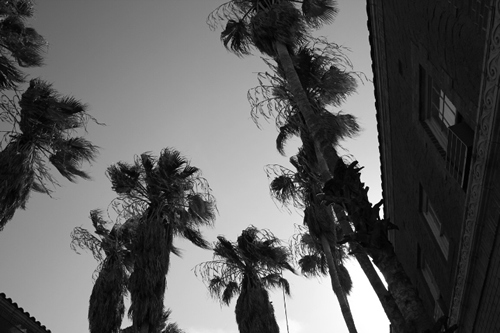
Catarina Hotel
Courtyard
Photo courtesy Robert Vahle, June 2011 |
“I happened
to look away from the TV and saw a ball of smoke moving down the hall,”
Cole recalls. “I just went back to watching TV. But the guy with me
said, ‘Did you see that? What are you going to do if a ghost comes
in your room?’”
Not being afraid of ghosts, Cole replied: “My room’s got two beds.
The ghost can have the other one.” Other guests have reported seeing
a headless apparition wandering the hotel, but the smoky blob is all
Cole ever saw.
“I’d hear creaking noises at night,” he said, “but it’s an old building.
In the heat of the day it expands and it cools off at night.”
Ghost stories make for interesting folklore, but Catarina
has a much more tangible history, grounded in the development of transportation.
|
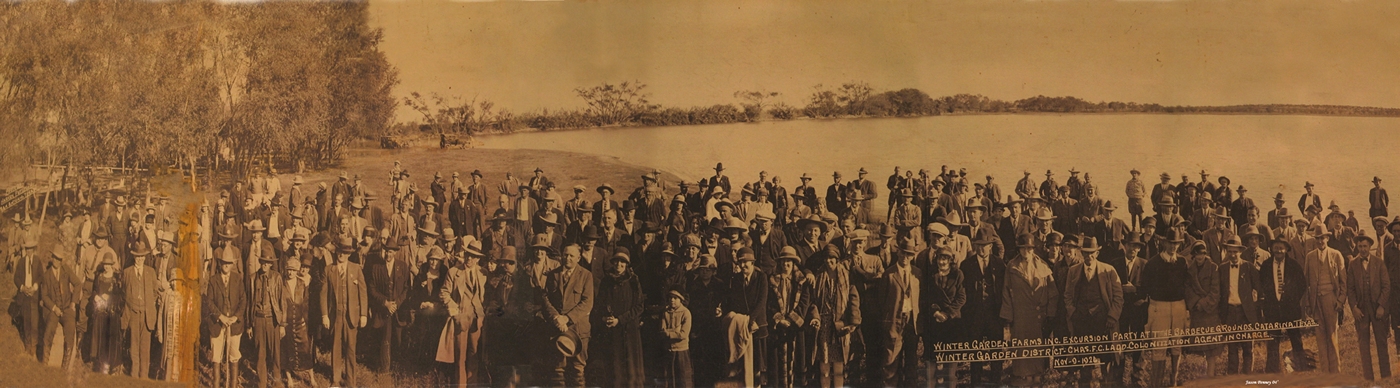
A Tour for Prospective
Landbuyers for Catarina Farms, Nov. 9, 1926
Photo
Courtesy Jason
Penney
Click on photo to enlarge |
Long
before Catarina
got started, the Camino
Real, the old Spanish road from Mexico to Louisiana, cut through
the area.
The fate of one person traveling Texas’ first “interstate” probably
provided the area its name. According to Cole, Catarina — her last
name long since lost to history — was a young Spanish woman killed
by Indians in the vicinity of the future town. A stream not far from
where she died became known as Catarina Creek. As the Handbook of
Texas reports, historians have found the name connected to the area
as far back as 1778.
The name also could have been in honor of Santa Catarina de Siena
-- canonized in 1461 -- the patron saint of everything from fire prevention
to temptation. Or, speculating further, the young woman killed by
Indians could have been named for the popular saint.
No matter how Catarina
got its name, more than 200 years later the Camino
Real made a logical route for the railroad to follow when Asher
Richardson bankrolled a new line connecting Carrizo
Springs with the International and Great Northern Railroad at
Artesia Wells.
The proposed route cut through the Taft-Catarina Ranch, which gave
Richardson right of way in exchange for a depot from which the ranch
could ship cattle.
When the railroad began running in 1910, ranch foreman Joseph F. Green
moved the pasture company’s headquarters to a site near the depot
and adjoining cattle pens and a small town soon developed. When the
ranch management expanded into irrigated farming, a development project
called Catarina Farms brought all the modern amenities, including
the Catarina Hotel.
As long as the water pumped from the nearby artesian wells, Catarina
thrived. But the wells played out and Catarina
began to dry up, literally and figuratively. The Depression didn’t
make things any better. The hotel, a stopping place on U.S. Highway
83, saw its last guests in the early 1950s. By the 1990 census, Catarina
had only 45 residents. |
T
he water never came back, but the hotel did. In 1997, new owners reopened
the long-boarded structure for the first time since the early days
of the Cold War. It has had two owners since then, but the property
has been renovated and does a steady business during the South
Texas dove, quail, deer and turkey seasons.
Just across the highway, to give hunters a place to pick up a gift
for the wives they left behind, a combination antique and gift store
has been in business for several years.
A few blocks past the antique store, partially hidden by mesquite,
is the old Catarina School. The building has fallen to ruin, but its
poured concrete structure assures that the skeleton will survive for
years to come.
Farther down the highway, the town’s once lavish swimming pool — part
of the Catarina Farms development — is debris-filled. The country
club building adjacent to it is long gone.
The Catarina cemetery, located at the end of a winding unpaved road
a couple of miles from town, is overgrown with mesquite, though some
burials occurred there in the 1980s and 1990s. But the location of
the final resting place of the woman who gave the area her name is
as uncertain as the existence of the ghosts who supposedly haunt the
old hotel.
© Mike Cox
"Texas Tales" October
6, 2005 column |
Forum:
Subject: Catarina Hotel
My parents ran
the hotel and restaurant back in 1978 - 1979, so it had been open
since the cold war.
The first and second story were open, the other floors were closed.
We had many fireplaces. Our cook's name was Manuella. It was a magical
place to live. - Thank you, Lana Jones, September 11, 2018
|
|
|
 HOME
HOME