|
Like
a scene from a black-and-white science fiction movie, Texans stopped
in their tracks and poured out of buildings to look skyward as the
huge silver object sailed over head.
Longer than two football fields, it glided across much of the state
in early October 1924, drawing crowds and making headlines
as it went. But this was no UFO—in fact, the term hadn’t yet
been coined. What Texans saw that long ago fall was the Navy’s newest
and largest dirigible, the U.S.S. Shenandoah, the first rigid airship
to fly coast to coast. |
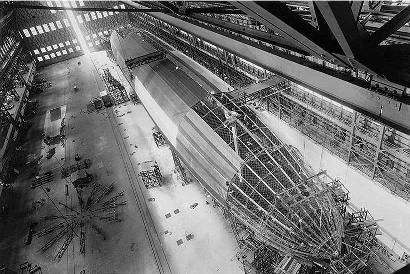
USS Shenandoah
Under Construction
Courtesy Wikipedia Commons |
Launched Aug.
20, 1923, the 36-ton Shenandoah stretched 680 feet long, extended
78 feet at her beam and 93 feet, 2 inches high. Propelled by 300-horsepower
engines, she could reach 70 miles an hour with a range of 5,000 miles.
Carrying a crew of 35, and longer than many sea-going vessels, she
was a ship that sailed the air.
The Shenandoah was based at the Lakehurst, NJ Naval Air Station, which
is where she had been constructed. But in the winter of 1923, the
Navy decided to fly the big blimp from New Jersey to the West Coast,
preparatory to a contemplated polar exploration mission. Rather than
have her cross the Rocky Mountains, naval brass opted for a southern
route where the airship could fly lower and expect better weather.
The big blimp’s only scheduled stop was Fort
Worth, where she arrived ahead of schedule Oct. 8. Not only did
Texans find that exciting, a native son served as the ship’s navigator.
That was 32-year-old Lt. Charles Emory Rosenthal of Cleburne,
a 1914 Naval Academy graduate. Another Texan on the ship was Lt.
T.G.W. Settle of San
Antonio.
In addition to being in charge of plotting the Shenandoah’s course,
Rosenthal had an even more critical responsibility – overseeing mooring
operations when the huge airship connected to the 165-foot steel mast
constructed in Tarrant County to handle what civil and military aviation
pioneers expected to be a surge in cross-county dirigible traffic.
The Fort Worth facility
was the only waypoint for blimps between the Atlantic and Pacific
and one of only a handful in the world.
The Shenandoah left Cowtown at 9:45 a.m. Oct. 9 and made her way westward
along the route of the Southern Pacific Railroad, reaching Eastland
at 12:50 p.m. By 2:30 p.m., making 45 miles an hour and fighting a
strong southerly wind, the airship appeared 3,000 feet over Abilene.
At that altitude, she could be seen from 45 miles in any direction.
Three hours and 15 minutes later, people in Midland
turned out to watch the silver giant float overhead.
As the sun set that day, the Shenandoah continued to the west. At
9:05 p.m., the railroad dispatcher at Kent,
163 miles east of El
Paso, telegraphed that he could see the airship’s lights. Forty-two
minutes later, at 8:47 p.m. Mountain time, the airship was over Van
Horn.
Once the Shenadoah made wireless contact with the Fort Bliss cavalry
post, one of the first messages received was a request for a World
Series update. (The Washington Senators had beaten the New York Giants
2-1 that day, setting up a final game that the Senators would win
to become world champions.)
The Shenandoah passed over El
Paso at 10:30 p.m. Mountain time. From Texas, she proceeded across
New Mexico and Arizona to San Diego, where she arrived the night of
Oct. 10. From there, she traveled up the California and Oregon coasts
to Washington State. |
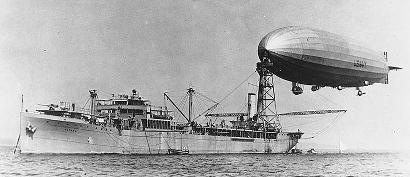 |
The Shenandoah
moored to the tender USS Patoka
Courtesy Wikipedia Commons |
|
Not
quite a year later, the airship lay in its enormous hangar at the
naval air station in New Jersey, being readied for another cross-country
flight, her 57th extended ascension. She left Lakehurst on Sept.
2, 1925. The young officer from Cleburne,
now Lt. Commander Rosendahl, was still a crew member, though
Lt. Settle did not make this flight. But another Texan, Austinite
Lewis Hancock, Jr. now served as the ship’s executive officer.
The following morning, the Shenandoah encountered a violent thunderstorm
over Noble County in southern Ohio and broke apart in mid-air. Since
the airship relied on non-combustible helium and not the explosive
element hydrogen, the blimp did not burst into flames and Rosendahl
succeeded in bringing down the bow portion of the airship softly.
He and 28 others survived, but 13 men, including the lieutenant
commander from Austin, died in the crash.
Despite the disaster, Rosendahl stayed in the Navy, primarily
in its rigid airship branch. Back in the traditional fleet for a
time during World
War II, he served as captain of the heavy cruiser U.S.S. Minneapolis
and received a Navy Cross for his role during the South Pacific
Battle of Tassaforonga in November 1942. He retired as a vice admiral
in 1946 and settled in New Jersey, not far from Lakehurst, the home
of lighter-than-air aviation.
In 1962, as a younger generation of naval aviators trained for space
flight, the Navy decided it no longer needed dirigible. In recognition
of his status as one of the pioneers in the field, the Navy let
Rosendahl go up on the military’s final blimp flight.
© Mike
Cox
"Texas Tales" October
20, 2011 column
Related Topics: Texas
Aviation & Aviators
|
| Books
by Mike Cox - Order Here |
|
|
 HOME
HOME