|
A
buffalo
wasn’t the only critter that could get skinned on the High Plains
if he wasn’t careful.
In 1877, when the Panhandle
still teemed with hundreds of thousands of shaggy-haired bison,
a young traveling salesman checked in with his home office at Galveston
by telegraph from Henrietta.
He worked for Leon and H. Blum, then the Southwest’s largest wholesaler
of staple and dry goods.
“They directed me to proceed to Tee
Pee City in Motley
County to collect an account against Armstrong, who operated
a general store [there],” the one-time salesman later recalled.
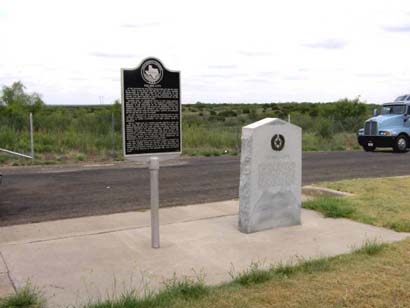
Founded
in 1875 as a buffalo
hunter camp on the site of an old Comanche village on the east side
of Tee Pee Creek where it enters the middle fork of the Pease River,
Tee Pee
City was one of the Panhandle’s
first settlements. Consisting of dugouts, tents and a few frame
buildings, it boasted a couple of saloons, a small hotel and one
or two eating places not quite refined enough to be called restaurants.
In addition to booze, the saloons offered girls and gambling. Finally,
Tee Pee
City had one or two retail establishments, including the store
operated by Isaac O. Armstrong, the fellow whose account stood in
arrears.
Armstrong and his partner reported to Charles Rath and Lee Reynolds,
traders who had hauled everything it took to start Tee
Pee City from Dodge City, Kansas. Rath and Reynolds had since
moved on to the Clear Fork of the Brazos, where they had opened
another buffalo hunter trading post.
Knowing nothing lay between Henrietta
and Tee
Pee City but open prairie, the salesman got a horse and a pack
horse and rode northwest for 170 miles or so until he found the
place.
“When I reached Tee
Pee City,” the salesman continued, “I found Armstrong had gone
to Liberal, Kansas with a load of buffalo
hides and to bring back merchandise. The smallpox was raging in
the town, many people suffering from the epidemic. I went down the
creek about a mile and established my camp and waited.”
Three or four days later, Armstrong returned from his buying trip
and the salesman hit him up about “the matter of settlement.”
Lacking any ready cash but having a small mountain of unsold buffalo
hides on his hands, Anderson cleverly – he thought – offered to
pay off what he owed in hides. Unfortunately, Anderson didn’t know
what the salesman knew. Before leaving Henrietta,
thanks to the telegraph, he had learned of a recent “sensational
rise in the price of buffalo
hides.”
Realizing the hides in question would fetch a lot more than Anderson
thought, the salesman readily agreed to the merchant’s proposition.
In fact, he later said, “I bought all the hides he had…, gave him
credit for the account he owed and wrote a draft on the house [the
Galveston jobber he represented] for the difference.”
The young salesman then chartered every available wagon in Tee
Pee City, all seven or eight of them, loaded them with the newly
purchased hides and headed east for the nearest market in Fort
Worth. Hurrying back to Henrietta
from the community that would later be known as Cowtown, the salesman
wired his company about the draft he’d writen.
“In the deal I made several hundred dollars for my employers,” he
said.
Barely a year later, most of the buffalo
had been killed or moved off and Tee
Pee City declined, though Armstrong continued to run his store
until his death in 1884. Tee
Pee City got a second wind when ranching
came to the South Plains as merchants realized cowboys could spend
as freely on booze and dance hall girls as the buffalo
hunters had.
Rowdy cowboys kept the Texas Rangers busy and greatly annoyed the
pious owners of the sprawling Matador
Ranch. When it got the opportunity in 1904, the ranch gladly
bought the land on which Tee
Pee City stood and quickly killed off the town.
The salesman who had skinned Anderson in the financial sense was
Sam Lazarus, a man who continued to demonstrate his business acumen.
Lazarus, who by then lived in St. Louis, told the Tee
Pee City story to G.E. Hamilton in 1921 on board his private
railroad car between Quanah
and Roaring
Springs. Hamilton related the story to the editor of the Matador
Tribune, who published it. The reason Lazarus had his own railroad
car was because he was president of the Quanah, Acme and Pacific
Railroad.
|
 HOME
HOME