|
 |
History in
a Pecan Shell
Originally a trading
post for buffalo
hunters and anyone foolish enough to be traveling this desolate region,
Tee Pee City came into being in the mid 1870s and was named for the
numerous lodge poles left by former inhabitants.
Storekeepers Charles Rath and Lee Reynolds imported wares from distant
Dodge City, Kansas, but soon went in search of greener prairies and
cash-paying customers. They left the store in the care of Isaac Armstrong,
a man who must’ve enjoyed his duties running the one-room hotel and
saloon since he spent the rest of his life there. (He died in 1884
and was buried nearby.)
As the buffalo
herds were wiped out, the hunters moved on, spelling the end of hunter-tourism
in capital letters. Civilization appeared in 1879 with the arrival
of the Cooper and Field families. The Coopers ran a dugout that served
a general store and post office for the few inhabitants.
A school was in operation from the mid 1890s through 1902 but misbehavior
by the uncivilized element drove most earnest settlers on. The post
office closed it’s doors in 1900 and Tee Pee City was visited by the
Texas Rangers on the numerous occasions when things got out of hand
and / or the wrong people were robbed.
The nearby Matador Ranch made the town
off-limits to its employees and actually ended the town’s wild and
woolly existence by buying the property. Today only the graves of
the Cooper family and Isaac Armstrong remain, along with a lone Texas
Centennial marker.
More on Tee Pee City
Rawhides: Business in Wild and
Woolly Tee Pee City
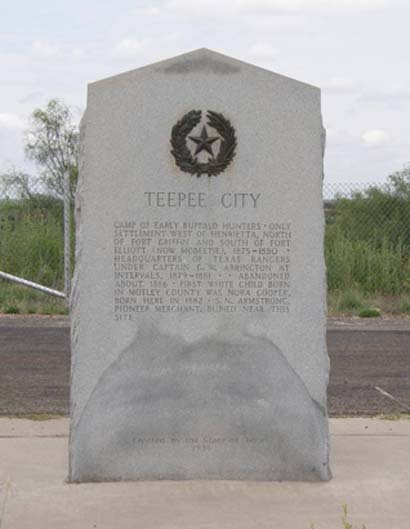
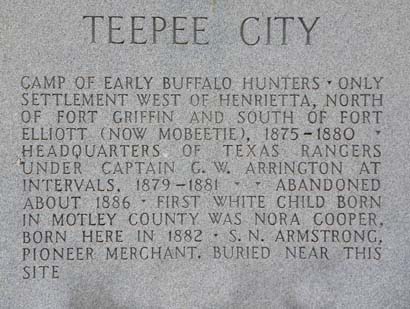
Tee Pee City Centennial
Marker
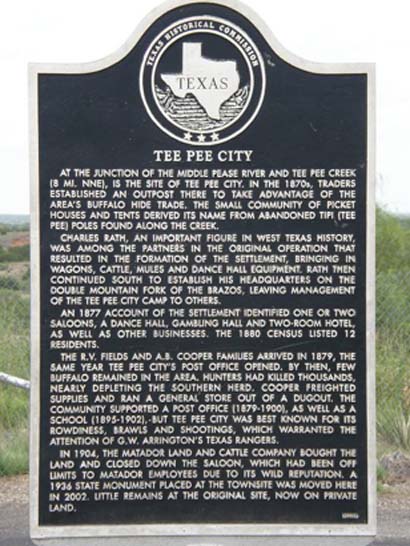
Tee Pee City Historical Marker |
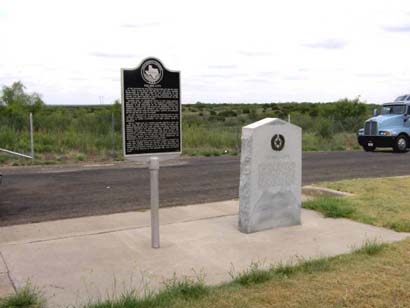 |
Tee Pee City
Centennial Marker
Photo courtesy Barclay
Gibson, July 2009 |
Tee
Pee City Historical Marker
Photo courtesy Barclay
Gibson, July 2009 |
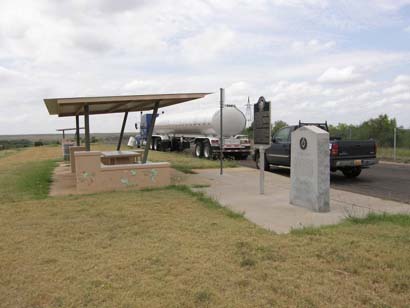
Historical Marker
Tee Pee City
Tee Pee City At
the junction of the Middle Pease River and Tee Pee Creek (8 mi. NNE),
is the site of Tee Pee City. In the 1870s, traders established an
outpost there to take advantage of the area's buffalo
hide trade. The small community of picket houses and tents derived
its name from abandoned tipi (tee pee) poles found along the creek.
Charles Rath, an important figure in West Texas history, was among
the partners in the original operation that resulted in the formation
of the settlement, bringing in wagons, cattle, mules and dance hall
equipment. Rath then continued south to establish his headquarters
on the Double Mountain Fork of the Brazos, leaving management of the
Tee Pee City camp to others.
An 1877 account of the settlement identified one or two saloons, a
dance hall, gambling hall and two-room hotel, as well as other businesses.
The 1880 census listed 12 residents.
The R.V. Fields and A.B. Cooper families arrived in 1879, the same
year Tee Pee City's post office opened. By then, few buffalo
remained in the area. Hunters had killed thousands, nearly depleting
the southern herd. Cooper freighted supplies and ran a general store
out of a dugout. The community supported a post office (1879-1900),
as well as a school (1895-1902), but Tee Pee City was best known for
its rowdiness, brawls and shootings, which warranted the attention
of G.W. Arrington's Texas Rangers.
In 1904, the Matador Land and Cattle Company bought the land and closed
down the saloon, which had been off limits to Matador
employees due to its wild reputation. A 1936 state monument placed
at the townsite was moved here in 2002. Little remains at the original
site, now on private land.
(2002) |
 |
Related Story:
Rawhides:
Business in Wild and Woolly Tee Pee City
by Mike
Cox
A buffalo wasn’t the only critter that could get skinned on the High
Plains if he wasn’t careful.
In 1877, when the Panhandle still teemed with hundreds of thousands
of shaggy-haired bison, a young traveling salesman checked in with
his home office at Galveston by telegraph from Henrietta. He worked
for Leon and H. Blum, then the Southwest’s largest wholesaler of staple
and dry goods.
“They directed me to proceed to Tee Pee City in Motley County to collect
an account against Armstrong, who operated a general store [there],”
the one-time salesman later recalled.
Founded in 1875 as a buffalo hunter camp on the site of an
old Comanche village on the east side of Tee Pee Creek where it enters
the middle fork of the Pease River... more |
| Texas
Escapes, in its purpose to preserve historic, endangered and vanishing
Texas, asks that anyone wishing to share their local history, stories,
landmarks and recent or vintage photos, please contact
us. |
|
|
 HOME
HOME