|
Years
ago, television had an abundance of stories about the old West.
One of my favorites was about the adventures of a kindly gunfighter
know as, "The Texan." This guy was my hero and best I remember he
always wore a black vest. I guess it was black; in those days everything
on television was either black or white.
I can't recall exactly who starred in the show but I believe it
was a guy named Rory Calhoun. In later years, I was told that the
series was based on the life of a Texas outlaw by the name of Bill
Longley. I decided to do a little research on Mr.
Longley and believe me; his real life was much different than
how it was portrayed on television. Fact is, he wasn't kindly at
all.
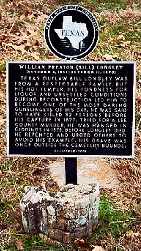
According to “The Handbook of Texas Online, ”William
Preston "Bill" Longley was born on October 6, 1851, in Austin
County, Texas. Longley
was a farm boy and was, no doubt, a product of his environment.
Like so many other young men in Texas during that era, he was extremely
bitter over the outcome of the Civil War.
Some of Bill
Longley's experiences were not unlike those of the notorious
John
Wesley Hardin. Although Hardin
acquired more fame than Longley,
the latter did his share of killing and terrorizing folks in south
central Texas. Although both men were known to have attacked
and murdered black men, Longley
was also accused of killing a black woman in Bastrop
County.
Bill
Longley' loved to brag about his exploits but most of the time
he didn't have actual witnesses to back up his claims. Some historians
believe that Longley's
criminal career was just a mixture of actual facts and his boasting
ways.
During
his life, Longley
was apparently somewhat of a drifter. He was a gold miner in the
Wyoming Territory and later joined the Army while in that part of
the country. He didn't care much for the military, however, and
soon deserted. The Army caught the Texas drifter and promptly court-martialed
and locked him up at Camp Stambaugh in Wyoming.
Six months later he was released back to his unit, but Bill
just didn't like army life and he deserted again on June 8, 1872.
Records indicate that Longley
made good his escape from the Army or it could be that they just
got tired of messing with him. After his less than illustrious military
career the drifting Longley
turned up in Bell
County, Texas. He supposedly worked as a cowboy in Comanche
County where he killed a black man.
Longley
continued his killing ways from 1872 to 1877. He killed a man named
Anderson supposedly because he (Anderson) had murdered Longley's
cousin. Anderson was plowing a field when Bill
unloaded a shotgun into him. In 1876 Longley
killed a man named Shroyer in a gunfight. Later, Bill
tried his hand at sharecropping in Delta County, Texas. He was working
for the Reverend William R. Lay. But, as was his habit, Longley
got in trouble again, this time it was over a woman, and local authorities
promptly arrested him.
The Delta County jail couldn't hold Longley;
he started a fire and made good his escape. For some reason, Bill
was angry with the Reverend Lay and murdered him while Lay was milking
a cow.
Longley
decided to hide out in Louisiana until things cooled off in Texas
but the long arm of the law reached out and caught Bill;
Sheriff Milton Mast of Nacogdoches County, Texas, captured him on
June 6, 1877. Longley
was returned to Texas were he was tried,
convicted, and sentenced to hang.
After his capture, Bill
Longley contacted several newspapers to tell of his adventures;
he told the local media that he had killed 32 men. Longley
evidently got religion and joined the Catholic Church while he was
awaiting execution. That event took place before a large crowd in
Giddings, Texas, on
October 11, 1878. Just before Lee County Sheriff James Madison Brown
executed him, Longley
said that he had only killed eight men. It seems that even in death,
Bill
couldn't get his stories straight.
Rumors were started that Longley's hanging had been a hoax and that
he had gone to South America and later died in Louisiana. According
to “The Handbook of Texas Online,” a search was conducted between
1992 and 1994 to find his body in the Giddings
Cemetery. The remains were never found but there was evidence
that his body may have been moved to Bell
County, Texas, after the execution.
© Murray
Montgomery
Lone
Star Diary November
20 , 2009 Column
More on Bill Longley
›
|
 HOME
HOME