|
|
When
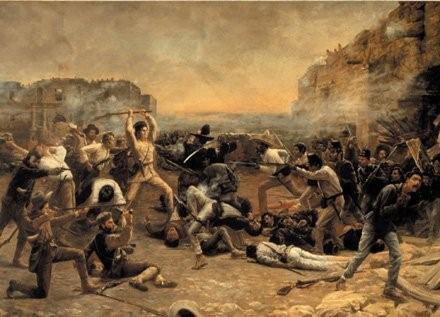
Mexican troops stormed over the walls of the Alamo
on the morning of March 6, 1836, they put to death a small band of
heroes who were willing to make the ultimate sacrifice for freedom
on that mesquite prairie near old San
Antonio.
In a battle that lasted only a matter of minutes, the names Bowie,
Travis, and Crockett would forever become known around the world -
indeed, these brave men would become martyrs.
Over the years, there have been those who, perhaps in an effort to
be “politically correct,” have tried to diminish the significance
of the event that happened on that bloody March morning. I have heard
folks say that if there had been a back door to the Alamo,
that there would have been no heroes. Really? Perhaps these naysayers
could use a little lesson in Texas
history. |
| Photo
courtesy Texas State Library & Archives |
As
a matter of fact, people were coming and going from the Alamo
up until the last day of the battle.
The men inside could have left the place at any time but instead they
chose to die there in the name of liberty. It is very important; that
word “chose.” It is something that you do of your own accord - no
one makes you do it - the heroes of the Alamo
chose that decision by staying within those stone walls, in the face
of certain death.
On March 1, 1836, some 32 men from Gonzales
and the surrounding area, including what would later become Lavaca
County, fought their way into the Alamo
- knowing they would soon die there. Back door, you say? Not hardly!
The Immortal 32 came in the front door, and gave their lives so other
Texans could be free - they chose to do so.
Texas history contains much information about the famous men who died
at the Alamo, but what
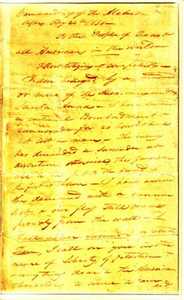
about the others; the messengers? Men who would continually put their
lives in danger to carry dispatches to Gen.
Sam Houston and others - including Alamo
commander Travis’
famous letter and plea for reinforcements. |
| Photo
courtesy Texas State Library & Archives |
According to the Handbook of Texas, several individuals were
given the title of “last messenger” from the Alamo.
One of these men was John William Smith. He has been included
as the last messenger from the Alamo
- it has been said that many of the Mexican folks around San Antonio
called him “El Colorado.” Smith was part of Green DeWitt’s colony.
He lived in Gonzales,
La
Bahia, and San Antonio.
He was married to Maria de Jesus Delgado Curbelo and the couple had
six children. Smith was fluent in Spanish and was able to communicate
well with the citizens of San
Antonio, making him very valuable as a messenger for the Texas
army. He was sent by Col. William B. Travis as the final messenger
to the Convention of 1836. After the
fall of the Alamo, Smith participated in the Battle
of San Jacinto. When independence was secured he returned to San
Antonio and became an influential citizen. He served as mayor
of San Antonio for
three years.
Another man who has been included as the last messenger from the Alamo
is James L. Allen. He was born in Kentucky, the eldest of seven
children. When hostilities broke out in Texas, Allen was a student
at Marion College, Missouri - he joined other students and volunteered
for military service with the Texas army.
Chances are that Allen was indeed the last courier to leave the Alamo.
He was sent with dispatches on the night of March 5, 1836; just hours
before the final battle took place. Allen went on to serve at the
Battle
of San Jacinto where he was a scout under Erastus
(Deaf) Smith and helped burned bridges behind Mexican lines to
cut off their retreat.
In 1865, Allen moved to Hochheim
where he owned a farm. He died at his home, five miles west of Yoakum
on April 25, 1901. Perhaps when we remember the Alamo,
we should honor the lesser-known men in both armies. Just like the
famous ones, these individuals also chose to fight for a cause they
believed in.
© Murray
Montgomery
Lone
Star Diary
April 11, 2011 column |
|
|
 HOME
HOME