|
Books by
Jeffery Robenalt
|
|
|
After
the defeat of General Martin Perfecto de Cos at the siege
of San Antonio in December 1835, no Mexican troops remained
in Texas. Texans thought their independence
was won, and the majority of the volunteers who made up the “Army
of the People” left service and returned to their families. Some
members of the provisional government were so confident of victory
that they foolishly planned an expedition to capture the Mexican
border town of Matamoros.
The Texans failed to understand that Mexican dictator Antonio Lopez
de Santa Anna was enraged over the capture of Captain Tenorio during
the disturbances at Anahuac
and the subsequent surrender of General Cos’s at San
Antonio de Bexar. Determined to reestablish Mexican control
in Texas, Santa Anna planned to either kill every Anglo American
and Tejano rebel who openly defied his rule, or drive them across
the Sabine
River and out of Texas for good.
By the time General Cos and his men crossed the Rio Grande and reentered
Mexico, Santa Anna was
marching north with a large army to meet him.
|
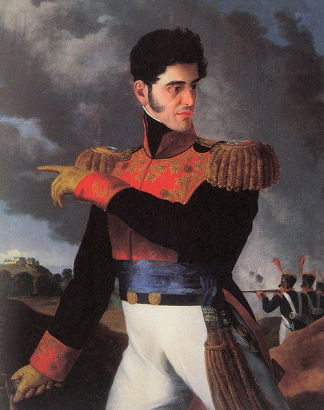 |
General
Antonio Lopez de Santa Anna
Wikimedia Commons |
Unaware that
the Mexican army was on the march, the Texans believed that if an
attack was to come at all, Santa Anna would surely wait until spring.
As a result, against the advice of a few men like Sam
Houston, the Texas forces remained unorganized and scattered.
To make matters worse, since the men who contributed to the victory
at the siege of San Antonio
had returned to the comforts of home and hearth, newly arrived volunteers
from the United States constituted the majority of Texas troops in
the field. The total lack of preparation would cost the Texans dearly.
In
1836, there were two main invasion routes from Mexico into Texas;
the Atascosito Road, and the Old
San Antonio Road (also known as the Camino
Real). The Atascosito Road crossed the Rio Grande at Matamoros
and ran north through Goliad
and Victoria,
before continuing on to the Louisiana border. The old
San Antonio Road crossed the Rio Grande at Eagle
Pass, continued northeast to San
Antonio de Bexar, and then on to Nacogdoches,
before entering Louisiana.
Colonel James Walker Fannin commanded the Texans who occupied
the Presidio La Bahia in Goliad.
It was his responsibility to deny the Atascosito Road to the Mexican
army. The forces blocking passage on the old
San Antonio Road, as it passed through Bexar, were commanded by
Colonel James C. Neill. General Santa Anna divided his forces
as he moved north, sending one column under the command of General
Jose Urrea up the Atascosito Road, and taking personal command
of the other column on the long march to San
Antonio. |
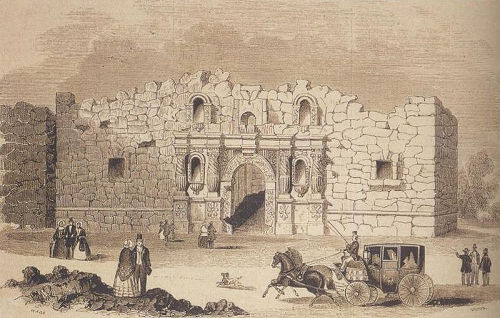 |
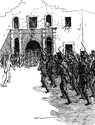
1854 Drawing
of the Alamo Mission
First
printed in 1854 in Gleason's Pictorial Drawing Room Companion
Wikimedia Commons |
The
Presidio of La Bahia was well constructed and defensible, but Colonel
Neill realized the Alamo
would have to be strengthened considerably before it could serve as
a fortress. With the assistance of engineer Green B. Jamison, Neill
reinforced the crumbling walls of the old mission and replaced a missing
section of wall with a log palisade. Twenty-one cannons, most of them
captured from General Cos after his surrender at the
siege of San Antonio, were them emplaced along the mission’s walls,
making the Alamo the
most heavily defended fortress in western North America.
Colonel Neill also requested reinforcements for his meager
Bexar garrison, but Sam
Houston, the commander of the Texas army, had begun to question
the wisdom of maintaining the
Alamo. Finally, in mid-January, Houston
ordered Colonel James Bowie to San
Antonio with a company of volunteers to blow up the old mission
and remove all the cannons and munitions to Gonzales.
However, when Bowie arrived in Bexar
on January 19, he was impressed by the efforts of Neill and Jamison
to fortify the Alamo.
As a result of their hard work, the old mission was beginning to look
like a fortress. Colonel Neill soon convinced Bowie that the
Alamo was the only obstacle on the Camino
Real that stood between the enemy and the Anglo settlements further
to the east, and that it must be defended at all costs. On February
2, Bowie wrote to Governor Henry Smith that he and Neill had
resolved to “die in these ditches” before they would surrender the
Alamo. |
|
|
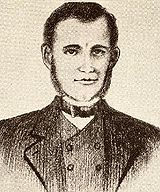
William Barrett Travis
Wikimedia Commons |
Governor
Smith realized that if the
Alamo were to function as a blocking position on the Camino
Real, it would have to be reinforced. Colonel Neill would also
need cavalry to act as outriders to give early warning of Santa Anna’s
approach. Therefore, to meet both needs, Smith directed Lt. Col.
William B. Travis to take his “Legion of Cavalry” and report to
San Antonio. However,
when only thirty men answered Travis’s call for duty, he pleaded with
Governor Smith to reconsider his order, threatening to resign his
commission rather than stain his reputation with the possibility of
failure.
Smith wisely ignored Travis’s threats and, at length, he obeyed the
Governor’s orders, reporting to Bexar
on February 3. Though he reported under duress, Travis, like Bowie,
soon became committed to the
Alamo as the “key to the defense of Texas.” David Crockett,
a former volunteer colonel and Congressman from Tennessee, arrived
at the Alamo on February
8, with a dozen men eager to win their own promised share of Texas.
|
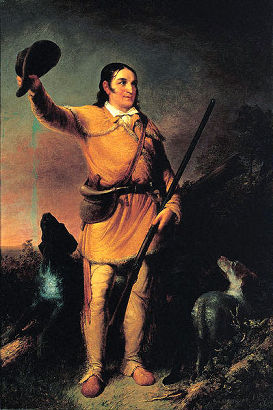 |
Portrait of Davy
Crockett
By John Gadsby Chapman
Wikimedia Commons |
I
n mid-February Colonel Neill was
forced to leave San Antonio
due to a family emergency. He placed Travis, who like Neill
was a member of the regular Texas army, in command. James Bowie,
though older and more experienced, was a volunteer. The decision did
not sit well with Bowie and his men, and they demanded an election
of officers, a tradition among volunteer forces. The decision was
split with the volunteers supporting Bowie and the regulars choosing
Travis. After much heated debate, the two men agreed to set aside
their differences and share a joint command. Then less than two weeks
later, Bowie was taken seriously ill and surrendered the command to
Travis.
Travis did his best to recruit additional defenders, sending Juan
Seguin and James
Butler Bonham to Goliad,
Gonzales, and other
communities across Texas asking for help. A few men arrived, but never
in the numbers that were required to properly defend the
Alamo. Colonel Fannin, the only source of meaningful reinforcement
available, was reluctant to abandon his post at Goliad.
His constant waffling would eventually lead to the meaningless death
of most of his men.
Then on February 23, Santa Anna’s
troops arrived in Bexar,
after a brutal winter march across the barren landscape of south
Texas, and the 13-day siege of the
Alamo began. Travis’s appeals for aid suddenly carried more weight.
By now growing desperate for assistance, he penned his famous message
that has become known as the most heroic document in Texas history.
The letter began “To the People of Texas & all Americans in the world
— Fellow citizens & compatriots — I am besieged, by a thousand or
more Mexicans under Santa Anna…” and ended “VICTORY OR DEATH.” John
William Smith slipped through the Mexican lines and delivered
the message to Gonzales.
Why did Santa Anna risk
his army by attacking the
Alamo instead of bypassing the old mission and marching straight
for the heart of the Anglo settlements further to the east? Such a
small garrison would have posed little threat to his rear. Most historians
would argue that he besieged the old mission and launched his ill-fated
assault for political, not military reasons. The dictator promised
the Mexican people that he would sweep the rebels out of Texas.
If he dared to bypass the fortress, his enemies in Mexico City could
claim that he avoided a fight. |
 |
| Photo
courtesy Texas State Library & Archives |
The
siege of the
Alamo
began with an artillery bombardment, while the Mexican infantry slowly
encircled the old mission. Travis continued to send messages pleading
for reinforcements, but the only meaningful assistance to arrive came
on March 1, when Lt.
George C. Kimbell and his 32-man Gonzales
ranging company rode through the Mexican cordon surrounding the
Alamo and entered the beleaguered mission. Although he was grateful
for the assistance, Travis knew he needed more men if he was to properly
defend the Alamo. He
revealed his frustration with the lack of support in a letter to a
friend. “If my countrymen do not rally to my relief, I am determined
to perish in the defense of this place, and my bones shall reproach
my country for her neglect.”
By March 5, day 12 of the siege,
about 1800 Mexican troops surrounded the
Alamo. The walls of the old mission were crumbling from the constant
bombardment, and no Texan relief column had appeared. To warn the
Texans of the fate that awaited them, Santa
Anna’s soldiers raised the red flag, and the band played the “Deguello”,
the cut throat song, traditional symbols of no mercy.
Santa Anna’s Generals argued
against an attack. Why risk the casualties that would surely result
from the Texans’ artillery and accurate fire from their long rifles?
Soon the walls would be down anyway, and the Texans would be forced
to surrender. Determined to make an example of the rebels, Santa
Anna ignored these reasonable objections and ordered an attack
for dawn on the morning of March 6.
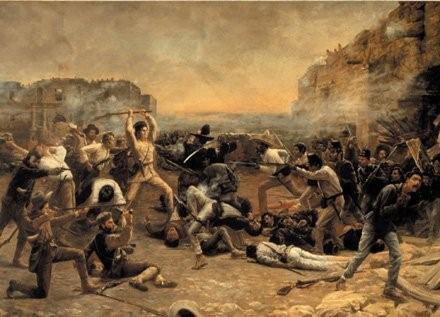
The exhausted Texans were sleeping when the blare of Mexican bugles
launched the assault. In his diary, Mexican officer Jose Enrique de
la Pena described the beginning of the epic battle: “… a bugle call
to attention was the agreed signal and we soon heard that terrible
bugle call of death.” Awakened by the cry “The Mexicans are coming!”
Travis leaped from his bed and ran to the north wall. He was
among the first defenders to die. Texas cannons roared their defiance,
canister shot ripping great holes in the oncoming Mexican lines, but
their overwhelming numbers enabled the Mexicans to reach the
Alamo’s walls in spite of the deadly artillery fire and the constant
barking of the Texas long rifles. |
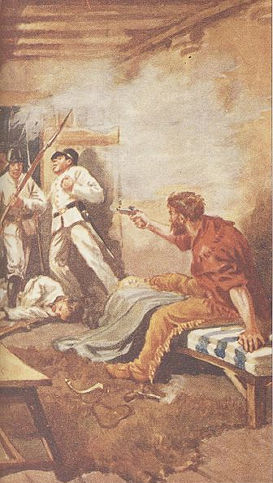 |
James Bowie's
Death
Illustration by Charles A. Stephens
Wikimedia Commons |
Bravely scrambling
up the scaling ladders into the face of direct fire, the Mexicans
burst through the Texas defenses on the walls and pored into the
Alamo, bayonets eager and ready to deal death. Deadly hand-to-hand
fighting raged throughout the old mission, bayonets against Bowie
knives and rifles used as clubs. Jim Bowie was killed on his
sickbed, though some credit him with fighting even there. By eight
o’clock in the morning, not much more than 90 minutes after the attack
began, resistance ceased. The bodies of hundreds of soldiers, Texan
and Mexican alike, lay intermingled in bloody heaps all across the
compound.
There is no exact count of casualties suffered during the Battle
of the Alamo. Most historians hold the number at 189 defenders
and about 600 Mexican soldiers. Legend had it that David Crockett
was among the last of the Alamo defenders to die, and that he died
fighting. However, Jose Enrique de la Pena wrote in his diary that
Crockett and six others were put to death by order of Santa
Anna after they tried to surrender. |
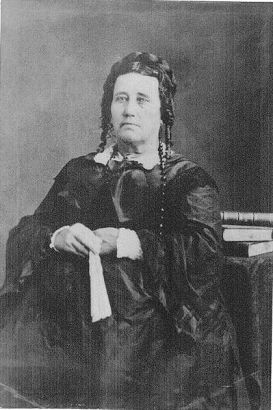 |
| Not all the
defenders of the Alamo were Anglo Americans. Nine Tejano defenders
also bravely gave their lives for the cause of Texas independence.
Among those spared were Susanna
Dickenson, widow of artillery commander Almeron
Dickenson; their 15-month old daughter, Angelina; and Travis’s
slave, Joe. Santa Anna
ordered them released in hopes that they would spread fear across
Texas. |
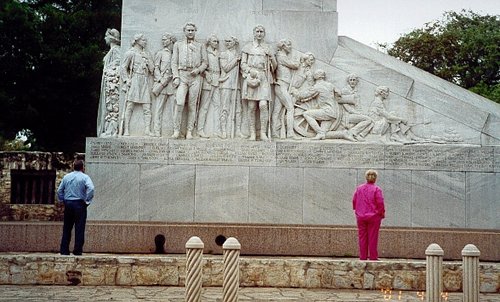 |
The
heroic sacrifice of the Alamo defenders accomplished little of military
value. Some have claimed that the stand provided Sam
Houston with the time he needed to raise and begin to train an
army, but Houston
spent most of his time during the 13 day siege at Washington-on-the-Brazos
participating in the Convention of 1836, not with the army. However,
the delay did allow the Texans to form a government and declare their
independence; both necessary steps before any nation would recognize
Texas. Had Santa
Anna been permitted to advance straight into the eastern settlements,
he may well have disrupted the proceedings and driven the rebels into
Louisiana before the government was formed.
Musings of history aside, there is one thing that cannot be denied.
The sacrifice of Travis, Bowie, Crockett and
the other gallant defenders of the Alamo united the Texans
once and for all behind the idea of independence, and kindled a righteous
wrath of “Remember the Alamo” that swept the Mexicans off the field
at San
Jacinto. Unfortunately, before Santa
Anna could be lured to that fateful plain, a final
tragedy was yet to unfold at Presidio La Bahia in Goliad.
© Jeffery
Robenalt, January
27, 2012 Column
jeffrobenalt@yahoo.com
References ›
More "A Glimpse of Texas Past"
More Columns |
References
for "Battle of The Alamo"
|
|
Barr, Alwyn
(1996), Black Texans: A History of African Americans in Texas,
1528-1995 (2nd ed.), Norman, OK: University of Oklahoma Press,
ISBN 0-8061-2878-X
Barr, Alwyn
(1990), Texans in Revolt" The Battle of San Antonio, 1835,
Austin, TX: University of Texas Press, ISBN 0-292-77042-1
Edmundson,
J.R. (2000), The Alamo Story-From History to Current Conflicts,
Plan, TX: Republic of Texas Press, ISBN 1-55622-678-0
Groneman, Bill
(1996), Eyewitness to the Alamo, Plano, TX: Republic of Texas
Press, ISBN 1-55622-502-4 • Hardin, Stephen L. (1999), Texan Illiad,
Austin, TX: University of Texas Press, ISBN 0-292-73086-1
Hopewell,
Clifford (1994), James Bowie Texas Fighting Man: A Biography,
Austin, TX: Eakin Press, ISBN 0-89015-881-9
Meyers, John
(1948), The Alamo, Lincoln, NE: University of Nebraska Press,
ISBN 0-8032-5779-1
Tinkle, Lon
(1985), 13 Days to Glory: The Siege of the Alamo, College
Station, TX: Texas A&M University Press, ISBN 0-89096-238-3
Todish, Timothy
J.; Todish, Terry; Spring, Ted (1998), Alamo Sourcebook, 1836:
A Comprehensive Guide to the Battle of the Alamo and the Texas Revolution,
Austin, TX: Eakin Press, ISBN 978-1-57168-152-2
|
|
|
 HOME
HOME