|
|
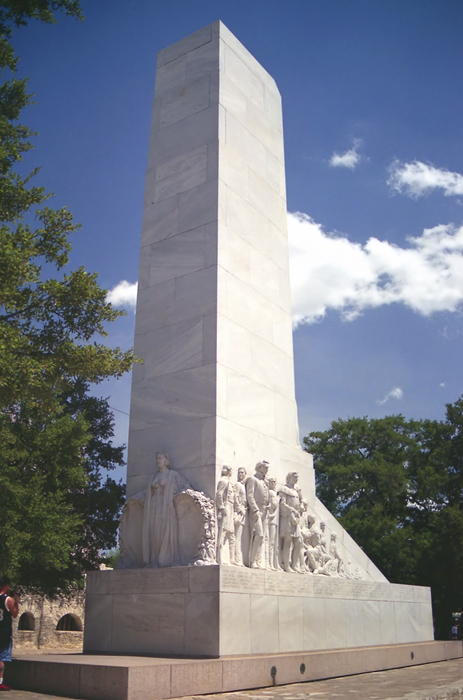
The Spirit of
Sacrifice Cenotaph
Photo Courtesy Lori
Martin, July 2001 |
| From
the Greek words kenos, (empty) and taphos, (tomb) - cenotaphs are
tombs or monuments erected to honor a person or persons whose remains
are elsewhere or their whereabouts unknown. Quite frequently cenotaphs
are erected for soldiers killed in distant places or sailors lost
at sea. Texas has many such empty tombs,
some of them modest tombstones in humble cemeteries. This one in San
Antonio's Alamo Plaza is sometimes referred to as "The"
Cenotaph. |
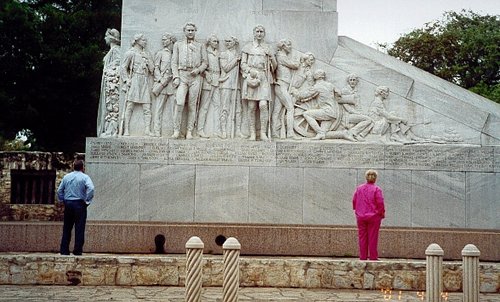
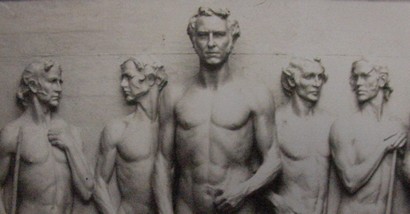
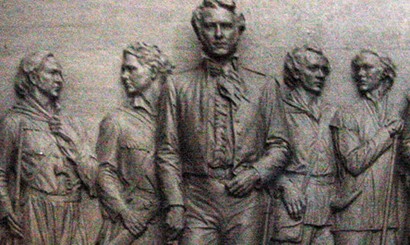
The west side
of the base showing the figures of Travis and others that appear in
two photos below. Figure of woman facing north (far left with garland)
symbolizes the state of Texas.
TE Photo April 2001 |
The
base of the sculpture is 12 feet by 40 feet and it rises to a height
of 60 feet. While Coppini
had preferred to show the men in battle - the cenotaph had been designed
by Carlton Adams before Coppini
was chosen as sculptor.
Some believe that the monument is built where many of the Alamo
defenders were put to death after the fall. Others believe the corpses
of the dead defenders were piled here and unceremoniously burned.
In actuality, the location was chosen because Alamo Plaza was the
only only space available near the Alamo, and the bandstand occupied
Plaza de Valero. The funeral pyres were near the Alameda.
In a newspaper article, writer J. Frank Dobie compared the piece to
a grain elevator - and even Coppini
agreed with Dobie that the figures looked as though they were assembling
for a portrait.
(Dobie on another occasion had stated that Coppini had "littered"
the state of Texas with his work, but here the two men agreed. To
our knowledge, Coppini never critiqued Dobie's writing.)
|
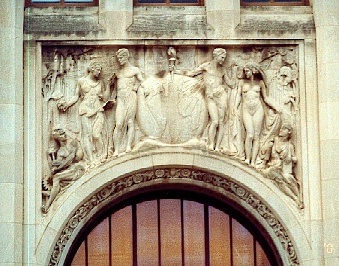 |
Another Coppini
work - a bas-relief over main entrance of a building two blocks north
of Alamo square.
TE Photo April 2001 |
The Cenotaph
was one of the largest works of famed Italian-born sculptor Pompeo
Coppini whose other works
include statues in Ballinger,
Galveston,
Gonzales, Victoria,
Austin and at least four
more pieces in San Antonio - including
his own elaborate tombstone. Three other Coppini
works can be found within walking distance of the Cenotaph - one over
the doorway of the old San Antonio News Office and two huge bronze
doors on the Scottish Rite building just a few blocks north of the
Alamo.
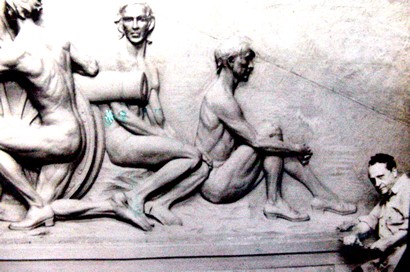
The
Texas Collection of Baylor University has a large file on Coppini
and his "adopted" daughter - Waldine
Tauch. Within the file are photos of Coppini
at work on the cenotaph figures. As you can see in these photos -
he went to extraordinary lengths, even working on the musculature
of the figures - even before adding the clothing. |
The figures on
the far right of the west side. Pompeo
Coppini at work.
Photo Courtesy The Texas Collection, Baylor University |
The figures on
the west side as they appeared in clay.
Photo Courtesy The Texas Collection, Baylor University |
The same figures
after being "clothed."
Photo Courtesy The Texas Collection, Baylor University |
The
south side of the main shaft has the 25-foot bas-relief figure - Spirit
of Sacrifice - and the north face has a female figure representing
Texas. The east and west faces have larger-than-life statues of various
Alamo defenders. Bowie and Bonham on the east face and Travis and
Crockett on the west face.
The marker reads:
Erected in Memory of the Heroes who sacrificed their lives at the
Alamo, March 6, 1836 in the defense
of Texas, "They chose never to surrender
nor retreat, these brave hearts with flag still proudly waving perished
in the flames of immortality that their high sacrifice might lead
to the founding on this Texas."
© John
Troesser |
|
|
 HOME
HOME