|
People
WILLIAM TAUCH
The Schulenburg Photographer
&
His Sculptor Daughter
WALDINE TAUCH
by John
Troesser
(Illustrated with 5 vintage photos ) |
The
Tauchs
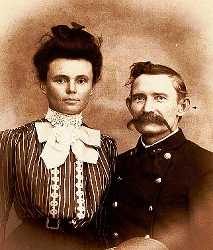
(William in his Volunteer Fire Dept Uniform)
Courtesy Fayette Heritage Museum & Archives |
Tauch
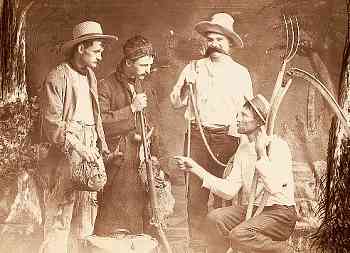
(kneeling with real mustache) in a play with the Mai Brothers
Courtesy Fayette Heritage Museum & Archives |
The
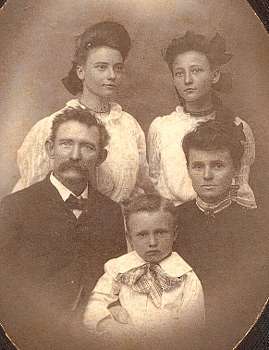
Tauch Family. Standing: Emma (left) and Waldine
Courtesy Fayette Heritage Museum & Archives |
Webmaster's Note:
Due to mix-up of Tauch family members in the original article, the
part about William Tauch has been deleted. For information, see Forum
below: |
Forum
Subject:
William Tauch
I'm an archivist
in the Fayette Heritage Museum and Archives and I've meant to email
you for some time about the story you wrote about William Tauch.
I saw where you based it upon an interview with Martha Tauch.
Somehow, you or she combined his history with that of his younger
brother, Henry. (Their father was also named Henry Tauch.)
William Tauch did a bit of photographic work in Fayetteville
for brief periods in the 1880s, but even then he was based out of
Schulenburg
where he worked as a photographer from about 1883 to 1906. Waldine
Tauch donated his large studio camera to our Archives back in 1980.
The cabinet card photo of the
bridal couple on that web page is the work of his brother, Henry,
at Fayetteville. See the H in the center of the photo? (William's
cards in Schulenburg were usually printed with his name on the back.)
Henry was a photographer in Fayetteville
from 1892 until at least 1902, when he was elected mayor of Fayetteville
— not William. The family left Fayetteville within a few years
of that election.
Mrs. William Tauch did cut her throat. However, according to
Waldine Tauch's biography, From Chalk to Bronze, written with her
cooperation, that did not occur until shortly after the family had
left Schulenburg
and he was no longer a photographer. The book states the rash act
occurred on Mrs. Tauch's brother's farm near Menardville in front
of Waldine, not in any town. From there the family moved to Brady.
I thought you'd like to know that the article has some pretty significant
errors. - Rox Ann Johnson, Fayette Heritage Museum & Archives, August
18, 2021 |
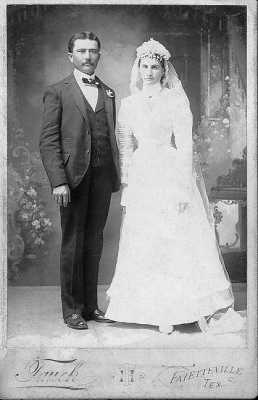 |
1890s
wedding "Cabinet Card" from the Tauch Studio in Fayetteville.
Note imprint at bottom.
From TE photo archives |
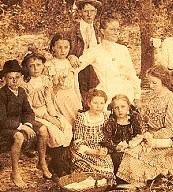
Waldine
and Emma (first seated girls on log (left)
Courtesy Fayette Heritage Museum & Archives |
|
Waldine
was so impressed by the detail in an ivory letter opener that she
carved an elephant's head in chalk. It was noticed by a neighbor
and shortly thereafter she was asked to form a centerpiece (in butter)
for The Brady Tuesday Study Club's luncheon. The group, recognized
talent when they saw it and collected money to send her to San
Antonio to study under the world-renowned sculptor Pompeo
Coppini.
Coppini was so impressed with her that he taught her gratis when
her tuition ran out. He and his wife asked to legally adopt Waldine,
even though she was technically full-grown by this time. Coppini
taught her on the condition that she must never wed. She never did
and she worked until she was in her 80s.
|
Forum:
Subject:
Waldine Tauch
I read with interest
your article on Waldine Tauch and her father. Thank you for this.
However, I would point out that seven Tauch pieces are part of our
collection, including the original plasters from which the bronzes
were cast for the Texas Ranger, Pippa Passes, Higher Education, and
Buckner Group. Tauch had a special relationship with Panhandle-Plains
as she also left twelve Pompeo Coppini pieces to PPHM as well. You
might add Canyon
and Burnet
(Buckner Children's Home) to the places one can see her work.
Keep up the good work about Texas.
- Respectfully, Michael R. Grauer, Curator of Art Panhandle-Plains
Historical Museum, Canyon, Texas, September 23, 2005 |
|
|
 HOME
HOME