|
History in
a Pecan Shell
Thought to be settled
after the Civil War, it was originally called Lecomteville after
Leon Lecomte, the town’s first postmaster. The office closed, reopened
in 1890 and then closed for good in 1910.
The name Losoya is thought to be a corruption of Laysawyer, the surname
of local settlers. The 1878 population was given as 100, but fell
to 89 by 1910. The proximity to San
Antonio kept the population low and by 1940 it was a mere 75 people.
The postwar boom of San
Antonio reached Losoya and it finally gained residents reaching
322 for the 1990 Census. The number was also used for the 2,000 figure.
|
Losoya, Texas
Attractions/Landmarks
|
| Church, Cemetery
& Historical Markers |
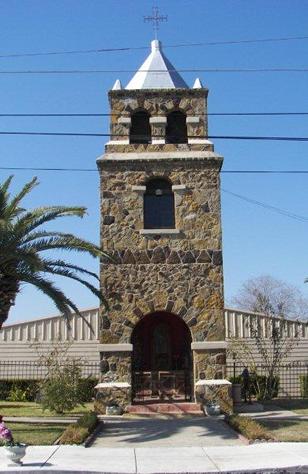
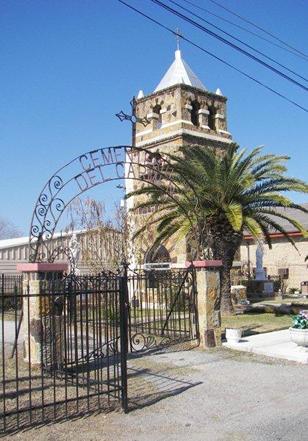
"Historical
marker for the El Carmen Cemetery (Cementerio del Carmen) in Losoya
at Our Lady of Mt. Carmel Catholic Church.
Many of the casualties of the Battle
of Medina were buried here."
- Terry
Jeanson |
Historical Marker
- 18555 Leal Rd., Losoya
El Carmen
Cemetery
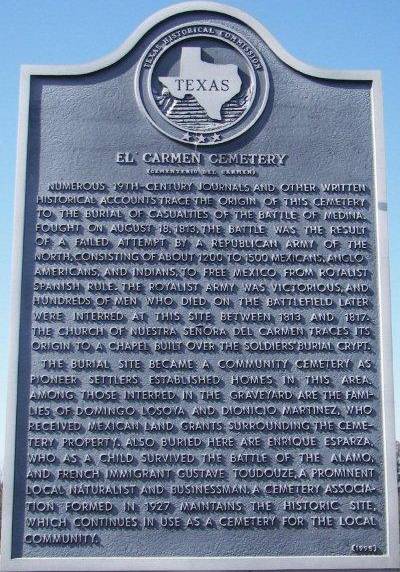
Numerous 19th-century
journals and other written historical accounts trace the origin of
this cemetery to the burial of casualties of the Battle
of Medina. Fought on August 18, 1813, the battle
was the result of a failed attempt by a Republican Army of the North,
consisting of about 1200 to 1500 Mexicans, Anglo-Americans, and Indians,
to free Mexico from Royalist Spanish Rule. The Royalist army was victorious,
and hundreds of men who died on the battlefield later were interred
at this site between 1813 and 1817. The church of Nuestra Senora del
Carmen traces its origin to a chapel built over the soldiers' burial
crypt.
The burial site became a community cemetery as pioneer settlers established
homes in this area. Among those interred in the graveyard are the
families of Domingo Losoya and Dionicio Martinez, who received Mexican
land grants surrounding the cemetery property. Also buried here are
Enrique Esparza, who as a child survived the Battle
of the Alamo, and French immigrant Gustave Toudouze, a prominent
local naturalist and businessman. A cemetery association formed in
1927 maintains the historic site, which continues in use as a cemetery
for the local community.
1994 |
 |
Centennial Marker
-
On the intersection of US highway 281 and FM 2537
The Battle
of the Medina
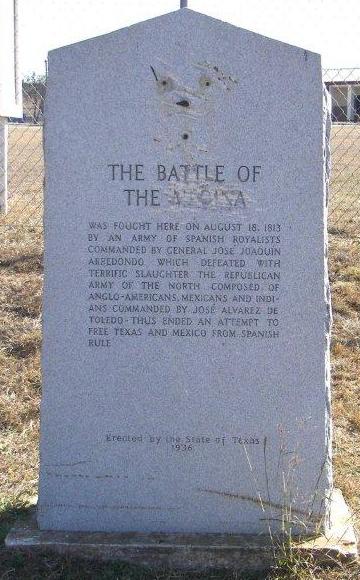
The Battle of
the Medina was fought here on August 18, 1813 by an army of Spanish
royalists commanded by General Jose Joaquin Arredondo which defeated
with terrific slaughter the Republican Army of the North composed
of Anglo-Americans, Mexicans and Indians commanded by Jose Alvarez
de Toledo. Thus ended an attempt to free Texas and Mexico from Spanish
rule. |
 |
Historical Marker
-
In Cemetery, MT. Carmel Catholic Church
Corner of Leal Rd & Martinez, Losoya
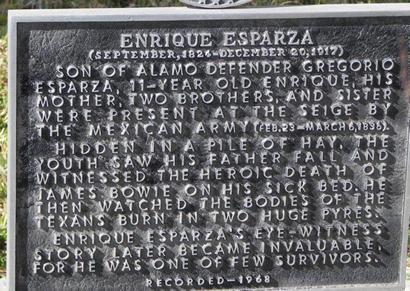
Enrique Esparza
(September, 1824-December 20, 1917)
Son of Alamo defender
Gregorio Esparaza, 11-year old Enrique, his mother, two brothers,
and sister were present at the seige by the Mexican Army (Feb. 23-Mar.
6, 1836). Hidden in a pile of hay, the youth saw his father fall and
sitnessed the Heroic death of James Bowie on his sick bed. He then
watched the bodies of the Texans burn in two huge pyres. Enrique Esparza's
Eyewitness story later became Invaluable, for he was one of few survivors. |
| Losoya, Texas
Forum
Subject:
Losoya, and the Battle of the Medina
With today's news, there is a gentleman claiming to have located
the actual site of the Battle of the Medina--well away from Nuestra
Senora Del Carmen and the cemetery (supposedly) originally populated
with the casualties. The church is there because of the chapel constructed
for burial site. Because of today's news, I read your page on Losoya.
According to your site, the name Losoya has two attributions. The
explicit (and perhaps less logical) is noted first, that "the name
Losoya is thought to be a corruption of Laysawyer, the surname of
local settlers." The next reference is not direct, but offers a
more reasonable source for the name: "Among those interred in the
graveyard are the families of Domingo Losoya and Dionicio Martinez,
who received Mexican land grants surrounding the cemetery property."
Martinez Losoya Road and Losoya Creek are found nearby. I can't
think why the name of Losoya would come from an obscure "corruption"
rather than a local land owner.
Apart from the source of the name...If the findings of Robert P.
Marshall are correct,
[ http://www.mysanantonio.com/news/local_news/article/Battle-of-Medina-site-found-geologist-says-3374995.php
] why would these men be buried so far away from the
battle site? And if they aren't the dead from the
battle--who are they?! Thanks for your time. Regards, Kerry
McCollough, March 02, 2012
|
| Texas
Escapes, in its purpose to preserve historic, endangered and vanishing
Texas, asks that anyone wishing to share their local history, stories,
landmarks and recent or vintage photos, please contact
us. |
|
|
 HOME
HOME