|
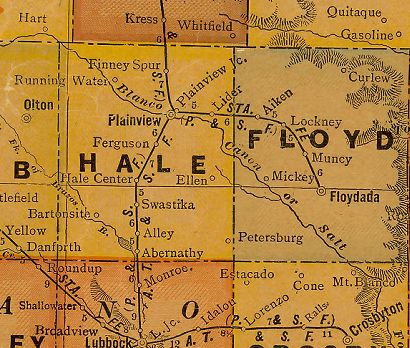
HALE CENTER,
TEXAS
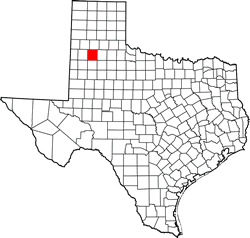
Hale
County,
Texas Panhandle
34°03'51"N 101°50'38"W (34.0642436 -101.8437866)
Intersection of Interstate 27 and FM 1914
On the high plains of Llano Estacado
33 miles N of Lubbock
11 miles SW of Plainview
38 miles W of Floydada
NE of Littlefield
ZIP code 79041
Area code 806
Population: 2,054 est ( 2019 )
2,252 (2010) 2,263 (2000) 2067 (1990)
Hale Center, Texas Area Hotels ›
Plainview
Hotels |
 |
History in
a Pecan Shell
What's not to like about Hale Center? Even the town's founding brought
together two rival towns. According to the Handbook of Texas, these
towns were named Hale City and Epworth and both were
founded the same year of 1891. While Texas has a well-known history
of small town rivalry, this is the first case we've heard of where
both towns moved homes and buildings to a common location. Since it
was a very centralized location, the name Hale Center was given as
the requested name for the new post office.
The Santa Fe Railroad came through in 1909 and the town rebounded
from a slump. After losing people during the Great Depression, growth
was slow, but steady through the 40s and 50s. A devastating tornado
occurred in 1965 which destroyed most of downtown. (See Hale
Center 1965 Tornado by Marlene Bradford.)
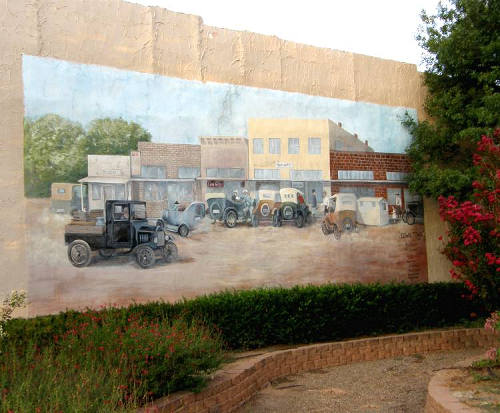
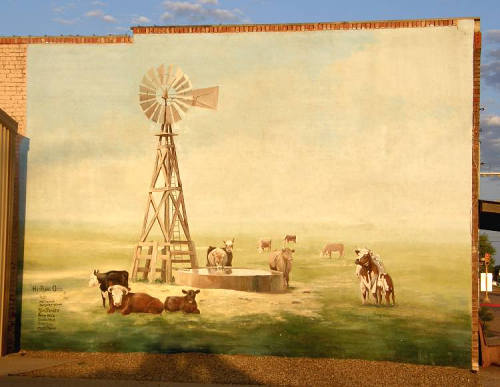
Hale Center physician Ray Freeman and wife Marjorie were instrumental
in starting the Hale Center
Mural Project. |
Hale Center,
Texas
Landmarks / Attractions
|
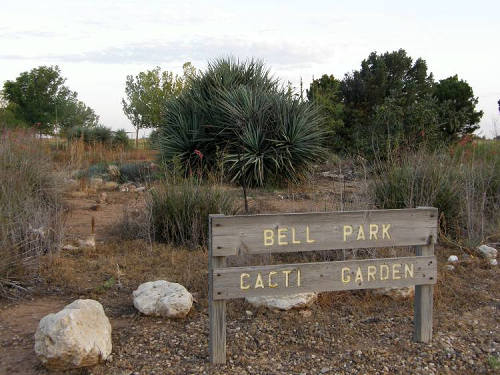
Bell Park
Cacti Garden
Over 350 specimens
Intersection of Ave K and Cleveland Street |
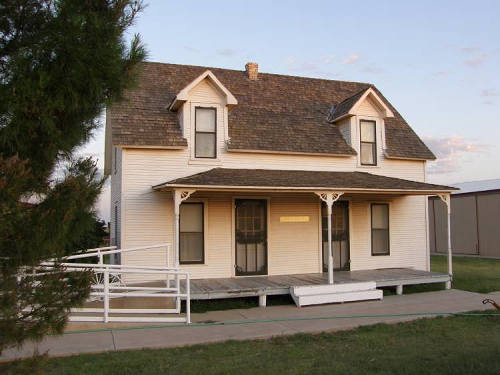
Hale County
Farm and Ranch Museum
One mile south of town on Hwy 27
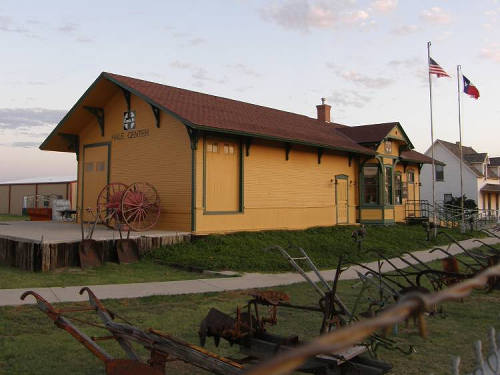
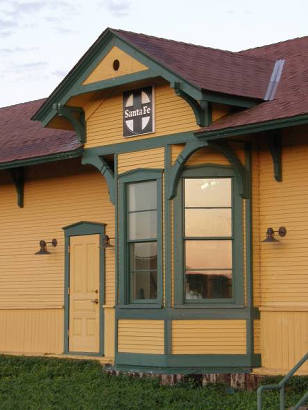
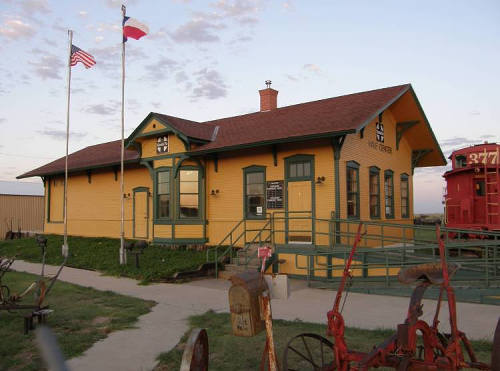
5 acre museum built around the 1910 Santa Fe Depot
Over 200 pieces of antique farm equipment on display
Open daily 1 to 5
806-839-2556 |
Historical Marker:
( I-27 about 1/2 mile South of Hale Center)
Ranching and
Farming in Hale County
Pioneer ranchers
began to settle Hale
County in the early 1880s. Land was plentiful and cheap, but life
was hard. Many settlers lived in dugouts. Supplies were freighted
from Colorado
City until the railroad reached Amarillo.
Cattle roamed the
free grazing land until round-up time, when they were separated according
to brands. Ranchers
earned extra income by selling buffalo bones for fertilizer, working
on the railroad,
or hiring out to larger ranches. Many worked at the Circle Ranch of
Col. C. C. Slaughter, which covered land in four counties. Other significant
ranches included the Callahan, Barton, and Norfleet ranches. When
the public land was gone and free grazing ended, the larger ranches
were divided into smaller tracts.
The transition from ranching
to farming was difficult. By the early 20th century, wheat farming
and dairy production began to replace ranching
operations. The Dust Bowl and Depression of the 1930s brought new
hardships. Soon after World
War II, however, a high percentage of the cultivated acreage in
Hale County was
under irrigation. This allowed for crop diversification with high
yields of grain sorghum, corn,
soybeans, wheat, vegetables, and livestock production. Cotton
has become the leading cash crop.
(1985) |
 |
The
1910 Santa Fe Depot
Hale County Farm and Ranch Museum |
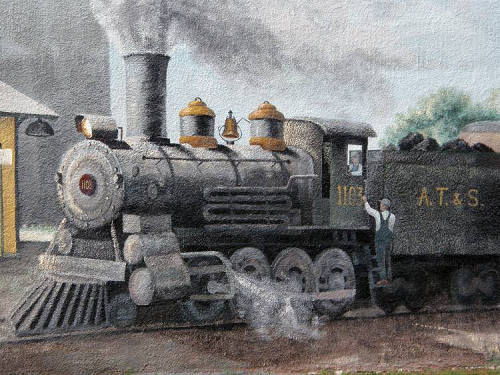
"Whistle
Stop" mural detail
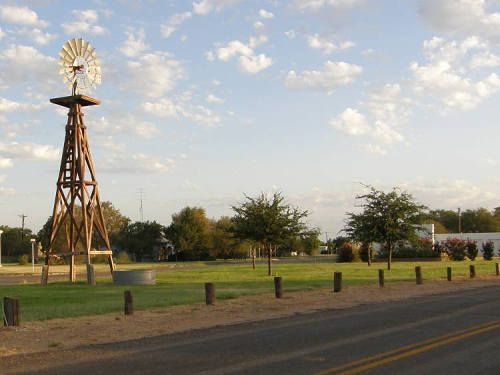
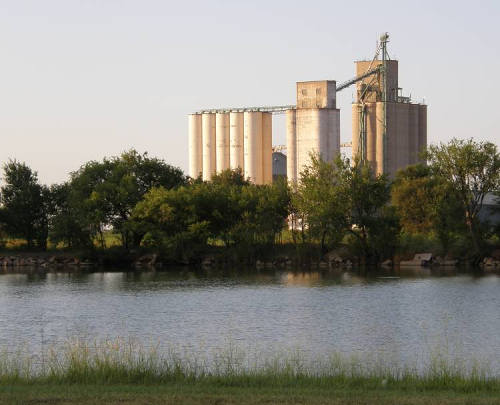
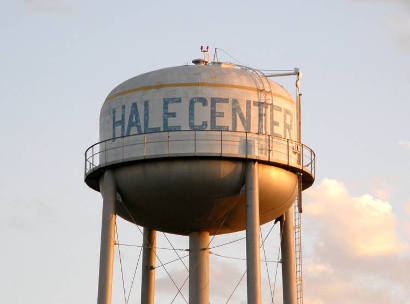
Photo courtesy Barclay
Gibson, August 2009 |
 |
 |
 |
 |
 |
 |
 |
 |
Hale Center,
Texas Forum
Subject:
another displaced Hale Centerite
Hello out there in West Texas.
I Just read Madrid's letter from Arizona that was born in Hale Center.
I grew up on a farm and ranch 5 miles south and 2-3 miles west on
the Cotton Center road (old Iowa Avenue). I was a McKnight born
in 1934. Have great memories, but am now trying to find the history
of the place I was born on. I even have an oil painting of the house.
I was a McKnight. My dad and relatives owned land all around that
part of the county, but I've never known who the Harrell people
were that we rented this place from. We never saw them in the 18
yrs I was growing up. We dealt with Mr. Hicks of Abernathy State
Bank all those years. It had been an old ranch headquarters I always
thought. It had first been an adobe smaller house, and later built
over and onto with lumber. It was considered very old when I was
born in 1934. I remember it had one of the gorgeous old oak wall
phones that we kids played with, as there was no phone service in
the 30's. It had old trees planted of course at that time. It also
had some beautiful stained glass in one of the doors that was fast
deteriorating. After we all left Hale County the Tullis family farmed
that and I think Bob Watson some. Still the same thing, heirs, and
no direct contact. I took small things from the old house and wanted
to take it all, but as was not mine I did not. I was very sad indeed
to find later that the farmer had burned the remains. I do have
2 adobe bricks and a closet door, of which I have memories of being
locked in that closet as punishment. This ranch was in the area
and era of Frank Norfleet, our neighbor that I remember when he
was in his 90's. I have an autographed copy of his book.
Anyone know anything about the origin of the Harrell place, as my
family has forever called it?? - Marita June McKnight Wood Barnett,
Hanford Ca. dbarnet@sbcglobal.net, September 17, 2006
My name is
Marylou Madrid. I was born in Hale Center, Texas but moved to Phoenix,
Arizonia at the age of six. I am now forty-nine and don't know much
about my hometown. I would love to see my hometown before my end
of time. I was told that we lived next to some railroad tracks and
I kind of remember looking out of a big picture window when it was
snowing and hanging out with a little boy by the name of Willie
picking up all kinds of frogs and putting them in empty coffee cans.
To this day I still collect nic nacks of frogs. My parents are deceased
now and I don't have not one picture of my home town. When people
ask me where I was born and I tell them Hale Center, Texas - they
look at me like I'm nuts and say "I never heard of Hale Center -
where in the heck is that?" Even if I don't know much about my hometown,
all I can say is that I'm proud to be a Texan. Thank you and God
bless Hale Center, Texas....forever. - Marylou Madrid, August 11,
2006
|
Nearby Destinations
Hwy 27 about 30 miles south to
Lubbock.
Hale Center Local and Tourist Information
Chamber of Commerce: 702 Main Street 806-839-2642
|
| Texas
Escapes, in its purpose to preserve historic, endangered and vanishing
Texas, asks that anyone wishing to share their local history, stories,
landmarks and recent or vintage photos, please contact
us. |
|
|
 HOME
HOME