|
|
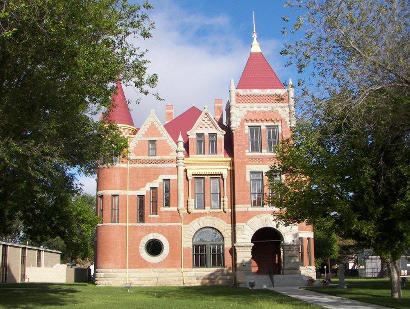
Donley County
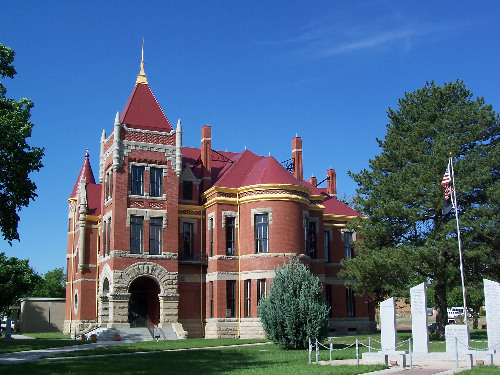
Courthouse (after 2002 restoration)
Photo courtesy Rhonda Aveni |
The Present
Donley County Courthouse
- Clarendon,
Texas
Date - 1890
Architect - Bulger and Rapp
Style - Romanesque revival
Material - Brick and stone |
History
If you're like me, when you hear the name Texas
Panhandle, you probably think blue northers and the Palo
Duro Canyon. It gets cold, cold in the Panhandle
where there's hardly anything but barbed
wire fence to keep out the brisk Arctic wind in the winter.
Donley County
is one of the squared counties located in the Panhandle.
Formerly the domain of Plains Apaches and later the Comanches and
Kiowas, this region was once overrun with buffalo
until White men settled in the latter 1870s. Many battles ensued between
the tribes and the Whites, including the decisive Red River War of
1874-75. Thereafter, the Indians were put on reservations in Indian
Territory, and the buffalo
were slaughtered. With the buffalo
gone, vast cattle
ranches could be established. |
Clarendon
This is about when Methodist preacher Lewis Carhart established "Saints
Roost" up in those parts. Actually, Carhart called his no-liquor,
no-gambling Christian colony "Clarendon" after his wife, Clara. But
local rowdies gave it its nickname since they weren't allowed to be
rowdy there. Carhart's motto, "Christianity, Education, Temperance,
Civilization - Westward," set high expectations for the townspeople.
Nevertheless, a saloon and dance hall were going to be erected by
some outsiders at one point. This didn't set well with several local
cowboys, who offered to scalp them if they didn't leave. It took legendary
cattle driver Charles
Goodnight to persuade the business owners to pack up and leave.
He gave them ten hours to go, and, by golly, they were gone before
that. By the early 1880s, Clarendon
was one of only three towns in the Panhandle.
Saints Roost is now like Atlantis, under water (the Greenbelt Reservoir,
to be exact). Clarendon
has been the county seat since 1882.
Incidentally, the August 2, 1879, edition of the Clarendon News,
which claimed that there was to be "no whisky forever in Clarendon,"
made comment on the Sunday law. This so-called law extended between
the hours of midnight on Saturday until midnight on Sunday, during
which time no shopping or trading was allowed. It appears that a drought
had laid siege on the land and that "to many old guzzlers, it seem[ed]
an eternity between drinks." I guess they were guzzling lemonade since
whisky wasn't allowed.*
Book Hotel Here > Clarendon
Hotels |
|
Donley
County is named for Stockton P. Donley,
skilled criminal lawyer and elected Texas Supreme Court Judge. He
didn't live in the Panhandle,
but he's said to have been as clever an attorney as Patrick "give
me liberty, or give me death" Henry. Donley
County, created in 1876, was also cattle country, with the JA
Ranch (established that year by Goodnight
and John Adair), the RO Ranch, and Carhart's Quarter Circle Heart
Ranch covering most of the area. |
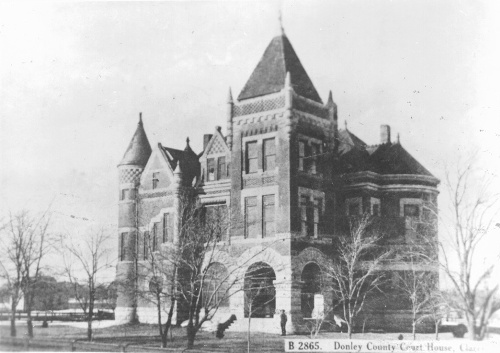
1890 Donley County
Courthouse, complete with tower and turret.
Photo courtesy THC |
The 1890
Donley County Courthouse
The Romanesque
Revival stone and brick courthouse is the third temple of justice
for the county. The stone base was supposedly taken from the previous
courthouse, which was a two-story stone edifice. Colorado architects
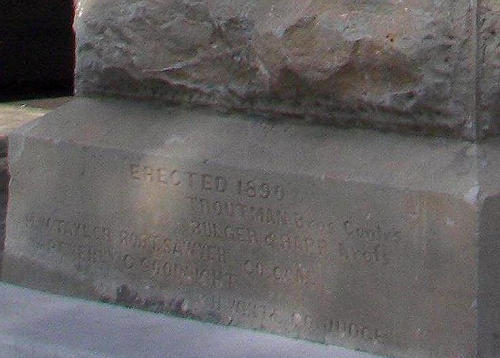
C. H. Bulger and Isaac Rapp had designed the current building
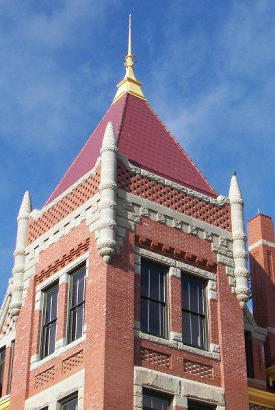
to have a tower in the northeast corner, a conical turret roof over
the stair in the southeast corner, and other decorative roof elements.
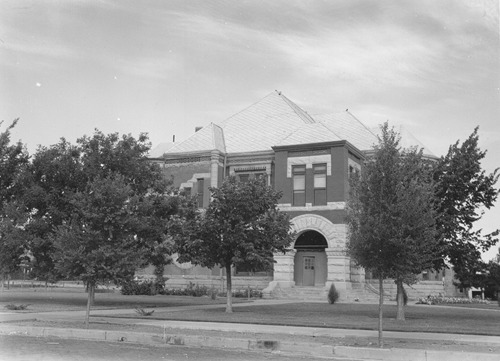
The original roof had had its share of problems. It was initially
sheathed with pressed metal shingles which shed water poorly. That
led to damage to the interior structure. The entire third floor and
the roof were removed and replaced between 1936-37. |
Donley County
Courthouse as it appeared in 1939
Photo courtesy TXDoT |
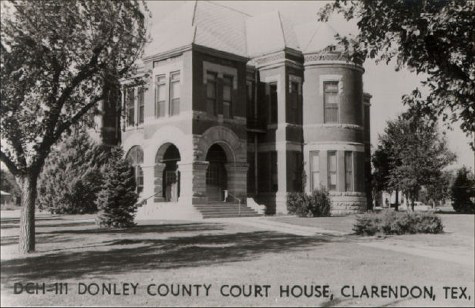
| Postcard
courtesy www.rootsweb.com/ %7Etxpstcrd/ |
|
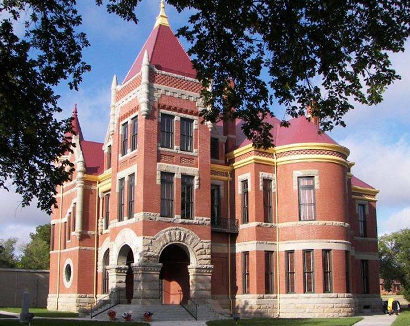
Stained glass
windows in arched openings still remain as hints of its Victorian
era roots. Columns with alternating courses of smooth and textured
stones support the arches of the tower base. The building itself
is very imposing, situated next to the modern courthouse annex that
doesn't match it at all. A ranch house would be more fitting out
in these parts, but since Clarendon
was dubbed "the Athens of the Panhandle," having a fancy Romanesque
courthouse would make some sense. (Wait. Wouldn't a Greek Revival
courthouse make even more sense?)
One of the most famous cases to be tried here was in November 1909
when G.R. Miller was sentenced to die for murdering two young men.
He was hanged from the brand new scaffold several blocks from the
courthouse in what was to be the last legal hanging in the Panhandle.
I guess you can say that they built the scaffold especially for
him.
The courthouse is undergoing renovation, courtesy of the Texas Historic
Courthouse Preservation Program. The word from the current judge's
office is that the courthouse will look like it did when it was
first built, if not better. Completion date is set for November
2002.
February,
2002
Copyright Lou Ann Herda
|
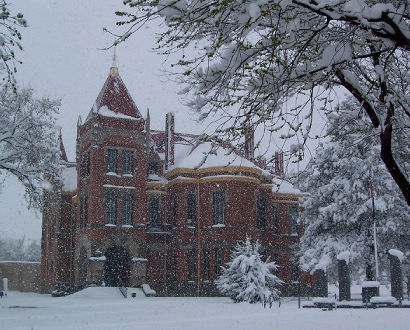 |
| Photo
courtesy Rhonda Aveni |
The Restored
1890 Donley County Courthouse
Photos & Captions
courtesy Terry
Jeanson, September 2007 |
| "The front
of the courthouse facing S. Sully St. Part of the restoration included
the reconstruction of the third story of the two front towers."
- Terry
Jeanson |
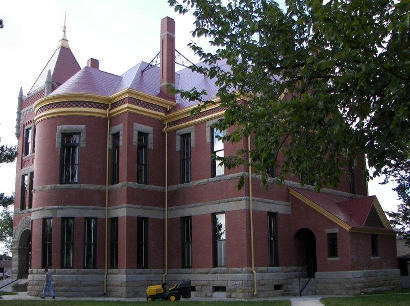
| "The side
of the courthouse facing W. Third St. A major undertaking of the restoration
included updating antiquated plumbing and electrical systems and making
the building more accessible. Large cracks in the brick and stone
have been repaired along with the sections of mortar that had deteriorated
and sections of the cornice which had fallen off. Holes in the exterior
had led to a major bat problem in the attic." |
| The restored
corner tower |
| "Courthouse
back facing S. Jefferson St. A breezeway separates the small back
section from the courthouse main." |
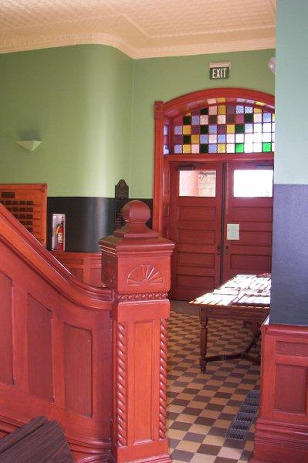
| View of front
entrance from the staircase. |
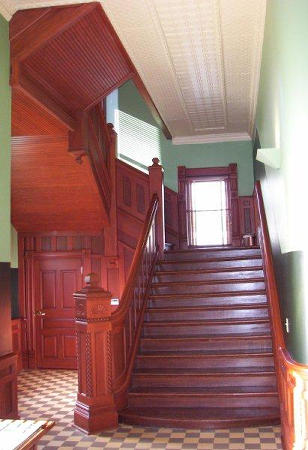
| "Staircase
inside the front entrance. The stairs lead up and turn into the left
corner tower on the front side of the courthouse as evidenced by the
stair-step windows on the front of the building." |
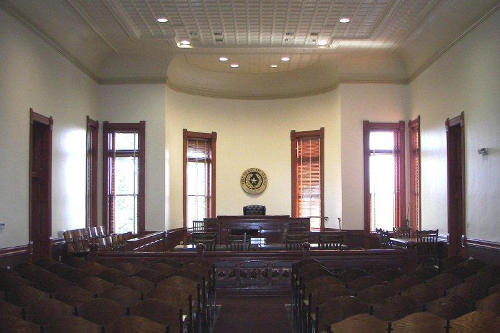
| "The second
floor district courtroom spans the building. A painting of the county's
namesake, Stockton P. Donley, is displayed at the rear of the courtroom." |
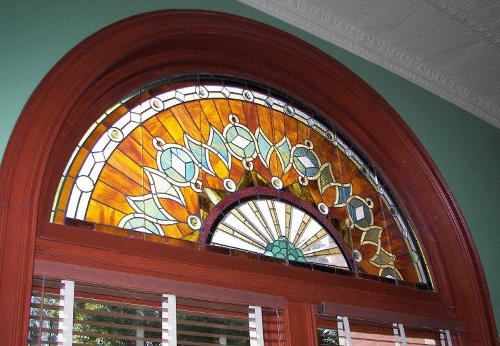
| "The stained
glass in the front central window. Private donations and the generosity
of county citizens made it possible to restore many things that the
grant money from the Texas Historical Commission did not cover." |
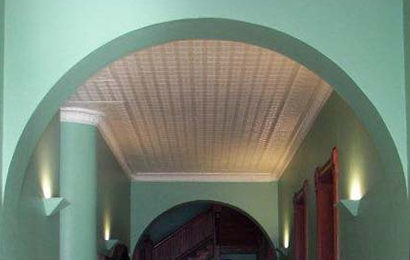
| "First floor
hallway. From what I've read, the pressed metal ceiling was not an
original feature of the courthouse and was added about ten years after
it was built." |
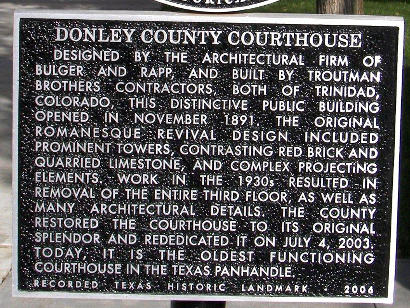
| "The Donley
County courthouse historical marker has been updated to include the
information about the restoration which was completed in 2003."
- Terry
Jeanson |
Historical Marker
Text
Donley County
Courthouse
Designed by the
architectural firm of Bulger and Rapp, and built by Troutman Brothers
Contractors, both of Trinidad, Colorado, this distinctive public building
opened in November 1891. The original Romanesque Revival design included
prominent towers, contrasting red brick and quarried limestone, and
complex projecting elements. Work in the 1930s resulted in removal
of the entire third floor, as well as many architectural details.
The county restored the courthouse to its original splendor and rededicated
it on July 4, 2003. Today, it is the oldest functioning courthouse
in the Texas Panhandle.
Recorded Texas Historic Landmark |
|
*History
of Donley County, © 1990
Thanks to Rhonda Aveni, secretary to County Judge Jack Hall, for
gathering the information for me and for being available when I
came through town. - Lou
Ann Herda
References and Additional Reading
|
|
|
 HOME
HOME