|
 |
Monument
Hill and
Kreische Brewery State Historical Parks
We will say right
here and now, even if it harelips the governor, that this is the most
under-appreciated State Historic Site in the system. Although short
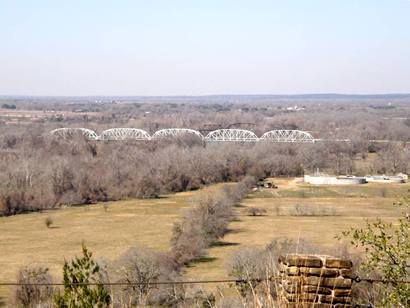
on activities, it should be famous if only for it's overlook of La
Grange and the Colorado River.
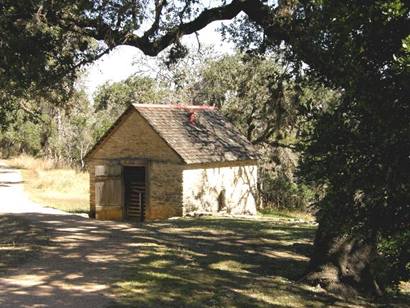
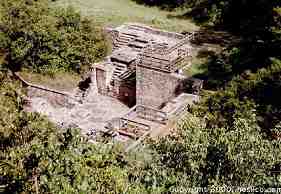
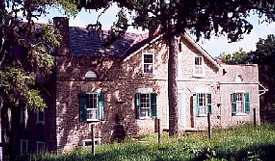
Architecturally it has the ruins of the Kreische
Brewery and the restored Kreische
home, both hand built by Heinrich Kreische and made from locally
quarried stone.
The main attraction is the burial vault of the men of the Dawson and
Mier Expeditions. This footnote to Texas
History is perhaps the biggest single event to influence Mexican-Republic
of Texas-United States relations and was a major factor in the annexation
of Texas to the United States.
Contact
Information:
Monument Hill & Kreische Brewery State Historic Site
414 State Loop 92 La Grange, TX 78945-5733
979/968-5658
http://www.tpwd.state.tx.us
Getting
There
Book
Hotel Here >
La
Grange Hotels
|
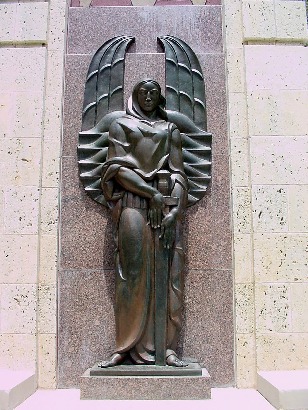 |
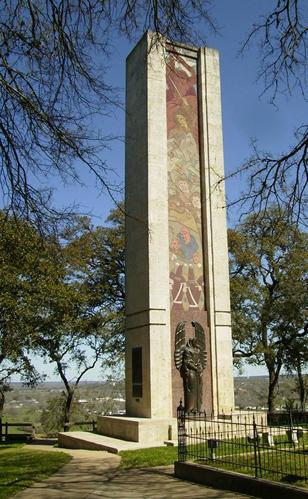
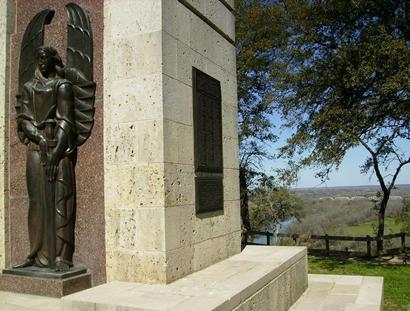
Statue on Monument
Hill
TE photo |
The 1936 Centennial
Monument
Photo
courtesy Sarah
Reveley, February 2010 |
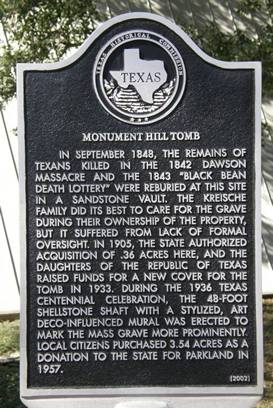
Monument
Hill Tomb Historical Marker
Photo courtesy Barclay
Gibson, February 2009 |
Historical
Marker Text
MONUMENT HILL
TOMB
In September 1848,
the remains of Texans killed in the 1842 Dawson
Massacre and the 1843 "Black Bean Death Lottery" were reburied
at this site in a sandstone vault. The Kreische family did its best
to care for the grave during their ownership of the property, but
it suffered from lack of formal oversight. In 1905, the state authorized
acquisition of .36 acres here, and the Daughters of the Republic of
Texas raised funds for a new cover for the tomb in 1933. During the
1936 Texas Centennial
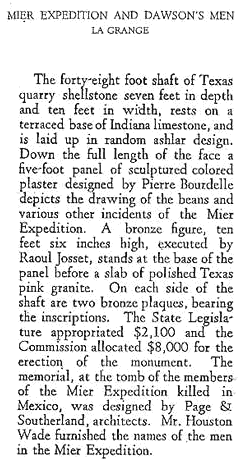
celebration, the 48-foot shellstone shaft with a stylized, Art Deco-influenced
mural was erected to mark the mass grave more prominently. Local citizens
purchased 3.54 acres as a donation to the state for parkland in 1957. |
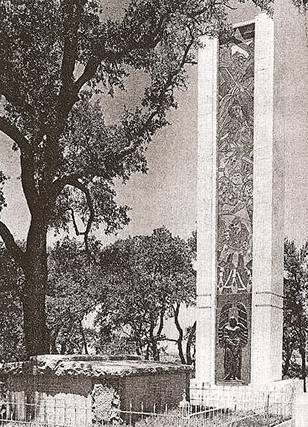
Centennial Monument
From
"Monuments Commemorating the Centenary of Texas Independence", State
of Texas, 1938
Courtesy Sarah
Reveley |
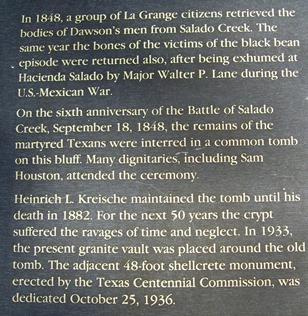
Centennial Monument
Description
From "Monuments
Commemorating the Centenary of Texas Independence", State of Texas,
1938
Courtesy Sarah
Reveley |
Kreische
Complex Historical Marker
Photo courtesy Barclay
Gibson, February 2009 |
Historical
Marker Text
KREISCHE
COMPLEX
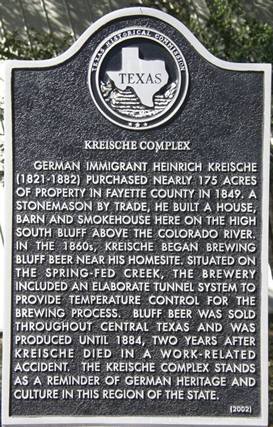
German immigrant Heinrich Kreische (1821-1882) purchased nearly 175
acres of property in Fayette County in 1849. A stonemason by trade,
he built a house, barn and smokehouse here on the high south bluff
above the Colorado River. In the 1860s, Kreische began brewing Bluff
Beer near his homesite. Situated on the spring-fed creek, the brewery
included an elaborate tunnel system to provide temperature control
for the brewing process. Bluff Beer was sold throughout Central Texas
and was produced until 1884, two years after Kreische died in a work-related
accident. The Kreische complex stands as a reminder of German heritage
and culture in this region of the state. |
|
|
The
Kreische Brewery ruins
© 2000, heskco.com |
|
|
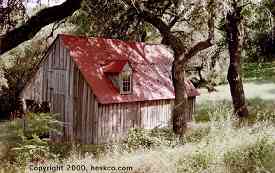
Small
shed on the grounds
© 2000, heskco.com |
|
|
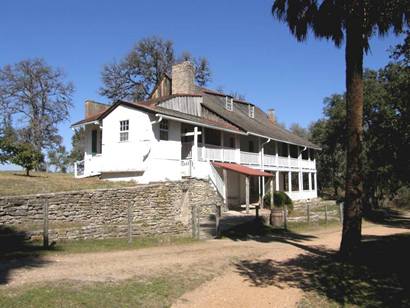
The
Kreische house
TE photo |
A view of La
Grange Bridges from Monument Hill
Photo courtesy Barclay
Gibson, February 2009 |
"Soldiers
of Misfortune"
Two exceptional books are available at the park's gift shop/museum
dealing with this misguided foray into Mexico in 1842. "Soldiers
of Misfortune" by Sam W. Haynes, and a 60.00 tome which could
substitute for a blunt instrument is there for the more than amateur
historian. The author died before finishing the book but his notes
were edited and a second volume is planned. |
|
|
1842 found Austin
still receiving attacks from Comanches, Mexico with a standing army
bigger than the United States (even when they sat down), and a Texan
Militia wherein insubordination was considered a virtue. Mr. Haynes'
detailed book reads faster than a mystery. If you wanted to pique
a young reader's interest in Texas
History, this could be the book. ...... > |
Santa Anna
We've heard many Mexicans say that Santa Anna's most noted accomplishment
was not selling the rest of Mexico to the United States. It's interesting
to note that Texas' favorite villain had a compassionate side.
Recognizing a familiar name on the list of prisoners from the Mier
Expedition, Santa Anna asked if the prisoner was related to the Doctor
who had pumped his (Santa Anna's) stomach after his attempted suicide
during his captivity. When informed "yes," he immediately
signed his release and sent him back to Texas but only after entertaining
him in his home for two weeks.
He also offered to adopt the youngest member of the Mier Expedition,
and after the boy checked with his father (also a prisoner) a deal
was struck and John C.C. Hill became the adopted son of Santa Anna.
His Father and brother were released and went back to Fayette County.
John learned Spanish, was sent to the prestigious College of Mines
and became a civil engineer. He had a life that was several rungs
up the social ladder from his poor Fayette County family and occasionally
visited the U.S. before he died in Mexico in 1909.
Lice and typhus were two things that the Mexicans couldn't control
and the guards suffered alongside the prisoners. Strangely, personal
property was respected and prisoners who had money could buy soap,
tobacco and Mescal. Used chewing tobacco was dried and sold at half
price. After it's second incarnation it was shredded and smoked in
pipes.
The names of many participants, whether they survived or not, should
be familiar to Texans, native or naturalized. Brenham, Cameron,
Daingerfield, Eastland, Hays, Hockley,
Sommervell and Wallace, just to mention a few. Invasion,
mutiny, racism, insubordination, survival, imprisonment and pestilence
- there's something for everyone.
Members
of the Mier Expedition
Member
of Captain Nicholas M. Dawson's Company of Volunteers |
The
Black Bean Episode
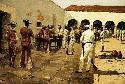
After the prisoners were captured, word was sent from Mexico City
to execute them all. Not wanting to provoke another war, it was decided
to kill every 10th prisoner. This was arranged by conducting a lottery
of white and black beans. Although this is referred to as the "Infamous
Black Bean Episode", we find it pretty democratic, although they
had the officers draw their beans first which wouldn't sit well with
today's military.
©
John Troesser
Book
Hotel Here > La
Grange Hotels |
|
Getting There:
If you enter
La Grange from the
north, east or west, you'll pass through downtown La Grange (one
block from the intersection of 71B and Hwy 77).
On the NE corner
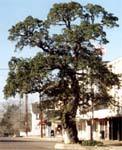
of the square you'll see the Muster
Oak under whose branches the men of the Somervell/Mier
expedition were sworn in. This may mean nothing to you now,
but after visiting Monument Hill you will understand its significance.
This is one of the "Famous
Trees of Texas" and while many are in their decline, the
Muster Oak looks healthier than it did in photographs from the 1940s.
|
As
you leave La Grange
on Hwy 77 South, the road starts to climb and wind immediately after
crossing the Colorado River. When you reach the top, the road to the
right will take you the 2/10ths of a mile to Monument Hill State
Park. This is SPUR 92. There is no light at the top,
so be careful.
Book
Hotel Here >
La
Grange Hotels
|
|
|
 HOME
HOME

 Gulf
Coast
Gulf
Coast East
Texas
East
Texas Central
North
Central
North Central
South
Central
South Panhandle
 South
Texas
South
Texas Hill
Country
Hill
Country West
Texas
West
Texas Ghost
Towns
Ghost
Towns COUNTIES