|
Books by
Jeffery Robenalt
|
|
In
March of 1842, Mexican President Santa Anna retaliated for Texas President
Mirabeau Lamar’s ill-fated "Wild Goose" expedition to Santa Fe
by sending General Raphael Vasquez and a substantial force of soldiers
across the Rio Grande with orders to occupy San
Antonio. The border incursion caught the Texans by surprise, but
fortunately the Mexican forces under Vasquez remained in San
Antonio for only two days before withdrawing and marching back
to the Rio Grande, their wagons piled high with plunder.
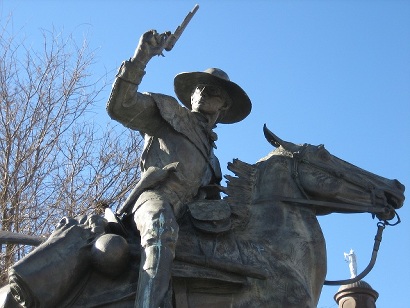
Captain Jack Hays and his Texas Rangers dogged the Mexicans on the
march back to Laredo,
but his small force lacked the strength to do anything except harass
the column. Angered by General Vazquez’s flagrant violation of the
border, the Texas Congress passed a declaration of war against Mexico,
but the current President, Sam
Houston, knowing how ill-prepared the bankrupt Republic was for
war, wisely vetoed it. “Texas would defend itself if need be,”
he declared, “but we must not attack.” |
 |
| Relations between
Texas and Mexico remained at an uneasy
standstill until Santa Anna decided to break the impasse by ordering
French mercenary General Adrian Woll to cross the border with twelve
hundred soldiers and again advance on San
Antonio. To Santa Anna, this incursion was not meant to be a formal
act of war, but merely a demonstration in force to accomplish three
goals: first, to assert Mexican sovereignty across the Rio Grande;
second, to chastise the Texans for their move on Santa Fe; and finally
to let the expansionists in the United States know Mexico
was prepared to act in the protection of its own interests. |
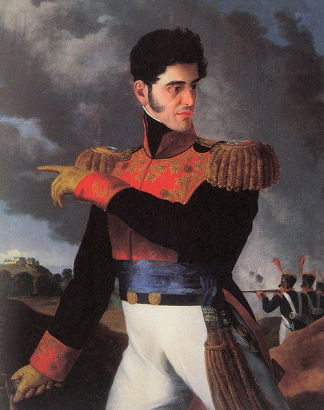
| General Santa
Anna oil painting on display at the Museum of the City of Mexico.
Wikimedia
Commons |
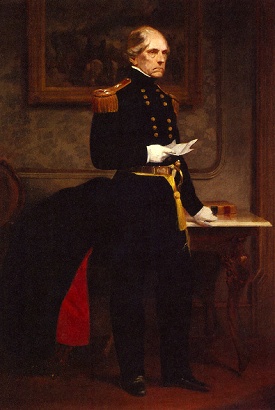
General Adrian
Wool
(National
Portrait Gallery, Smithsonian Institution)
www.history.army.mil |
Cleverly avoiding
the scouts Jack Hays had posted south of town, General Woll left the
main road and made a night march through the hills, capturing San
Antonio well before dawn on September 12. Like General Vasquez,
Woll only planned to occupy San
Antonio for a brief period, but he made good use of his time by
capturing the members of the district court which happened to be in
session, along with a number of other prominent Texans. With only
a small force of Rangers, Hays could do nothing except send his men
to gather the militia.
Scattering
over the countryside, the Rangers sent out the call and from all across
central Texas individuals and small
groups of men rode or walked to the relief of San
Antonio. Soon more than two hundred volunteers gathered at Seguin,
every man eager to drive the Mexicans out of the Republic.
The volunteers cheered when Matthew “Old Paint” Caldwell, a recently
released prisoner from the Santa
Fe expedition, galloped into town at the head of a strong detachment
from Gonzales and
the Guadalupe Valley. The well known Indian fighter was immediately
elected to the rank of Colonel and given command of the small Texas
army. Jack Hays was selected to lead the forty-two man mounted detachment,
most of them men from his own Ranger Company. |
 |
 |
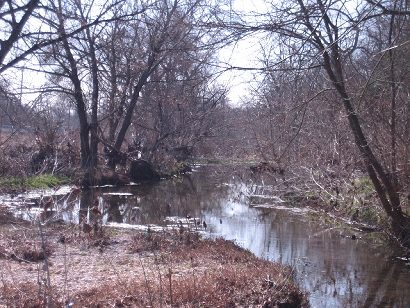
By midnight on
September 17, Colonel Caldwell and his two hundred and ten volunteers
were encamped on the east bank of Salado Creek, six miles northeast
of San Antonio, not
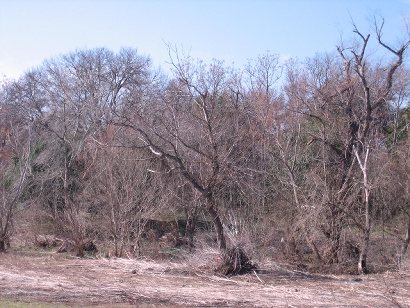
far from the site of present day Fort Sam Houston. A natural earthen
embankment on the east side of Salado Creek and a good stretch of
timber provided the volunteers with excellent cover.
From behind the embankment, there was a clear field of fire into a
wide grassy prairie that rose gently from the creek to a low ridge
nearly 800 yards away. Anyone foolish enough to approach the creek
across the open prairie would be fair game for the accuracy of the
Texans’ long rifles. To the rear of the position, a steep, heavily
thicketed ridge rose nearly vertical from the far bank of the creek,
rendering an approach from the west practically impossible.
However, no matter how secure the position on the creek appeared to
be, most of the volunteers were eager to abandon the camp and attack
San Antonio. Fortunately,
Caldwell realized his small force could never hope to drive General
Woll and his 1200 soldiers out of the Alamo
where the Mexicans had set up their headquarters. The only answer
was to somehow lure the General into attacking the strong defensive
position along the creek where the marksmanship of the Texans could
be put to best advantage.
After careful consideration, Caldwell
came up with a plan. Early the following morning, he sent Jack Hays
and a few Rangers to the Alamo.
Following Caldwell’s orders, the Rangers rode along the mission's
walls and shouted insults to the guards, challenging the Mexicans
to a fight. Suddenly Mexican bugles began to blare and a troop of
lancers galloped out of the compound in hot pursuit of their tormentors.
Fleeing towards the Salado, the Rangers splashed across the creek
a mile above Caldwell’s camp and reached the safety of the Texas lines
well before the Mexican cavalry reined up on the low ridge to the
east. After a brief rest, Hays led his Rangers in a series of skirmishes
with the lancers. Putting their few Colt Paterson revolvers and muzzle-loading
shotguns to good use, the Rangers managed to kill ten Mexican cavalrymen
and wound twenty-three more before returning to the creek without
suffering a single casualty.
Early in the afternoon, General Woll arrived on the ridge east of
Salado Creek at the head of 400 infantry, 160 dragoons, and two pieces
of artillery. The guns were immediately brought forward and unlimbered.
Soon they were banging away at the Texas positions along the creek,
shells screaming in at regular intervals.
The barrage did little damage, but Caldwell was thankful General Woll
had left most of his artillery in the Alamo.
A sustained bombardment from all of Woll's guns may well have driven
the Texans away from the protection of the creek bank, and the inexperienced
volunteers were ill-prepared to confront the well-trained Mexican
troops in the open.
While the laborers conscripted into Woll’s service were busy setting
up a huge, pavilion-like tent to shield the General and his staff
from the broiling rays of a merciless Texas
sun, the Mexican drummers began to beat a steady tattoo of commands.
Responding to the beat, the Mexican infantry formed up in four long
lines of battle facing the creek, with a thin line of skirmishers
well to the front and the dragoons in the rear to act as a reserve.
Cavalry served as a screen for each flank. General Woll was now prepared
for what he thought would be an easy victory.
For the next two hours, Caldwell was content to send out fifteen to
twenty skirmishers at a time to mix it up with the Mexican skirmishers.
He was hoping to lure General Woll into launching an all out attack
across the open prairie before the Frenchman decided to send for more
artillery. Time passed slowly, and still Woll refused to take the
bait. |
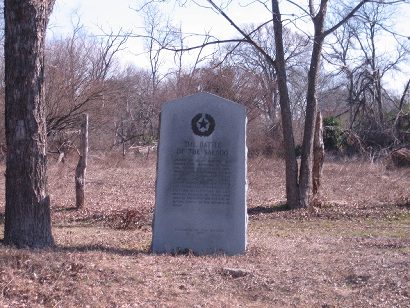 |
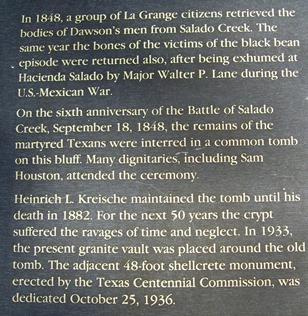
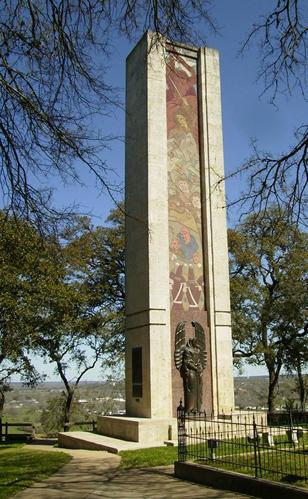
Battle Of Salado
Creek, Texas 1936 Centennial Marker
Photo
by Jeffery Robenalt,
February 2011 |
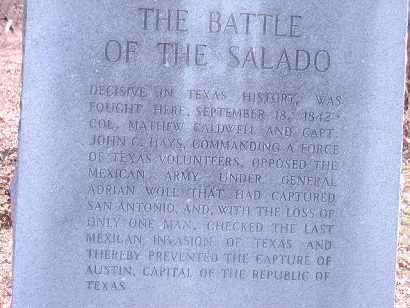
Battle Of Salado
Creek, Texas 1936 Centennial Marker text
Photo
by Jeffery Robenalt,
February 2011 |
During
this lull, two riders bearing bad news suddenly burst through the
Mexican lines on well-lathered horses and reined up in front of Caldwell,
nearly shouting their breathless message. Responding to "Old Paint's"
call for assistance, a detachment of 53 volunteers out of La
Grange under the command of Captain Nicholas Dawson had been cut
off and surrounded several miles from Salado Creek.
After an unsuccessful cavalry charge, the Mexicans had stood off and
shelled the unlucky Texans with artillery until the battered volunteers
raised a white flag and laid down their arms. Ignoring pleas for mercy,
the Mexican troops moved in and bayoneted the wounded and many of
the others, taking few prisoners. |
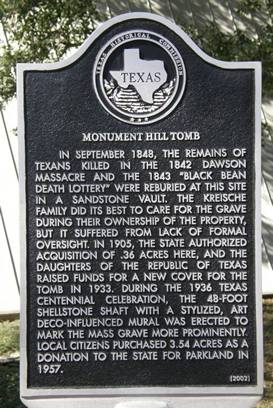
Monument Hill
Tomb Historical Marker
Photo
courtesy Barclay
Gibson, February 2009 |
|
Word
of the atrocity quickly flashed up and down the Texas lines, and
many of the furious volunteers demanded an immediate attack on the
Mexicans. Wisely disregarding the rumblings of discontent, Caldwell
continued to bide his time, and the veteran Indian fighter's patience
was finally rewarded when General Woll took the bait he had been
offering. Once again the drums began their steady beat as the Mexican
officers drew their swords and signaled the infantry and dragoons
to advance across the open prairie.
The outcome of the battle was exactly what Caldwell had hoped for.
The Mexicans marched forward to the beat of their drums as if on
parade, bayonets glistening in the late afternoon sun, and the Texas
marksmen, concealed behind the cover of the earthen embankment,
delivered volley after volley of devastatingly accurate rifle fire
into the enemy’s massed ranks. Mexican soldiers fell by the score,
most of them hit in the head or center-punched in the chest. One
Texan remarked the fight “was an easygoing affair” and “seemed like
child’s play.”
Toward sunset, General Woll, now thoroughly cowed by the pinpoint
marksmanship of the Texas volunteers, reassembled his battered troops
and ordered a retreat to San
Antonio. During the brief encounter, only one Texan had been
killed. The Mexicans left sixty bodies on the battlefield and filled
their wagons with another forty-four dead and one hundred and fifty
wounded. The following day the Mexicans held a mass funeral in San
Antonio rather than the grand victory fandango they had
planned earlier.
General Woll’s troops evacuated San
Antonio on September 20, taking a herd of five hundred cattle
and whatever wagons and carts they could lay their hands on piled
high with plunder. Two hundred Mexican families seeking protection
from the town’s enraged Anglo citizens also accompanied the column.
Caldwell called a council of war, and a vote was taken. Thanks to
the persistence of Jack Hays, it was decided to pursue the Mexicans
and attack them if possible.
Hays and the Texas Rangers led the pursuit, catching up with the
Mexican rear guard near the Arroyo Hondo in mid-afternoon on September
22. By then Woll's main column had crossed the river and assumed
good defensive positions along the west bank. Only a company of
infantry and a few cavalry remained on the east bank to protect
two cannons and the Mexican families who had not yet crossed.
Caldwell gave Captain Hays permission to assault the Mexican guns
and promised to support the attack with his infantry. Led by Hays,
the Rangers made a valiant mounted charge into the face of the Mexican
cannons, killing all five artillerymen as they galloped past. However,
Caldwell failed to support the effort as promised, and a determined
advance by the Mexican infantry forced the Rangers to spike the
guns and withdraw.
|
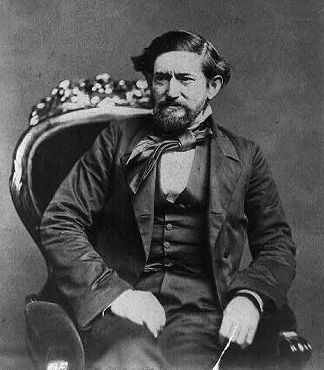 |
Portrait of
Jack Hays
Wikimedia
Commons |
Jack Hays was
furious with Caldwell, but fearing the Mexican cannons, the volunteers
had simply refused to advance on the strong position along the river,
and there was nothing the veteran militia leader could have done to
make them move. General Woll led his tired and badly bloodied force
away from the river during the night and reached the safety of the
Rio Grande on October 1. Refusing Caldwell’s order to withdraw, Hays
and the Rangers had dogged Woll’s column all the way back to the border,
occasionally skirmishing with the Mexican cavalry.
Even though the Rangers were disappointed with the outcome of the
Battle of the Salado, welcome news awaited them upon their return
to San Antonio. Finally
bowing to the growing tide of political pressure, President Houston
had ordered General Alexander Somervell to organize an expedition
for the purpose of conducting a patrol in force along the Rio Grande,
with authority cross the border if he deemed it necessary. At long
last the Rangers would have an opportunity to take the fight to Mexico.
© Jeffery
Robenalt
"'A Glimpse of Texas Past"'
February
21, 2011 Column
jeffrobenalt@yahoo.com |
|
|
 HOME
HOME