|
|
Editor’s
Note:
Harold Bell called me out of the blue one day back in 1999 to mention
a collection of stories he had written about his younger years growing
up in Decatur,
Texas. Something we had published (I believe it was praise for
another Decatur author) had caught his eye and he was making himself
known. Since he didn’t use a computer, we used the phone. Whenever
I heard Mr. Bell’s gruff baritone on the answering machine – I picked
up immediately and we took up where our last call had ended. He seemed
to tire easily, but I was always able to remind him where he had left
off. In fact several times, I’d spend hours thinking “how is this
one going to end?” Work caused me to turn down repeated invitations
to visit him at his home. When I finally found time to visit him at
his home in Haltom City, he was alone with a private duty nurse. He
jumped up and took me to Decatur –ordering the reluctant nurse to
get the car. We drove to Decatur, the scene of so many of his stories.
He was surprisingly animated as he pointed out this and that – events
I remembered from his self-published book. After walking around the
square we went to the mayor’s office –right at closing time. There
was the mayor himself – locking the door to city hall. But recognizing
Harold’s presence, the mayor cordially invited us into his office.
Mr. Bell was Decatur to me and I was a little bothered by the fact
that the mayor didn’t know him by name. But as Mr. Bell might have
said: “That man didn’t look at his watch once.” It was later that
evening when I heard the nurse on the phone explaining his absence
to other family members. “I couldn’t believe his energy, she exclaimed
– he walked all over the town square!” It was then I learned that
he was dying – and had been chair-bound for some time. We had eaten
at a restaurant in Decatur and Mr. Bell addressed the waitress with
the never-before heard line: “Do you remember me? The last time I
was here, I was dying.” I thought at the time that it was some sort
of inside joke – known to them.
Mr. Bell had always wanted to be a writer – but he and his wife Lou
had moved to NYC after marrying in the last days of WWII
and he dove into his career at Coca-Cola while his wife, a librarian,
realized her dream of working at the New York Public Library (the
one with the lions). After his death, I mentioned the publication
of his stories with family members – a promise I had made to Harold.
The response was a “let’s wait and see” one, but as years pass, and
I reread his delightful, insightful stories, I have decided to publish
some of them to fulfill my promise. Texas needs Harold Bell’s stories
now more than ever. - Ed |
|
Her
name was Miss Bell Ford.
My guess is that half the people in town didn’t know her last name.
She was just “Miss Bell.”
One Christmas, a Houston friend of Miss Bell sent an envelope simply
addressed with a drawing of a bell and a Model T Ford. All the post
office employees knew Miss Bell well, so she received her letter
without delay.
Nobody in the world, dead or alive, knew how long Miss Bell taught
the fourth grade in and around Decatur,
Texas. Some say she started teaching at age fifteen. If that’s
true, then she taught close to sixty years.
Miss Bell never married. In those days if a woman teacher wasn't
married by the time she was twenty-eight, then people referred to
her as a “schoolmarm” or an “old-maid school teacher.” There was
no disrespect intended.
It was very prestigious for a child to be in Miss Bell’s fourth
grade class. Some parents politicled the best they knew how to get
their child there. They knew that she would teach them well, and
there would be absolutely no discipline problems. She and my mother
were in the same Sunday School class, so I was fortunate to become
one of her students. However, I probably didn’t feel so lucky at
the time because Miss Bell was pretty strict with me. I’m sure I
was a very timid child and not very aggressive, or a good student.
It seemed like nearly every day Miss Bell would turn to me and say,
“Harold, you’re never going to amount to anything because you don’t
show any gumption.” The next time she would say, “Harold, you’re
never going to amount to a hill of beans because you don’t have
any gumption.” I finally looked up the word “gumption” in the dictionary
and found that it’s a slang word meaning “initiative” or “spunk.”
Whatever it was, I knew I didn’t have any. This bothered me for
many years.
Miss Bell had her own technique to make her students behave. I never
saw her give a child a spanking or even hit them on the wrist with
a ruler. If a child was unruly, she would simply report it to his
or her parents – not the school principal. If she did report it
to a parent, that child was in a heap of trouble.
If there was a need, she would talk to the parents in the grocery
store or meet them on the square on a Saturday afternoon – maybe
even see them in church on Sunday.
Well,
a lot of time went by, and Miss Bell kept teaching the fourth grade,
and I didn’t see much of her until I was in my late twenties.
When I was visiting friends in Decatur
on my vacation from New York City, I needed to mail a letter. I
went to the post office to buy a stamp, and Miss Bell was at the
stamp window. I noticed that she had just bought one stamp. After
making her purchase, she turned around, and we greeted each other.
It was great to see her.
|
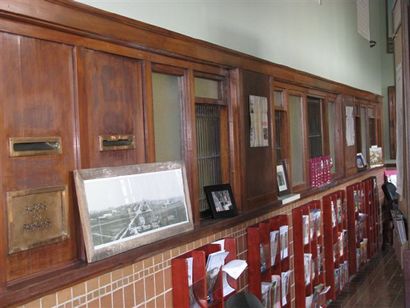 |
"Miss Bell
was at the stamp window."
Photo courtesy Mike
Price, August 2009 |
I noted the way
she was dressed and the fact that she only bought one stamp and wondered
if her teacher’s retirement was as good as I would have hoped.
I stepped up to the stamp window and bought a book of stamps and handed
them to Miss Bell. You would’ve thought I had bought her a new Cadillac.
She went through the lobby of the old post office showing everybody
her supply of stamps and saying, “Look, Harold bought me a whole book
of stamps! Wasn’t that nice?”
Then she stepped up to the stamp window and called back to an old
classmate of mine working in the post office and shouted: “Look here
Thurman, Harold bought me a whole book of stamps!”
Miss Bell and I continued our visit for a few more minutes in the
post office lobby. I offered to drive her home, but she told me she
had some shopping to do on the town square a block away. I told her
my car was parked there, so we proceeded together.
As we walked down the post office steps, she took my arm, and we continued
to talk. |
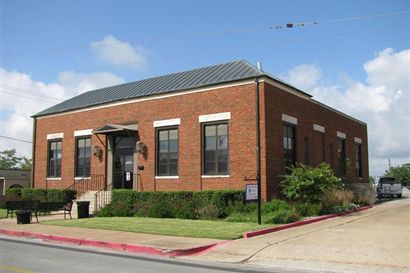 |
"As we walked
down the post office steps, she took my arm, and we continued to talk."
Photo courtesy Mike
Price, August 2009 |
About this time
I was felling a little pleased with myself for what I had accomplished
since I had left Miss Bell’s fourth grade. I quickly thought that
here was my chance to put myself in a good light with her and maybe
even make her a little proud of me.
As we walked the long block, I told her that I had gone to school
over in Denton
for two years and then went down to Austin
to the University for a year and a half. Then I told her after Pearl
Harbor, I went straight into the Armed Forces – just as dozens
of her former students had done.
Miss Bell didn’t interrupt, so I kept on talking because I was thinking,
“Here’s my chance to redeem myself in her eyes.”
I told her that while I was a student in Denton,
I had met a nice, talented girl, Lou Mitchell, and we were married
about a year before the end of the war.
Lou was a librarian at Hillcreat High School in Dallas
when we wed. My ambition was to go to New York City to continue my
education. This was great for Lou because she had dreamed that someday
she could work at the New York City Library.
I told Miss Bell that I had received my bachelor’s degree from Pace
University, and how I was going to night classes two evenings a week
at New York University and one evening at Columbia University – both
short distances on the subway from our apartment in Greenich Village.
By that time Lou had also realized her dream. Shortly after arriving
in New York, she became a librarian for the New York Public Library
where she often associated with famous literary people. Some people
she associated with were the ones who had written the textbooks she
had studied in college. She thought this was great.
Miss Bell kept listening, so I kept talking.
I told her how I now worked for the Coca-Cola Company and had an office
on Madison Avenue. Mr. James A. Farley*
was president of the company’s export division, and his office was
just one floor above mine. Although I didn’t report to him, we often
rode the same elevator.
When I told this to Miss Bell, she got a look of amazement on her
face because 99 percent of the people in town were Democrats, and
they all loved Mr. Farley. She could hardly believe that I saw him
almost every day. |
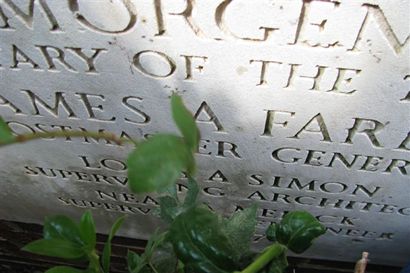 |
"... and
they all loved Mr. Farley."
Photo courtesy Mike
Price, August 2009 |
|
By this time,
we had reached my car, and Miss Bell gave me an affectionate pat
on the arm, as only a woman can do. She then said, “Harold, going
all the way back to the fourth grade, I knew you would be a fine
success because you always had so much gumption.”
© Harold Bell
Published
in TE September 1, 2009
* Mr. Farley was Postmaster General
the entire length of President Franklin D. Roosevelt’s terms in
office. Next to President Roosevelt, Mr. Farley was the most famous
person in the United States. He had the reputation of being able
to recall the name of everyone he had ever met, and that included
people from around the world.
|
More excerpts from
"I Was
a Teen in the 1930s and Some More Stuff" by Harold Bell
Miss Bell
Nobody in the world, dead or alive, knew how long Miss Bell taught
the fourth grade in and around Decatur, Texas...
The
Sheriff
"You never know when somebody says something, or does something,
that it may have a big effect on you the rest of your life."
The
Tight-Wire Walker
"She's very daring. They put her wire up to the very tiptop
of the tent thirty-five feet above the ground, and she does exciting
maneuvers without using a net."
My
Date with Mary
Mary was the cause of the most exciting week of my young life.
|
|
|
 HOME
HOME