| |
A
Texas-Norwegian-German Valentine"No
Person Shall Put Asunder" by Benard Burson
A synopsis by Coleman St.
James | 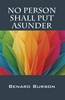
|
Benard
and Mary Burson of Round Rock
are in their 63rd year of marriage. While their wedding was performed by a pastor,
it’s our belief that their 1945 wedding vows were at least witnessed by a well-wishing
blacksmith for the strength of their commitment seems to have been forged by iron
bands. Their words of promise have certainly withstood the test of time - especially
the parts about sickness, health and “richer and poorer.”
This tiny self-published
volume of 90 pages has the makings of an epic saga, but (as it will be explained
in the book), Mr. Burson has the economic mind of an inventor and problem-solver.
He may deal only in facts - but wonderful facts they are.
Besides Ben
and Mary’s Burson’s personal tale, which, in the right hands could be written
into an inspirational screenplay, this modest book contains other stories of courtship
and devotion. Perhaps quaint, by today’s standards, the purity of these tales
has the ring of classical romance. |
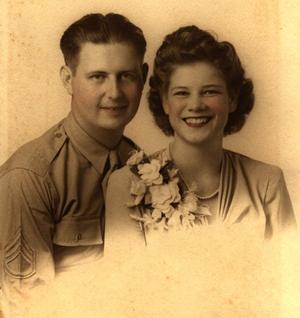
| | Benard
and Mary Burson, 1945 | |
|
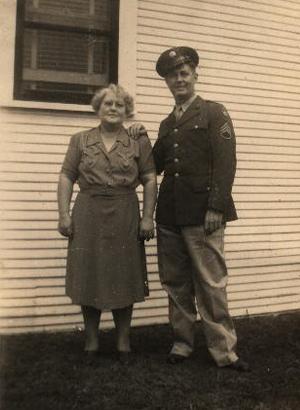
| | SSgt.
Burson with Mother Burson, 1943 | |
|
Mr.
Bursons’ grandparents immigrated from Norway and settled in Bosque County in the
1860s. The book touches briefly on some of their stories and then proceeds to
the second generation and of Benard’s father (Benny Burson) and his induction
into the army during WWI and adventures
as a railroad brakeman.
Before he could be sent to training, Pvt. Burson contracted Spanish Influenza
in 1918 at a camp in St. Louis and was left for dead. He wasn’t expected to last
the night and the nursing staff had been ordered not to feed him. A chance meeting
with a Lutheran Chaplain and a meal of communion wafers spared Benny’s life –
the first of many miracles, both large and small that the family would receive
over the years.
Perhaps the most fascinating part of the book is Benny’s
railroad career and courtship. In the 1890s the railroad laid tracks across countless
Texas farms. One particular farm was near the Washington/ Austin County line,
close to the town of Kenny,
Texas.
From the porch of one particular farm, a widow (with four
girls and two boys), watched the semaphore signals that would raise or lower with
the approach and passing of trains. She believed that “God and his angels” controlled
the railroad signals and considering that it was a train that would bring her
a son-in-law, she wasn’t too far off.
Benny Burson was a brakeman on
the railroad and when the train passed this farm, he couldn’t help but notice
the four girls that waved to the train (making absolutely sure they were noticed
by the crew). Before long, presents were thrown from the caboose and kisses were
blown back. A block of ice thrown when the train was heading north, had the girls
saluting the train with glasses of lemonade when it returned southbound.
Before long, Benny was borrowing the railroad handcar to visit the girls, pumping
the machine eight miles – one way. Benny would come to dinner and soon sister
Minnie became the focus of Benny’s attention. Dinner evolved into a private picnic
(with chaperoning sisters in the bushes) and a first kiss was followed seconds
later by a proposal of marriage (complete with ring).
Benard
was born in 1922. In consideration of time and space, we’ll fast-forward to 1945
when Staff Sergeant Benard Burson was stationed at Avinger
Field at Sweetwater,
Texas. SSgt. Burson was in charge of tower communication for the field, which
became headquarters for the WAASP.
Off duty, he’d visit a town eatery
known as the City Café where he became enamored of a laconic waitress who was
“the most beautiful angel to my eyes I had ever seen.” Benard kept ordering chicken-fried
steaks until the other waitresses took pity on him, and gave him Mary’s name and
some helpful hints on winning her heart. (Details of their courtship and wedding
are included in the book.)
The Burson’s built their house near Austin
“from scratch” using kite string to mark the foundations and free coat hangers
for reinforcement wire. A barn was salvaged for the boards and only the fireplace
was contracted out.
Benard’s mechanical mind was forever in gear and
a series of problems brought before him resulted in eight separate inventions.
Several of them years before their time. Trusting that the people who had sought
his knowledge would compensate him, Benard was sorely disappointed. He seldom
got so much as a thank-you, although some of his “solutions” went on to make a
lot of money for someone else.
While his life has been blessed with love
and family, sadly, finance and health were not included in the blessings. Mary
has suffered a disease for decades and Benard, in his seventies, attempted to
fix appliances to supplement their diminutive SS benefits. There isn’t much of
a demand for appliance repairs in a throwaway society and between jobs, Benard
began writing a family history. His attempts were recognized to have worth beyond
the immediate family (we concur) and Benard took the step of self-publishing his
book.
Although, the book's main flaw is editing, it’s still a delightful
collection of inspirational stories that would be right at home in the Texana
section of small town libraries and especially the towns along the old Santa Fe
Railroad line.
Mr. Burson’s book can be ordered from:
http://outskirtspress.com/webpage.php?isbn=9781432709518
More
Texas Books | Love
and Marriages |
More
stories:
Texas | Online
Magazine | Features | Columns
| "They
shoe horses, don't they?" | |
|