|
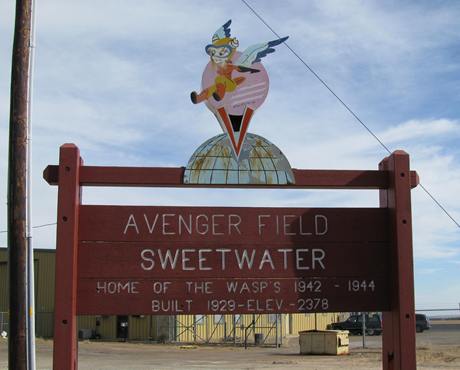
While
many of Texas’ current municipal airports were postwar gifts to the
host communities, the case was reversed in Sweetwater
where the existing municipal airport became a training facility in
May of 1942.
The transfer was a tremendous help to the war effort since it only
required expansion and improvement of the field, which had been in
use since the late 1920s. The name was chosen from a contest sponsored
by the local newspaper.
Expanded to a total of 920 acres by the city of Sweetwater,
the War Department leased it for a token payment of $1.00 per year. |
 |
Training the
necessary pilots and personnel for a two-theater war was a daunting
task and during the first months of the war, instructors were often
civilian contractors. This was the case with the first class to graduate
from the facility – a single class of British RAF cadets. After that,
ten classes of American aviation cadets graduated and then three classes
of enlisted student pilots (most pilots were commissioned officers).
The
lasting legacy of the field was formed from February 21, 1943 until
December 20th, 1944 when the base became the training facility for
the Women's Airforce Service Pilots (WASPs).
Licensed female civilian pilots were recruited and trained to fly
military aircraft, ferrying them from factory to shipping point and
on occasion flying damaged planes back for repair. This enabled more
male pilots to be sent into combat. |
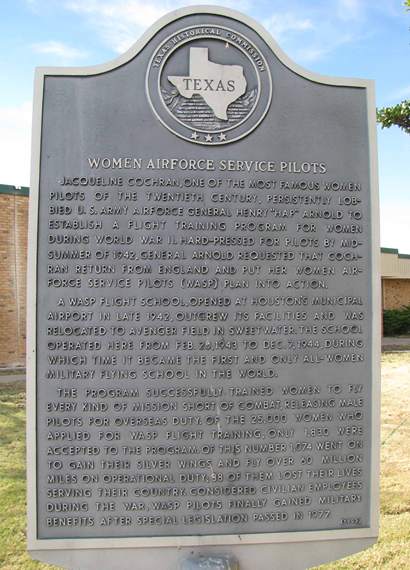
Women Airforce
Service Pilots Historical Marker
Photos
courtesy Mike
Price, December 2007 |
Women Airforce
Service Pilots Historical Marker Text:
Women Airforce
Service Pilots
Jacqueline Cochran,
one to the most famous women pilots of the Twentieth Century, persistently
lobbied U.S. Army Airforce General Henry "Hap" Arnold to establish
a flight training program for women during World
War II. Hard-pressed for pilots by mid-summer of 1942, General
Arnold requested that Cochran return from England and put her women
airforce pilots (WASP) plan into action.
A WASP flight school, opened at Houston's
Municipal
Airport in late 1942, outgrew its facilities and was relocated
to Avenger Field in Sweetwater.
The school operated here from February 20, 1943 to December 7, 1944,
during which time it became the first and only all-women military
flying school in the world.*(See Forum)
The program successfully trained women to fly every kind of overseas
duty. Of the 25,000 women who applied for WASP flight training, only
1,830 were accepted to the program. Of this number 1,074 went on to
gain their silver wings and fly over 60 million miles on operational
duty; 38 of them lost their lives serving their country. Considered
civilian employees during the war, WASP pilots finally gained military
benefits after special legislation passed in 1977.
(1993)
*Forum:
Subject: corrections
I would like to call your attention to the information on the WASP
at Avenger Field. The WASP and the training school at Sweetwater
were NOT the first women to be trained as women military pilots. The
Russians opened a training school for 400 women combat pilots in October
15, 1941. It was located on the banks of the Vogel River at Engels
just north of Stalingrad. Some 1200 women trailed there and fought
in three Regiments of Fighter and bomber pilots during WWII.
All of these women fougt in actual combat. - Mardell Haskins, Author
with Southwest Aviation Report, January 15, 2015 |
Jacqueline
Cochran
The unit was led
by aviatrix Jacqueline Cochran, a natural-born pilot who held more
speed, distance and altitude records than any other aviator, male
or female.
A friend of the soon-to-be-missing Amelia Earhart, Cochran was part
of "Wings for Britain" prior to the U.S. entry into WWII.
Delivering American aircraft to Britain, she became the first woman
to fly a bomber across the Atlantic.
She first worked for the British, her job recruiting qualified U.S.
women pilots to fly for the British Air Transport Auxiliary. After
the U.S. became a combatant, it was Cochran who proposed a unit of
female transport pilots in the U.S.
Howard Hughes Field
Houston’s Howard Hughes
Field (see the 1940
Houston Air Terminal Museum) had been a WASP training facility,
but heavy fogs and civilian air traffic necessitated the move to Sweetwater.
Avenger Field trained both men and women for a brief period, but beginning
in April of 1943 it was designated the only all-female air base in
history (excepting male instructors, maintenance and communication
crews).
Avenger
graduated 1,074 pilots during its tenure and the pilots learned to
fly everything from trainers to the new B-29 Superfortress. In 1945
the field became a training base for P-47 Thunderbolt pilots, the
pursuit planes that escorted B-17s over their bombing runs over Germany.
In November 1945 ownership reverted to the City of Sweetwater.
It was reopened briefly as an auxiliary field for Big
Spring's Webb Air Force Base during the Korean War. |
Avenger Field
WW II WASP Memorials
|
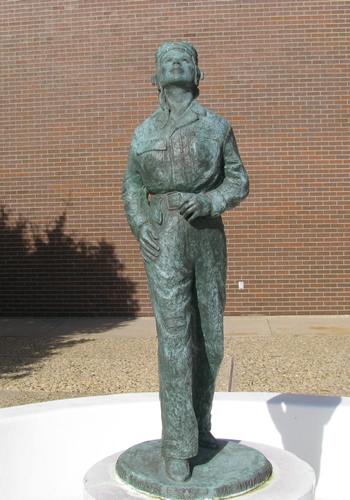
| "The memorials
are located at the airport in a stand alone hanger at the south end
of the airport, with the large monument at the TSTC grounds toward
the north west part of the field." - Mike
Price, photographer, December 08, 2007 |
Names of WASPs
on display
Photos
courtesy Mike
Price, December 2007 |
Close-up of statue
in preceeding photo.
Photos
courtesy Mike
Price, December 2007 |
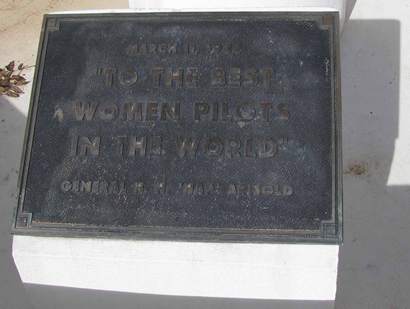
Inscription:
"To the best women pilots in the world."
- General "Hap" Arnold
Photos
courtesy Mike
Price, December 2007 |
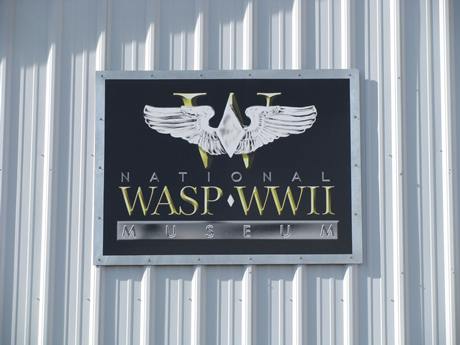
Museum Sign showing
the wings wore by WASPs
Photos
courtesy Mike
Price, December 2007 |
Photographers'
Notes:
Subject: Sweetwater WW II WASP Memorials
The Women Airforce
Service Pilots (WASP) were a little known group of female pilots who
performed many duties short of combat during WW
II. Their story makes pretty good reading for those interested
in WW II. All
were trained at Avenger Field in Sweetwater.
While the army was forming the 509'th group (to deliver the atomic
bombs) the men pilots did not want to fly the large and complicated
B-29 which had a reputation for problems. The commanding officer brought
in two WASP pilots and in a couple of days trained them to fly that
plane and they proceed to shame the men into flying.
The only flying B-29, owned by the CAF in Midland,
carries the nose art name of FIFI. - Mike
Price, December 08, 2007 |
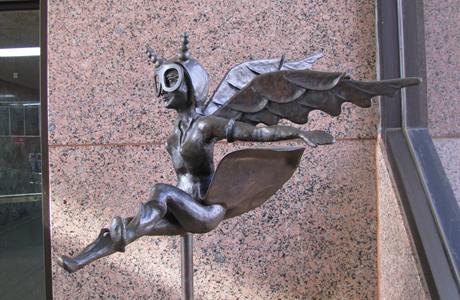
3-D Statue of
"Fifi" (Finfinella) is in the Nolan
County Courthouse lobby. The mascot design was supplied by the
Walt Disney Co.
Photos
courtesy Mike
Price, December 2007 |
|
|
 HOME
HOME