|
|
| Photo
courtesy Ken Rudine, July 2007 |
History
in a Pecan Shell
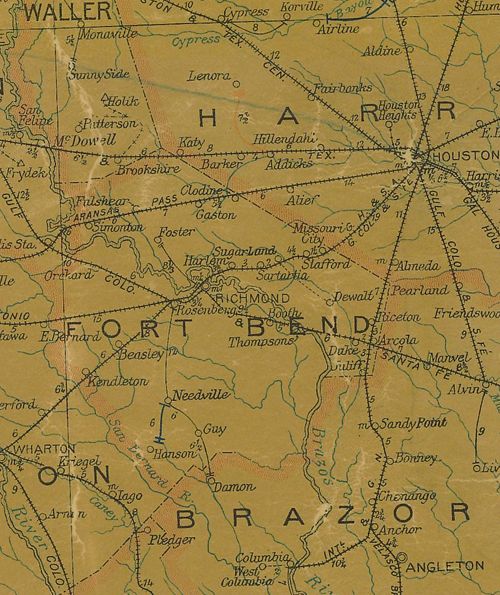
Prior to the Civil War the area had been part of the Arcola Plantation
(see Arcola, Texas)
and was a shipping point for area cotton.
It throve until the arrival of the Houston Tap and Brazoria Railroad
in 1858. The town was named for early settler John J. Juliff ("Triple
J" to his friends).
The town was granted a post office in 1891. It closed in 1908, reopened
in 1914, and then closed permanently in 1958.
During the Great Depression several saloons and a dance hall were
opened alongside the railroad tracks. The landlord was one Thurman
"Doc" Duke.With these unsavory businesses serving as the community's
nucleus, things went from bad to worse. Juliff did have a church,
but the congregation was outnumbered by drunks, gamblers and prostitutes
- with some residents performing combinations of these roles. Needless
to say, they weren't often called for jury duty.
According to the Handbook of Texas, around 1934 a local musician
was sober enough (or drunk enough) to write a song (supposedly) about
Juliff. The lyrics "Diddy Wa Diddy - "ain't no town - ain't no city"
don't mention Juliff by name and folklorists say that Diddy Wa Diddy
is a reference to a mythical place (like the Big Rock Candy Mountain
was to Hobos) where there's abundant food and no work. Other sources
attribute the song to Arthur "Blind" Blake, a guitarist from Jacksonville
(Florida, not Texas) who recorded at least two versions of the song
before disappearing around 1931. Since Blind Blake's recordings are
still around, we have to assume that the unnamed musician in Juliff
was just one in a long string of people who used the lyric.
In one version of the song, the singer declares "I just found out
what Diddy Wa Diddy means" while in another the singer pleads: "Won't
somebody tell me what Diddy Wa Diddy means?" The words were also used
as a title (Diddy Waw Diddy) by Texas Author/ Journalist Billy Porterfield
(who was no stranger to places like old Juliff).
Despite the tenuous link to that well-known song, the town was down
to 40 residents by 1940. It reached its high-water mark in the late
40s with about 150 people. By the early 60s, the saloons had all moved
to Richmond's
notorious Mud Alley or the Wards of Houston.
Today only bloodweed and a few scattered houses occupy the area.
Perhaps the old saying about the mythical town is true: "Everybody
would live in Diddy Wa Diddy - if only it wasn't so hard to find."
And if only Juliff could've collected royalties...it might still
be there as a tourist attraction.
by Luke Warm |
 |
Juliff, Texas
Forum
Subject: I grew
up in Juliff Texas
I grew up in Juliff in the 70's. My dad told me pretty much everything
you wrote in your article and he never had google!
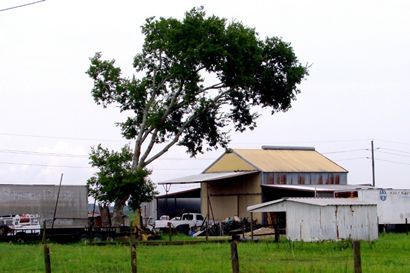
I still live in Juliff. One of the oldest landmarks I can think of
is the Brazos River pumping plant. That was a really neat place to
visit with lots of history as well.
I enjoyed your article about Juliff. By the way, it was very lonely
and extremely boring as a child growing up there.:>) - Dana Walt,
November 25, 2019 |
Author's Note:
Anyone who would like to share stories, memories or information about
Juliff, Texas, the current whereabouts of Billy Porterfield, the meaning
of Diddy Wa Diddy, or the disapearance of Blind Blake, please write
to history@texasescapes.com.
Tell them Luke sent you. |
| Diddy
Waw Diddy: Passage of an American Son |
|
| Texas
Escapes, in its purpose to preserve historic, endangered and vanishing
Texas, asks that anyone wishing to share their local history, stories,
landmarks and vintage/historic photos, please contact
us. |
|
|
 HOME
HOME

 Texas
Gulf Coast
Texas
Gulf Coast East
Texas
East
Texas Central
Texas North
Central
Texas North Central
Texas South
Central
Texas South Texas
Panhandle
Texas
Panhandle South
Texas
South
Texas Texas
Hill Country
Texas
Hill Country West
Texas
West
Texas Texas
Ghost Towns
Texas
Ghost Towns Texas
Counties
Texas
Counties