|
|
History
in a Pecan Shell
Part of the original Stephen F. Austin land grant, Brazoria was platted
in 1828 by John Austin. It was deserted in what is called the Runaway
Scrape as the Mexican army advanced from their victory at the
Alamo.
A school opened as early as 1838 but it wasn't granted a post office
for eight more years. The town had a respectable population of 800
by the mid 1880s. Sugar mills and cotton gins provided employment
and income while the town gained three hotels and no less than twelve
general stores.
The town became the county seat and by 1890 the population reached
900. The first newspaper was published in 1892 and a second sometime
before 1914. Brazoria was bypassed by the railroad and lost its status
as county seat to Angleton. Nevertheless,
the population grew from 633 in 1904 to 1,050 by 1929. Its population
reached 1,291 by the early 1960s which has more than doubled to 2,787
in 2000.. |
Brazoria,
Texas Landmarks/Attractions:
|
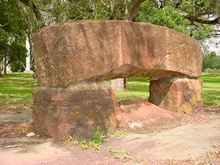
All that remains
of the 1894
courthouse in Brazoria
Photo courtesy Julie McConnell, 2002 |
|
|
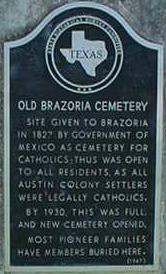
Historical
Marker -
Corner of Star and Camp St
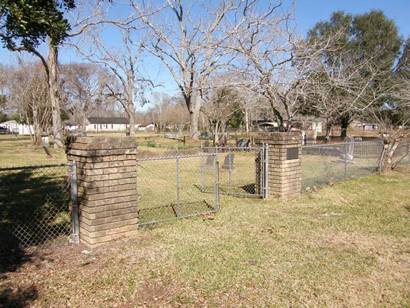
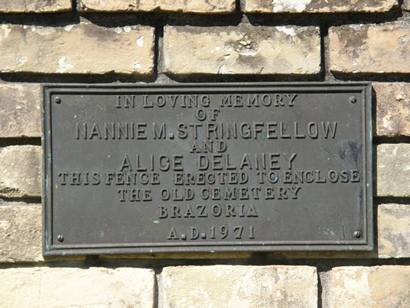
Old Brazoria Cemetery
Site given to Brazoria in 1827 by government of Mexico as cemetery
for Catholics; thus was open to all residents, as all Austin Colony
settlers were legally Catholics. By 1930, this was full, and new cemetery
opened. Most pioneer families have members buried here.
Photo courtesy Julie McConnell |
|
|
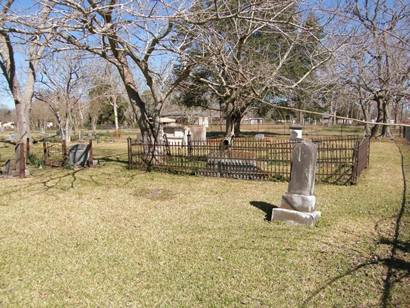
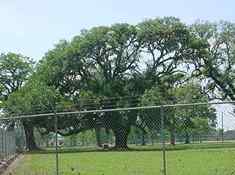
"This
Oak stands in the Old Brazoria Cemetery - on the south side of Pleasant
Street in Brazoria. This area had been designated as a cemetery in
1833. It was on property that had belonged to (General) John Austin
who had died of cholera in 1833." - Photo
Courtesy Julie McConnell |
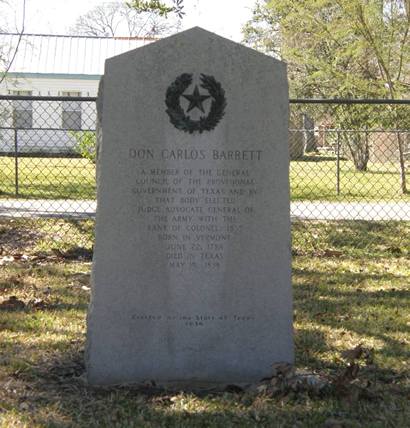
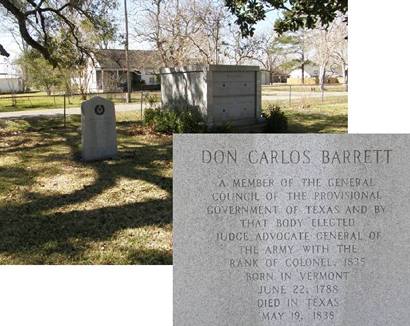
Don Carlos Barrett
Centennial Marker in The Old Brazoria Cemetery
Photo courtesy Barclay
Gibson, February 2009 |
Centennial
Marker - Corner of China and Travis
Don Carlos
Barrett
A member of the
General Council of the Provisional Government of Texas and by that
body elected judge advocate general of the army with the rank of colonel,
1835. Born in Vermont June 22, 1788; died in Texas May 19, 1838.
|
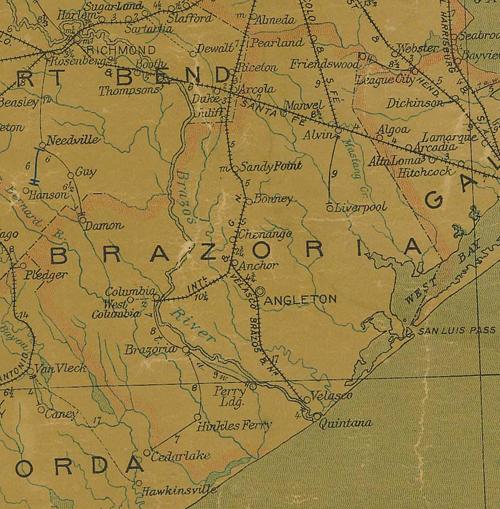
1907 Brazoria
County postal map showing Brazoria
From Texas state map #2090
Courtesy
Texas General Land Office |
| Texas
Escapes, in its purpose to preserve historic, endangered and vanishing
Texas, asks that anyone wishing to share their local history, stories,
landmarks and recent/vintage/historic photos, please contact
us. |
|
|
 HOME
HOME

 Texas
Gulf Coast
Texas
Gulf Coast East
Texas
East
Texas Central
Texas North
Central
Texas North Central
Texas South
Central
Texas South Texas
Panhandle
Texas
Panhandle South
Texas
South
Texas Texas
Hill Country
Texas
Hill Country West
Texas
West
Texas Texas
Ghost Towns
Texas
Ghost Towns Texas
Counties
Texas
Counties