|
|
 |
Photographer's
Note:
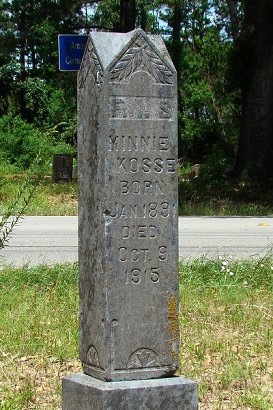
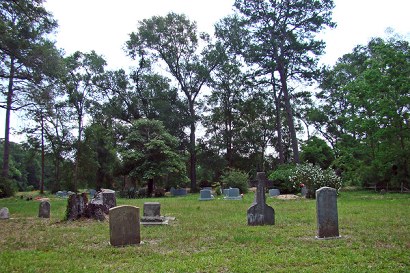
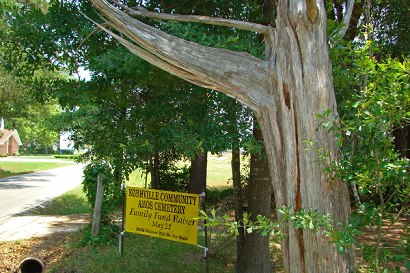
South of Spring-Cypress Road on Huffsmith-Kohrville Road FM2978 are
two cemeteries, Amos and Kohrville. The nearby railroad
passes through Louetta. FM249 is about equal distance from the cemeteries
on the opposite side from the railroad.
- Ken
Rudine, May 2010
History in
a Pecan Shell
A small African-American
community near the above mentioned intersection was founded by Freedmen
from Alabama in the 1870s. The community's economy was timber-related
and the name came from German immigrant Paul Kohrmann, postmaster
in 1881.
In the early 1900s another Kohrmann (Agnes Tautenhahn Kohrmann) was
operating the community store. About this time the town had a population
of fifty. In 1906 a thirty-one pupil, one-teacher school was open.
The post office closed in 1911 and mail was rerouted through Hufsmith.
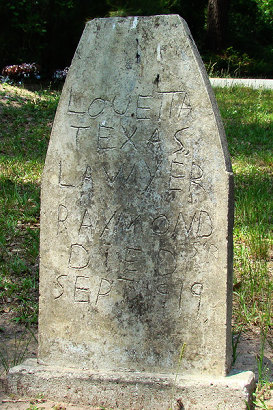
Kohrville managed to keep one business in operation in 1940 and the
former school became a community center. That same year the town had
thirty residents, two churches and two cemeteries. |
 |
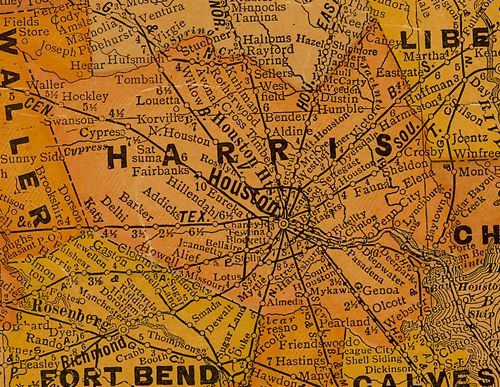
Harris
County 1920s map showing Kohrville as Korville
(Above "A' in 'HARRIS')
Photo courtesy Texas General Land Office |
The "Lost"
Towns of NW Harris County:
Kohrville | Louetta
| North Houston | Satsuma
If these are ghost towns, why are there so many people here?
Although they now only exist as sign names at large intersections
(Barker-Cypress, Bammel-North Houston, Aldine-Bender, Alief-Clodine,
et. al.). It may surprise non-natives that all of these names once
represented once struggling or proudly self-sufficient towns. Even
the inside-the-loop street of Crosstimbers was once a separate town.
While most people associate ghost
towns with ruins and desolation - these ghosts live among us.
Were aisles seven and eight at your local HEB once a syrup mill? Was
Radio Shack once a livery stable? Best Buy a cornfield or cotton gin?
Are there unmarked graves under the floor of your favorite Mexican
restaurant?
The short answer is this: In many cases these villages were already
ghost towns - or so close to being ghost towns that you could hardly
tell the difference. Most had their life-blood drained from them after
WWII with the
migration of rural families to Houston.
The phenomenon was statewide. Dallas
and Ft. Worth have
their fair share of postwar "absorbed" ghost towns - as do smaller
cities.
Then "Edge City" happened. The relentless march of strip centers,
subdivisions and gated communities overtook these former towns until
only the names and cemeteries remained.
While the subject is worthy of further investigation (exactly where
is the Lily White cemetery behind Memorial City Shopping Center?),
we're happy to include this topic, made possible by generous grant
of time, sweat and reseach by the Team
Rudine.
- Editor
"15
Minutes of Separation" May
12, 2010 column |
| Texas
Escapes, in its purpose to preserve historic, endangered and vanishing
Texas, asks that anyone wishing to share their local history, stories,
landmarks and recent or vintage photos, please contact
us. |
|
|
 HOME
HOME

 Texas
Gulf Coast
Texas
Gulf Coast East
Texas
East
Texas Central
Texas North
Central
Texas North Central
Texas South
Central
Texas South Texas
Panhandle
Texas
Panhandle South
Texas
South
Texas Texas
Hill Country
Texas
Hill Country West
Texas
West
Texas Texas
Ghost Towns
Texas
Ghost Towns Texas
Counties
Texas
Counties