|
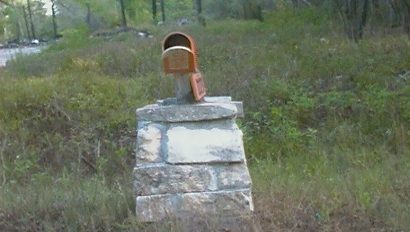
"Out of place mail box "
Photo
courtesy Paul Latour, 2011 |
History in
a Pecan Shell
By
Paul Latour
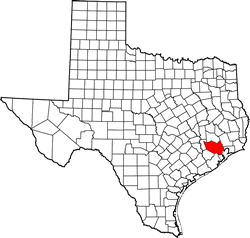
Moonshine Hill began as a result of an oil boom and was located 2
miles east of Humble in northeastern
Harris County off
of FM 1960. Gas seepage were first noticed in 1887 by James Slaughter,
who, in cooperation with S.A. Hart, unsuccessfully drilled for the
commodity. The Moonshine Hill Road is supposedly the oldest paved
road in Texas.
In 1903 the Houstonian Charles F. Barrett took a lease at Moonshine
Hill which is now part of Farm Road 1960. In 1904 oil was discovered,
and led to the town's growth, and equally, after a total of 3 oil
booms and no more prospects, led to its demise.
Interestingly however, at one point, Moonshine Hill's population was
bigger than neighboring Humble, culminating
at approximately 10,000 people. In its heyday at the beginning of
the twentieth century, Moonshine Hill had 6 to 8 saloons, 3 grocery
stores, a dance hall, a meat market, a drugstore, a school, and a
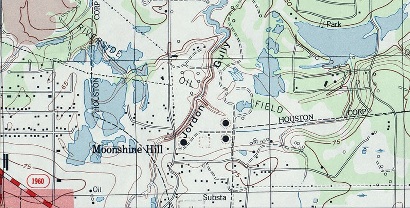
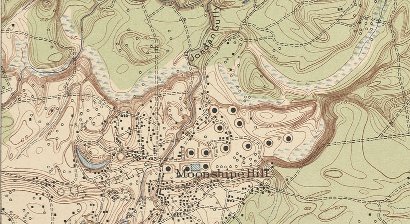
union church. The drop in population is easily apparent in comparing
the 1916 topographic map of the town to the 1995 map. |
 |
| Moonshine
Hill - 1916 Topography Map |
| Moonshine
Hill - 1955 Topography Map |
"During
World War I elements
of the 19th Inf from Fort Sam Houston were stationed at Moonshine
Hill. A reminder of WWI
exists today in the name of Belleau Woods Drive." This is a reference
to the Battle of Belleau Wood in 1918 during World
War I, in which a wooded area on the Metz-Paris road, known as
the "Bois de Belleau" i.e. Belleau Woods was recaptured by American
forces from the Germans.
Sources:
http://www.firstworldwar.com/battles/belleau.htm
http://www.texasescapes.com/TexasGulfCoastTowns/Humble-Texas.htm
References: http://www.tshaonline.org/handbook/online/articles/hrmnl
See Moonshine
Hill Historical Marker
|
The Flood of
October 1994
More
damage was done to the town of Moonshine Hill and other areas surrounding
the San Jacinto River in the Flood of October 1994. According to the
Houston Chronicle, the larger Houston
area suffered over 15,000 damaged homes, over 3,000 destroyed homes
and 22 deaths. This is no surprise, as 29 inches of rain fell over
the course of 3 days in Harris
County. Many homes along the river were simply washed away, while
others were later scrapped due to the amount of water and mold damage.
Sources:
http://pubs.usgs.gov/fs/fs-073-94/pdf/FS-94-073.pdf
http://www.wxresearch.com/almanac/houflood.html
Moonshine
Hill Today › |
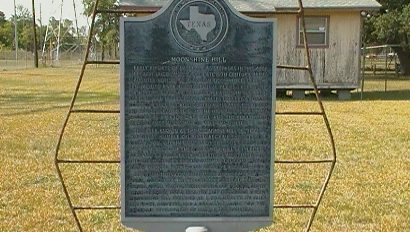
Moonshine
Hill Historical Marker
Location 2735 FM 1960 E
Photo courtesy Paul Latour, 2011
|
MOONSHINE HILL
Early reports of
natural gas seepages in this area were not uncommon in the late 19th
century. James Slaughter noticed such natural occurences near the
San Jacinto River in 1887. Several years later, with S. A. Hart, he
set up a drilling operation in the area, but it proved unsuccessful.
Charles Barrett, a former Houston
merchant, also drilled wells here, but found the results limited.
In 1904, the Higgins Oil Company brought in a major gas well and the
following year, the first successful oil well was drilled.
This area, known as the Moonshine Hill section of the great Humble
oil field, became the site of a boom town. Within months of the 1905
discovery, the population of the Moonshine Hill settlement increased
to 10,000. Early operations associated with the site included the
Moonshine Oil Company of Walter Sharp, Ed Prather, and Howard R. Hughes.
Although tents comprised most of the early structures, Moonshine Hill
eventually included a church, school, postal station, stores, hotels,
and saloons.
Despite three separate boom eras, the last occurring in 1929, Moonshine
Hill declined as a community. Its brief existence, however, had a
dramatic impact on the economic development of Humble
and Houston.
Texas Sesquicentennial 1836 - 1986 |
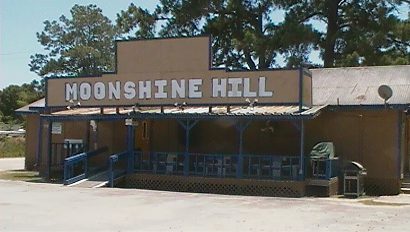 |
Saloon
Photo courtesy Paul Latour, 2011 |
Moonshine Hill
Today
Moonshine Hill
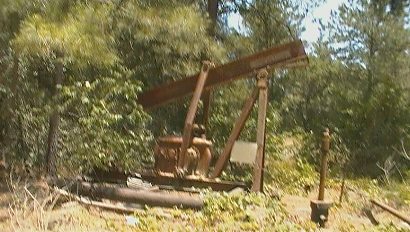
today is but a reminder of what was once there. A few homes are strewn
about the streets that are still accessible, however many of the homes
that are lived in are littered with "No Trespassing" signs and/or
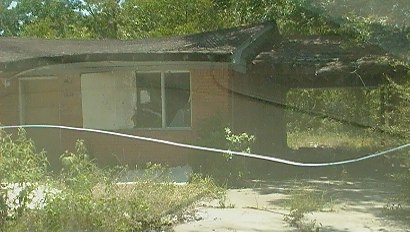
security video cameras. A few of the homes appear to have burned down.
Though unproven, it is possible that some of the homes are even tenanted
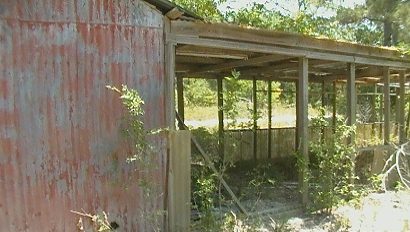
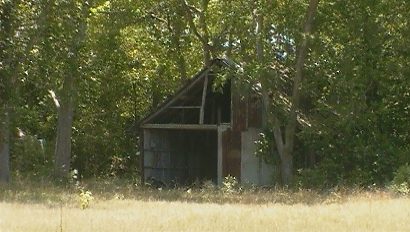
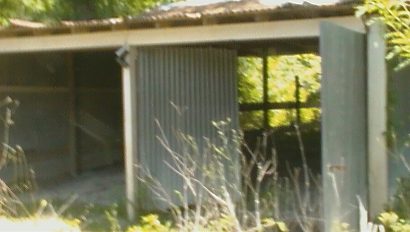
by squatters. There are many signs that this area is old: old shacks
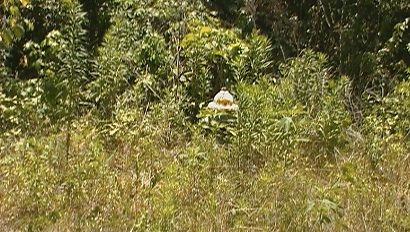
barely standing, antiquated or out of place fire hydrants, old looking
or out of place mail boxes, gravel and dirt roads, and a bit of a
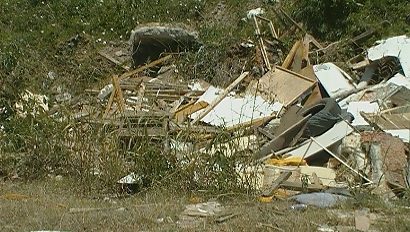
feeling of lawlessness. Trash is dumped in places that truly ruin
the beauty and mystery of the old town. Also, there are metal scrappers
roaming the area like a vulture circling a carcass overhead, and people
fishing in areas that were once scenic and serene, but now are filled
with trash.
© Paul Latour
July 9, 2011 |
Old
Oil Well
Photo courtesy Paul Latour, 2011 |
"Out
of place fire hydrant"
Photo courtesy Paul Latour, 2011 |
Abandoned
Building
Photo courtesy Paul Latour, 2011 |
Falling
Apart Structure
Photo courtesy Paul Latour, 2011 |
Old
Barn
Photo courtesy Paul Latour, 2011 |
Burned
Building
Photo courtesy Paul Latour, 2011 |
| Photo
courtesy Paul Latour, 2011 |
| Texas
Escapes, in its purpose to preserve historic, endangered and vanishing
Texas, asks that anyone wishing to share their local history, stories,
landmarks and recent or vintage photos, please contact
us. |
|
|
 HOME
HOME