|
|
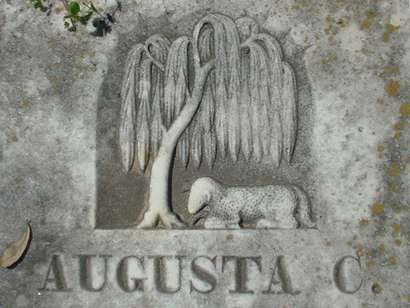
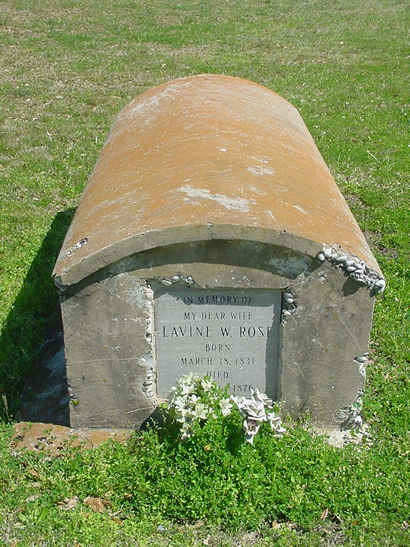
Tombstone Detail
TE Photo March 2007
|
Getting There
To get to Sabine Pass - Direction
At the main intersection, a small park is to your left (look for the
old lighthouse lantern and watchroom) and the cemetery is about a
quarter of a mile to the right - on the south side of the road.
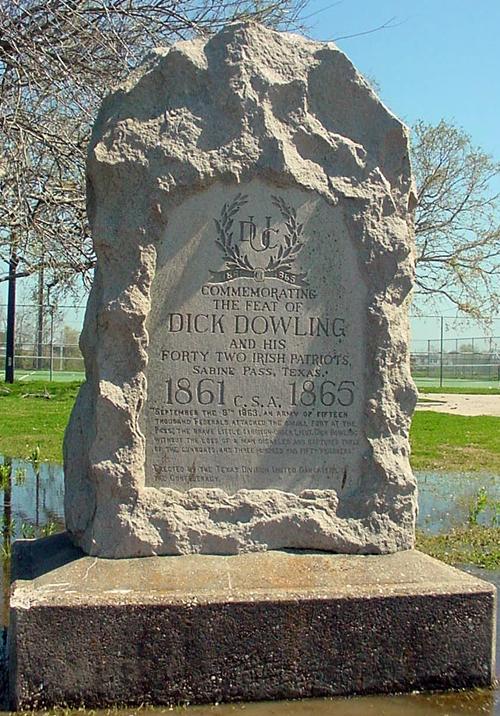
On the way to the cemetery (also on the south side of the road) you
will see the granite marker erected by the Texas Division of the United
Daughters of the Confederacy to commemorate Dick
Dowling's lopsided defeat of the invading Union gunships in 1863. |
Dick
Dowling marker near Sabine Pass Cemetery
TE photo, March 2007 |
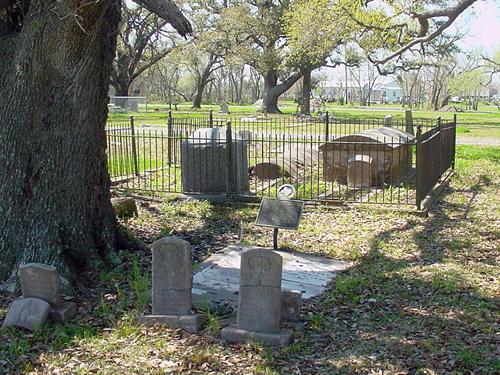
Sabine Pass Cemetery
(Small historical marker denotes the Kate
Dorman gravesite)
TE photo, March 2007 |
Historical Marker
Sabine Pass
Cemetery
The oldest continually
used cemetery in Jefferson
County, This graveyard has served the citizens of the Sabine
Pass area since the 1840s. The earliest documented grave is that
of a 12-year-old John A. Dashiell, son of William V.C. and Mary Dashiell,
who died on August 27, 1847. The large site now known as Sabine Pass
Cemetery represents a combination of five formerly distinct burial
grounds. Included in what was once called "The Colored Peoples Cemetery"
is the unmarked grave of 108-year-old Louis Williams. Born a slave
in Mississippi in 1813, Williams died on June 23, 1921.
Among the burials in this historic graveyard are those of many distinguished
military veterans. Able Coffin (1792-1862) and Burwell Jackson (1783-1864)
fought in the War of 1812. Jacob Harmon Garner (1814-1887), Benjamin
Johnson (1815-1872) and Niles F. Smith (1800-1858) were Texas Revolution
veterans. Soldiers and sailors from both the Union and Confederate
forces of the Civil War also are interred here. The two Union sailors
Patrick Ferlin and Albert W. Marshall, died of wounds sustained during
the offshore naval encounter on January 21, 1863, while serving on
the ship Morning Light. A number of Confederate veterans rest in the
cemetery, as does Kate
Dorman, dubbed "the heroine of Sabine Pass" for her assistance
of the southern troops. A number of graves have been specially marked
with military or state historical markers.
Maintained by Jefferson
County and cared for by local volunteer organizations, the Sabine
Pass Cemetery remains in use by citizens of the area. Its historic
gravestones and monuments provide a unique component of the cultural
history of Jefferson
County.
(1999) |
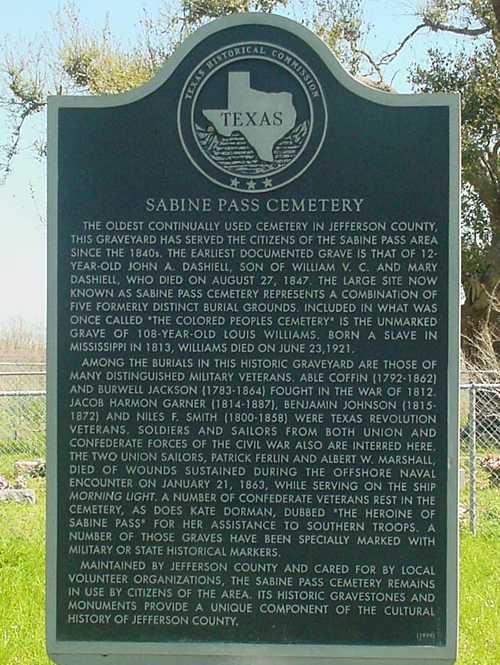 |
Sabine Pass Cemetery
Historical Marker
TE photo, March 2007 |
According to
the historical marker, the cemetery contains the remains of both Confederate
and (at least two) Union soldiers as well as veterans of the War of
1812, the War for Texas Independence and the reason for our visit,
the final resting place of Kate
Dorman, the "heroine of Sabine Pass."
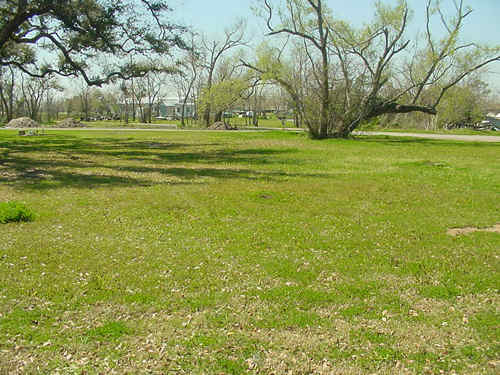
The cemetery, which is still in use, has a deep and wide vacant
spot in the middle. Although there are no tombstones, Mr. Block informed
us that an estimated 100-150 people are buried in several mass graves
here - hastily dug during a Yellow Fever epidemic.
Among the Yellow Fever victims and fallen soldiers, there also the
remains of a young man who died in 1901 as a result of of shooting
into a pit of unexploded ordnance left in an abandoned gun emplacement.
His remains were covered and a cenotaph placed in Port
Arthur's Evergreen Cemetery. |
Several mass
graves of Yellow Fever victims appear as an open field.
TE photo, March 2007 |
|
While
the cemetery isn't fenced in black iron or rich with funereal statuary,
it's a memorable cemetery to visit for its typical coastal flora
and fauna - and for its somber timelessness. Ken
Rudine, who is an avid birder, identified a large flock of white
and black Egyptian Ibis that were wading in large puddles looking
for food.
|
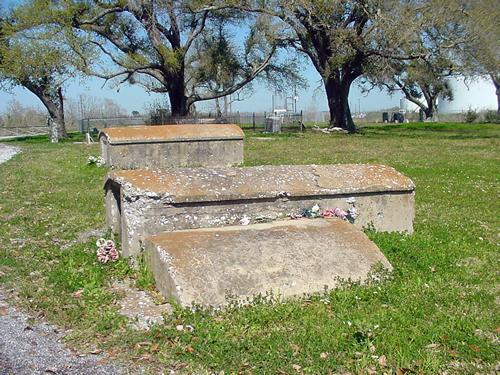
Crypts
TE photos, March 2007 |
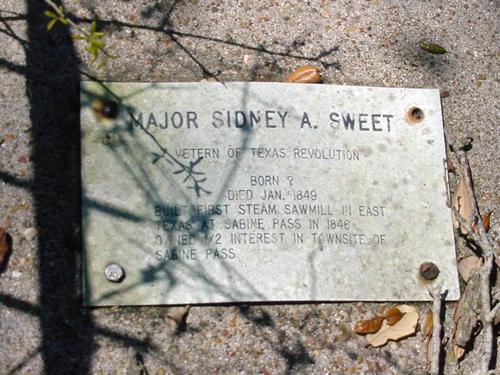
One of the many
aluminun markers made and installed by W.
T. Block for graves that were in danger of becoming unknown.
TE Photo, March 2007 |
|
To get to the
battleground
park, return to the intersection and go right on 3322. This
road follows the Sabine Pass estuary which connects Sabine Lake
with the Gulf of Mexico.... more
|
|
|
 HOME
HOME