|
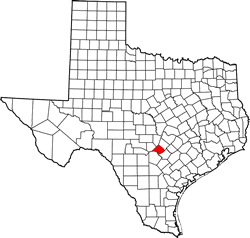
HUNTER TEXAS
in the 20s and 30s
A Memoir by
Pablo L. Sanchez
Photos courtesy Paul O. Sanchez |
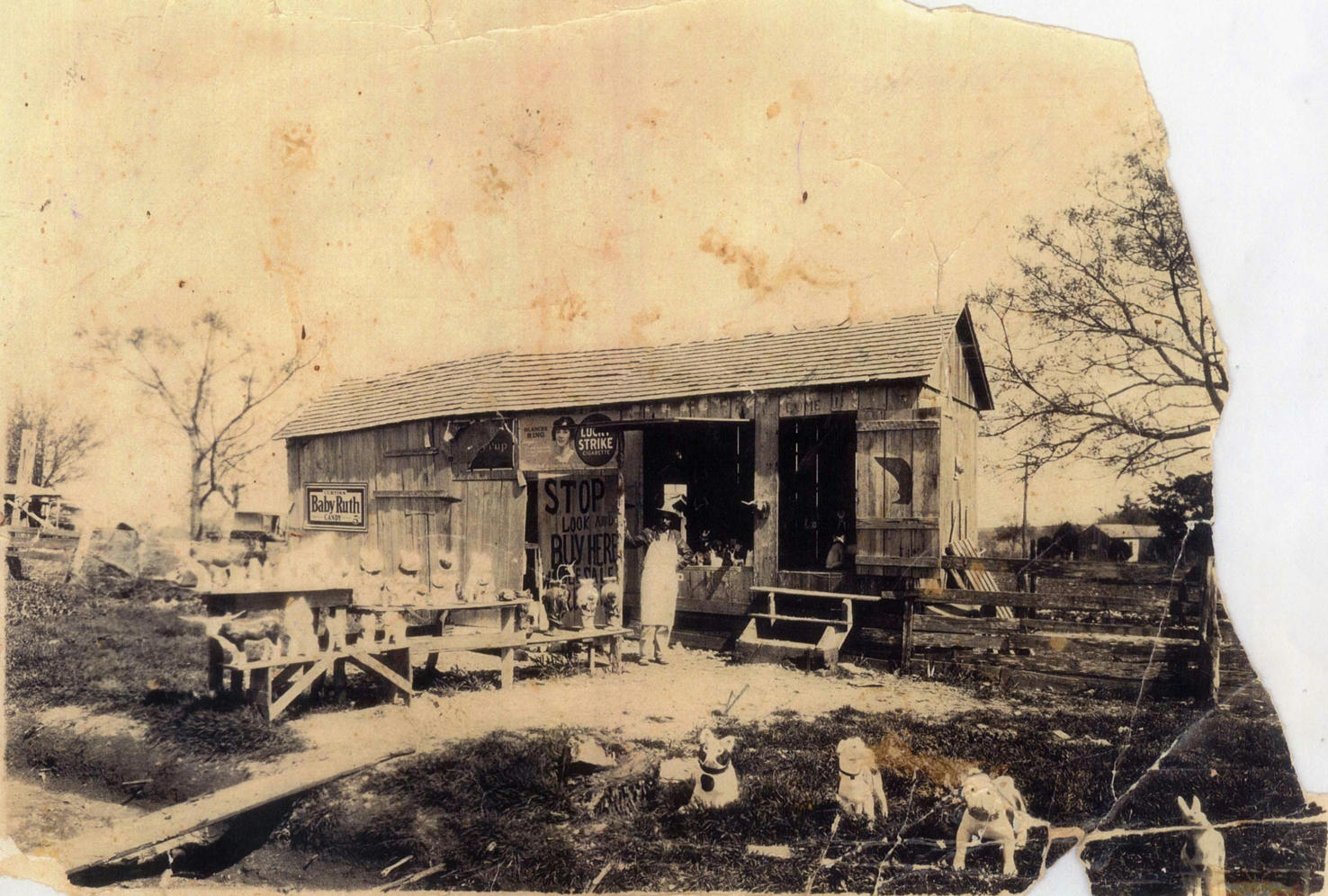
Vending tables
in Hunter
Click on image to enlarge
Photo courtesy Paul O. Sanchez |
| I
was born November 18, 1919, in Lockhart,
Texas, but my early childhood began in Hunter,
Texas when my family moved there in 1921. Although I was only
two years old, I do remember persons that lived, and events that took
place in those times. Hunter was very lively
in those days for it sat between the International and Great Northern
Railroad, which was called the “Linegene” by many, and the Missouri,
Kansas and Texas Railroad, also referred to as the “El Katy.”
|
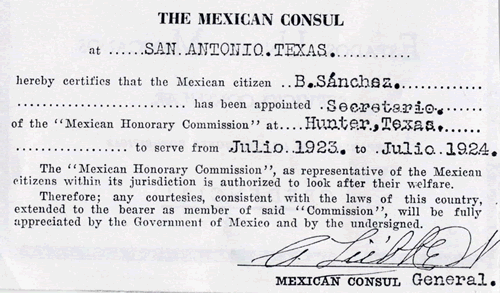
A rare document
from the Mexican Consul General in San
Antonio appointing Bernardino Sanchez (father of Pablo) as Secretary
of the "Mexican Honorary Commission" at Hunter,
1923-1924
Photo courtesy Paul O. Sanchez |
| The
kinfolk back then were primarily Hispanic, and Hunter
was known as “La Mota.” The handful of Anglo residents that lived
there were primarily farmers and cattlemen. |
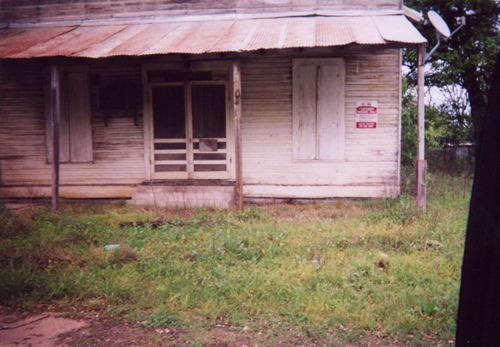
The General
Store as it appears today.
Photo courtesy Paul O. Sanchez, 2005 |
| The
general store was owned by a Mr. Simon, referred to as “El Simon.”
In addition to owning the store, he was also the sheriff and the postmaster.
The store was the center attraction. In those days every one made
their own beer. In the evenings people would gather in front of the
store drinking beer and relaxing. El Simon would join the group. He
used to warn everyone that he never want to catch anybody making beer
because, as sheriff, he would have to jail them. Yet, as owner of
the store, he sold the very ingredients used in making beer -- yeast,
blue ribbon malt, sugar in ten pound bags and boxes of bottle caps
etc. |
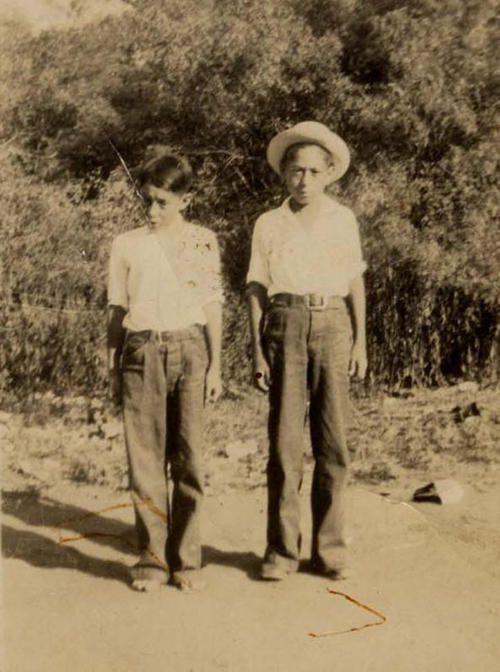
The Brothers
Sanchez in Hunter, Pablo, left, and Augustin
in hat.
Photo courtesy Paul O. Sanchez |
| I
remember boyish days of playing at the old abandoned cotton gin near
the railroad tracks. I remember seeing cattle drives that terrified
me because of the size of the herds and the thunderous noise. |
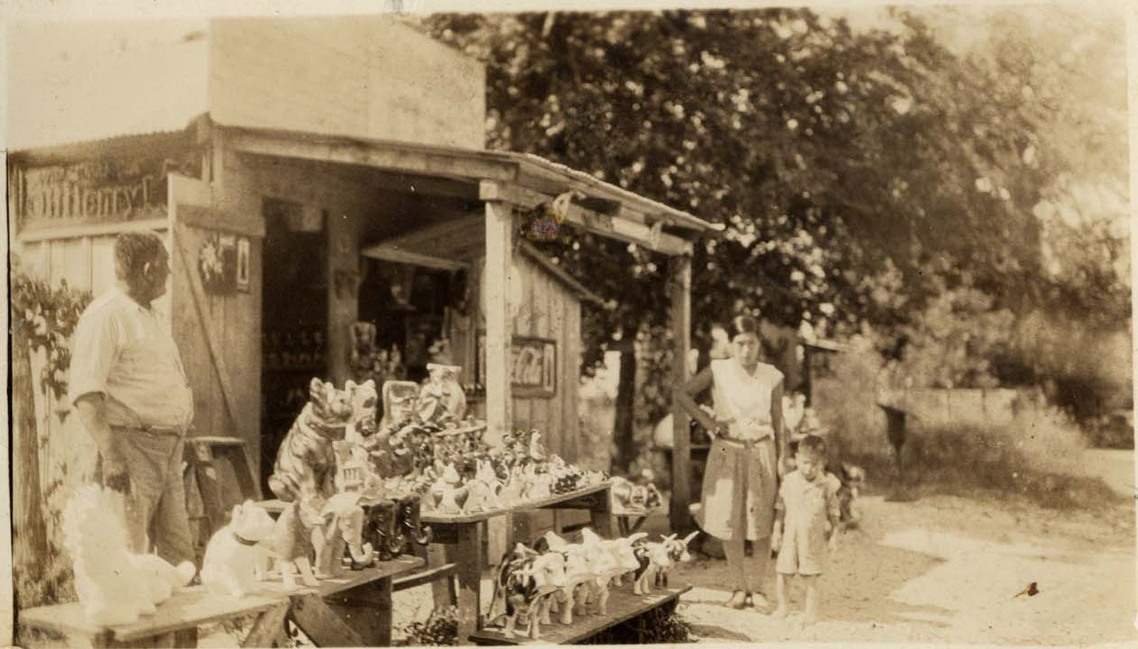
Vending tables
displaying the plaster animal figurines. They sold like "hotcakes."
Clcik on image to enlarge
Photo courtesy Paul O. Sanchez |
| My
father learned to make figurines of animals from plaster. He bought
nine additional lots alongside the road and used them as vending areas
to sell his plaster animals. In fact, as you entered Hunter,
you'd see rows and rows of tables with these animals - from one end
of town to the other. They sold like hotcakes. In fact, business was
so good that my father paid cash for a brand new 1928 Model A Ford.
|
Vending table
next to Dr. Dunn's house
Click on image to enlarge
Photo courtesy Paul O. Sanchez |
I
can remember Dr. Dunn, who was our family doctor. He was the best
doctor in town - because he was the only doctor in town. I remember
Mr. Brown who owned a clothing store, and I can still hear the pounding
of the hammer on the anvil at the blacksmith - owned by Bruno. Although
annoying back then, today I miss it dearly. Eluterio Parra, a young
kid neighbor, took correspondence lessons to become an automobile
mechanic, and of course, he became the town mechanic.
On weekdays you could see people walking either to the general store
or the blacksmith and across the street there were some very small
stores selling their products. You could see wagons, buggies, Model
Ts, and horses; most of them parked by the general store or the blacksmith.
Of course, on Sunday there were baseball games and nearly everyone
in Hunter participated.
And then there was Old Man Riley who owned a gasoline pump. He furnished
the gas to all the cars and farm equipment in Hunter.
|
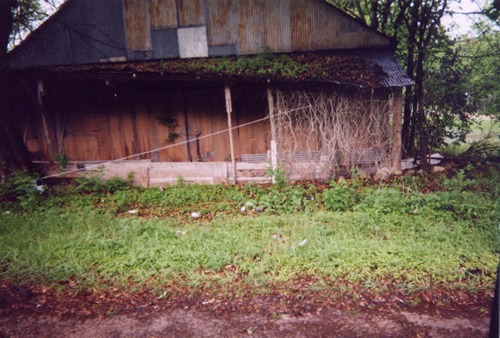 |
A recent photo
of the Livery Stable at Hunter.
Photo courtesy Paul O. Sanchez, 2005 |
|
|
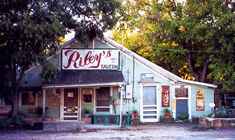
Riley's
Tavern
TE photo,
September 2001 |
When
our family moved to Hunter initially, we
purchased a home, but did not stay there long. On January 23, 1925
my father purchased what is now known as Riley’s Tavern. Court
records show that it was purchased from J. M. Cochran and his wife
Mellie. We lived in that house until 1930 when my father moved us
to New Braunfels.
My grandfather, mother’s dad, stayed at the house until 1932. Although
it was our residence, it must have been a saloon way before our time
because I saw beer racks in the attic. My father said the racks were
to hold beer barrels. I heard it was a stopover for cattle drives
in the 1800s.
Court documents reflect a 1937 lease for the residence was executed
between my father and Old Man Riley for $48 a year --- the payment
per month was $4. Court records also show that the residence was then
sold to Curtis Riley (son) on November 3, 1942 for $700. |
|
|
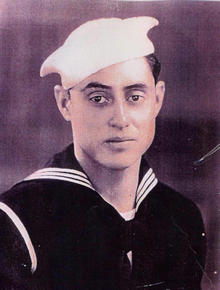
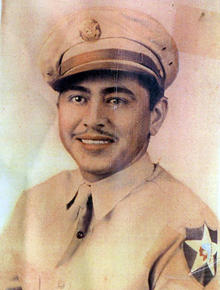
The
author Pablo Sanchez served in the Pacific during WWII
|
|
|
Brother
Augustin landed at Normandy on Utah Beach and survived the Battle
of the Bulge |
|
At the time,
my oldest brother, Augustin, and I were away at war. He landed in
Normandy at UTAH beach and eventually survived the Battle of the
Bulge. I served in the Pacific War. When we returned from the war
we learned that my father sold the residence. We were saddened and
disappointed, no doubt, but certainly understood; for my father
had a brilliant mind for business, and we knew better to ever question
his decisions about our family and way of life.
The end of an era.
© Pablo L. Sanchez
August 1, 2005
|
|
|
 HOME
HOME