|
When
I was on a camping trip to the Hill
country in late August 1974, our original intention was to look
at land for sale in Wimberley,
and camp on the Guadalupe
River. The next day when we decided to swim just downstream
from the dam. I decided the water was much too cold for a bikini,
so we went for a drive down the river road, turned into what is
Preiss Heights and eventually onto Gruene Road. We crossed the charming
bridge and proceeded through the town, which did not take long.
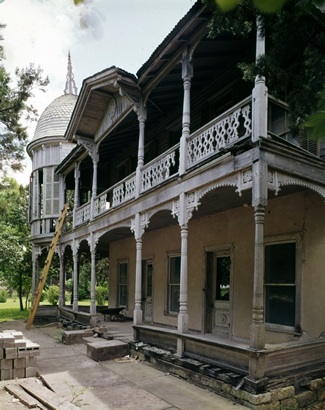
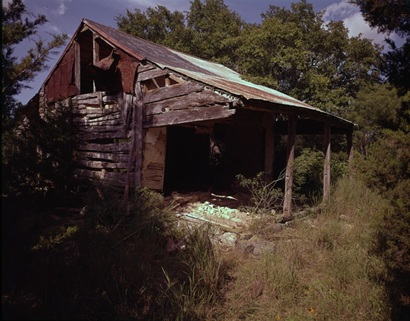
I noticed a house with it’s front door wide open sitting by itself
in a field. I instructed my husband to turn around so we could explore
it. When we got closer I yelled "stop the car" and jumped out and
climbed onto the rickety porch. After many minutes my husband followed
me in and found me standing in the center room, which was covered
in peeling plaster flakes and “Daddy Long Legs” spiders bunched
into one corner. The floors were a roller coaster of undulating
red pine, and this center room floor was covered in layers of linoleum
and oil cloth. He quietly said, "Oh my God", and I replied, "we
are going to buy this house."
I left Houston the following
week and returned to see who owned it. In those days you went to
the courthouse and looked at maps. Then you took those numbers and
looked up other numbers to find out who owned what you were interested
in. While I was looking at page after page of maps to identify this
house, an elderly man walked into the room and hugged the woman
clerk. Then he asked her if she knew he had "done solt Gruene's."
First I asked myself if that was how you pronounced the name of
the town, and then I figured out that this must be the person to
whom I should speak about ownership. I caught up with the man as
he left, who turned out to be Henry Gruene Jr. himself, and spoke
at length with him.
I asked him to lunch, and proceeded to fill a spiral notebook. I
used up a package of Bic pens writing down the history of Gruene.
I left him after seven and a half hours and drove back home to Houston
quite excited. I asked my husband if he was going to let me buy
this house, and he agreed. Well, he just demurred, as he never had
an opinion about anything.
I called the new owners, Rathgeber, West and Leach and spoke with
Don West, the builder. He told me he needed a reason to save it
from the wrecking ball, as one of the partners was Dick Rathgeber,
who owned a demolition company and I would be taking money out of
his pockets if he sold me the house.
I
wrote many letters to historic towns and buildings all over America
asking about how to go about developing a town. I never received
a reply. So I took out a yellow legal pad and wrote down what I
wanted the town to become, and submitted a development plan to them.
While researching this, I found out about the National Trust’s Main
Street Project, and contacted Truett Latimer who was running the
Texas Historical Commission at the time. I was told it needed an
historic survey.
I quit my job at Exxon so I could leave Houston
at five a.m. and be in New
Braunfels by eight when the courthouse
opened. I read all the county files I could, spent hours taping
interviews of Mr. Gruene, and then spent many more hours in the
Texas room of the Julia Ideson Public Library in downtown Houston,
where I read translated German immigrant diaries, among other things
I completed this historical survey within a month, sent it to Mr.
Latimer in Austin, who
forwarded it on to Washington D.C. for final approval. Unfortunately,
Mr. Latimer signed his name to my work, which I did not know until
a few years ago when researching this online. But the listing was
accepted, and the developers decided to sell me the house by the
end of October, 1974. At the time, I could have had any building
in Gruene, but this one spoke to me, and I have not looked back.
Others
showed up and decided to buy other buildings, and some of the local
kids started hanging out in Gruene, being hired to work on the different
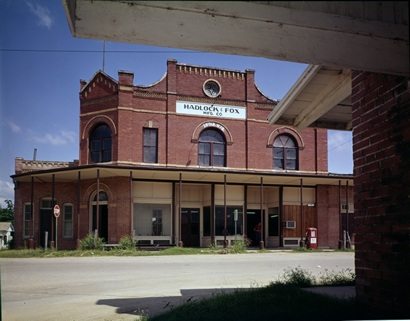
buildings, or for Hadlock and Fox Saddletree, the only employer
in town.
After a few months, I became concerned because my deed said only
"Oldest House in Gruene", not lot and block or meets and bounds
like other deeds had, so I organized a few other purchasers to discuss
this with the developers. I was told they were surveying the lots
and needed deed restrictions. I hired an attorney out of Houston,
who took the money I had collected from other property owners, but
did not return any phone calls. Clearly he was not going to follow
through.
Since I had worked for Baker, Botts, Shepherd and Coats, I knew
legalese, so I wrote out the protective covenants and submitted
them to his attorney. With a few of his minor tweaks, they were
accepted, and were probably the first protective covenants to an
historic district in Texas, and possibly the country. A few years
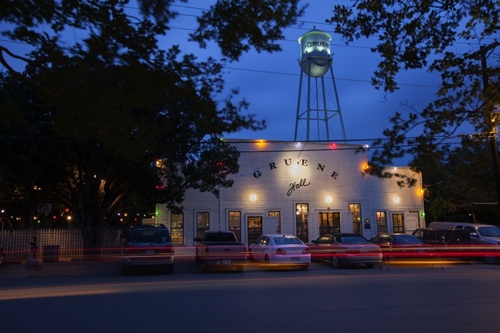
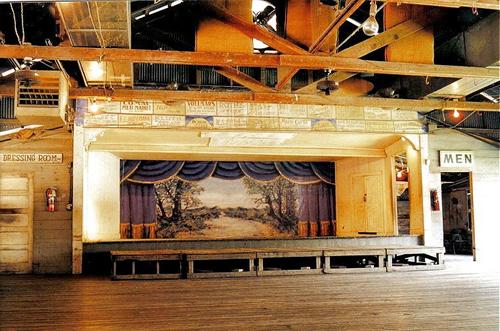
later, Pat Molak purchased Gruene Hall. Not too long after
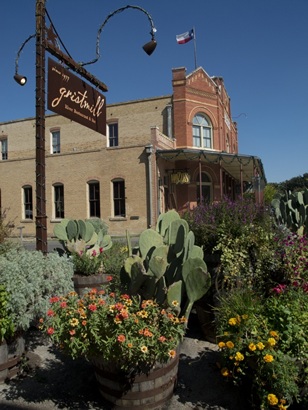
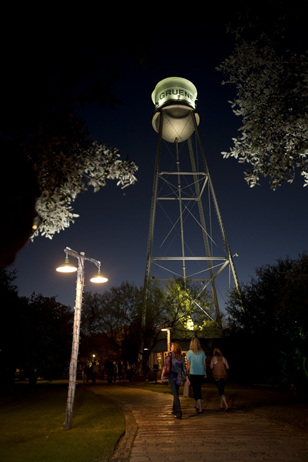
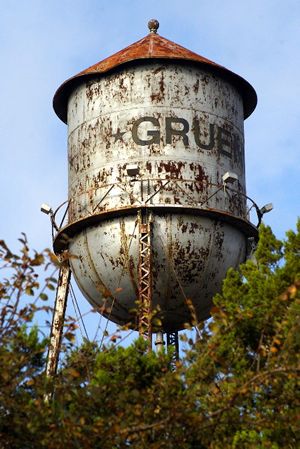
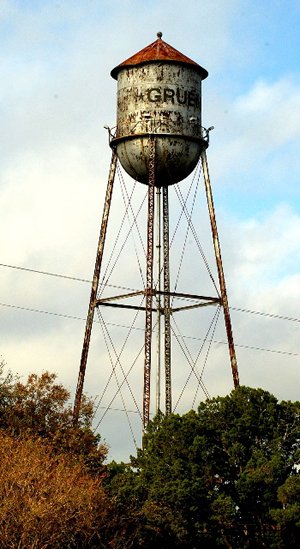
that, Chip Kauffman bought the Gristmill and sold the water
tower for $5,000 to pay for a roof. The scrap value of the steel
in the tower was over $250,000 and it’s value as a working water
tower was perhaps double that.
Pat Molak called me some months later when a crane had raised the
tank off it's supports and said he had gotten a restraining order
and wanted me to testify in court since I was the writer of the
deed restrictions and the historic researcher. I agreed, and brought
ABC, CBS, NBC, and Texas Monthly and Parade magazines to cover the
lawsuit, as I did not trust the judge to be honest. Each time we
left the courtroom, I was pushed into the waiting cameras by the
other property owners and asked for an update on the discussions
and testimony.
While waiting in the hallway to testify during that week, Mr. Molak
told me I was going to have to be partly responsible for the legal
fees. Knowing I had much better places to spend that money, I organized
a music festival to pay those fees, telling Mr. Molak that his talk
of making this a dance hall and music Mecca was going to come true,
and it was time to put his money where his mouth was.
I had a spiel written for each of the girls who were to call Austin
City Limits and Armadillo World Headquarters to get the play list
for all the musicians who had played or wanted to play there. When
they contacted the musician's managers, they were to mention the
music festival in my spiel and how much we needed them to come and
play to make this a success.
I again brought the TV stations and Texas Monthly to cover the music
festival. We blocked off Gruene Rd just in front of my house and
past the General Store, which Hadlock and Fox owned, put in a lowboy
flat bed trailer with hay bales to support to the amps, and had
the bands lined up so they could switch out quickly. I told Molak
to ask Mr. Hadlock if we could use his electricity and offer to
pay his bill for the month when it came in. There was an auction
of donated items down by the cotton gin where Cafe Adobe Verde is
now, and other functions throughout town. If anyone remembers attending
this festival or has any pictures, please contact me, Cheryle Fuller
at cfuller007@me.com
Or better yet, come visit.
© Cheryle Fuller
May 8, 2014
|
 HOME
HOME

 Texas
Gulf Coast
Texas
Gulf Coast East
Texas
East
Texas Central
Texas North
Central
Texas North Central
Texas South
Central
Texas South Texas
Panhandle
Texas
Panhandle South
Texas
South
Texas Texas
Hill Country
Texas
Hill Country West
Texas
West
Texas Texas
Ghost Towns
Texas
Ghost Towns Texas
Counties
Texas
Counties