|
History in
a Pecan Shell
Originally named
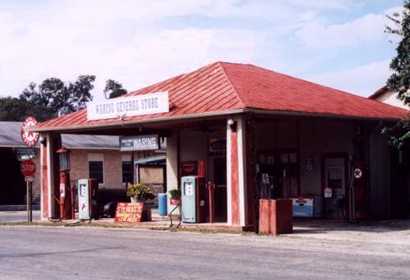
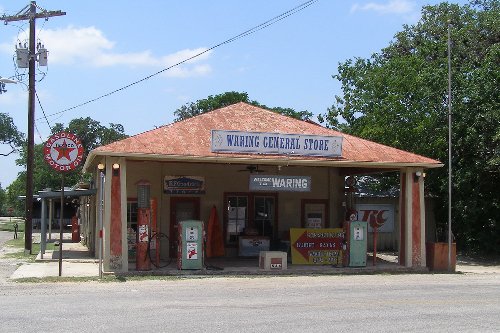
Waringford when R. P. M. Waring, an Irishman from Waringford,
Ireland sold or donated land to the San Antonio and Aransas Pass Railway
for its Kerrville
line in the late 1880s. In 1888 a post office from neighboring Windsor,
Texas moved across the Guadalupe River to Waringford.
The town's name was shortened to plain Waring in early 1901. The population
hovered between 100-150 until 1914 when it peaked at 300. Waring had
most essential businesses as well as a lumberyard and quarry.
The population fell to a mere 80 by the early 1950s and the estimated
population remains at just 73. |
| Looking
back at Waring
"Hindsights"
by Michael Barr
A visitor to Waring might think the lights are on, but nobody's
home. That's because Waring, near Comfort in Kendall County, is
6 miles north of I-10 and doesn't get many tourists. But Waring
was once a busy place and a popular destination for travelers...
more
|
Waring, Texas
Landmarks & Attractions:
|
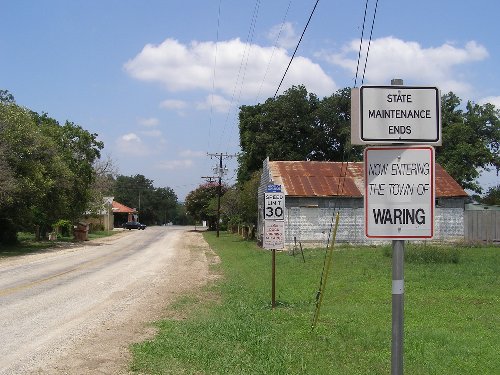
"Now
Entering The Town of Waring"
Photo courtesy Will
Beauchamp, June 2010 |
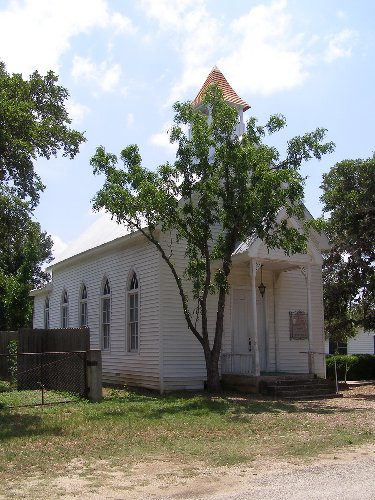
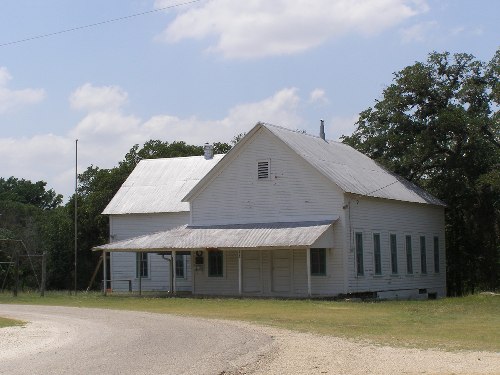
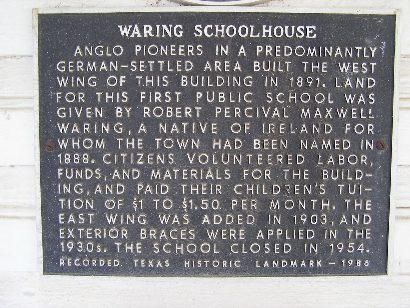
Historical Marker
Waring Schoolhouse
Anglo pioneers
in a predominantly German-settled area built the west wing of this
building in 1891. Land for this first public school was given by Robert
Percival Maxwell Waring, a native of Ireland for whom the town had
been named in 1888. Citizens volunteered labor, funds, and materials
for the building, and paid their children's tuition of $1 to $1.50
per month. The east wing was added in 1903, and exterior braces were
applied in the 1930s. The school closed in 1954.
Recorded Texas Historic Landmark - 1986 |
Waring
Schoolhouse Historical Marker
Photo courtesy Will
Beauchamp, June 2010 |
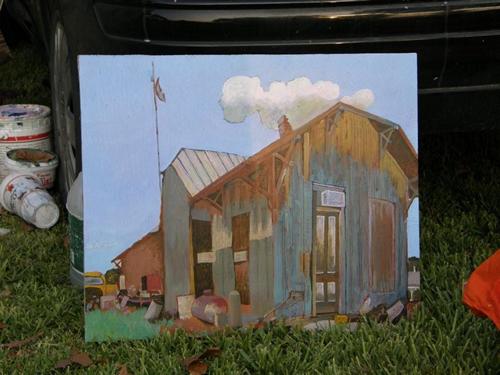
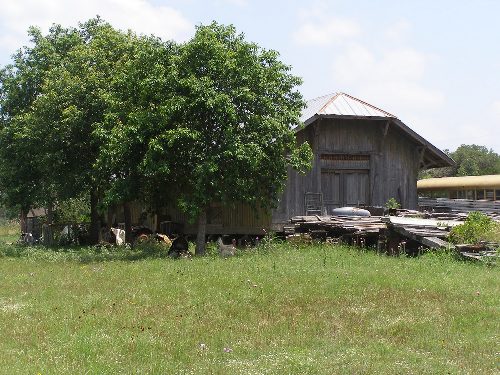
Waring Depot
Sketch by Jacinto
Guevara
Photo by John Troesser, October 2007 |
| Waring Nearby
Destinations: |
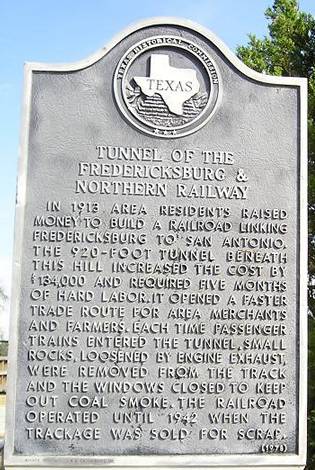
Tunnel
of The Fredericksburg & Northern Railroad
... Today, if you follow FM 1376 from San
Antonio to Sisterdale, then
take FM 473 west and go beyond the road to Waring, you'll find
where an old but still paved road forms (or used to form) a T intersection
with 473. If you turn north and follow the road and the bed of Black
Creek, you will be paralleling the route of the F&N, and just about
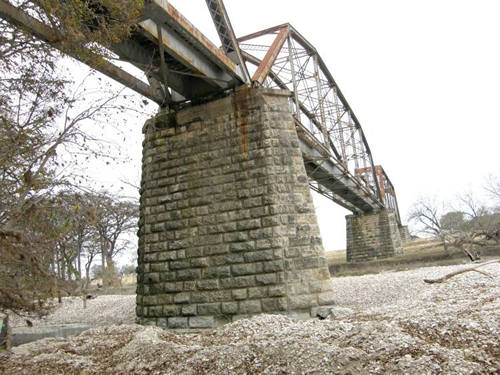
the time you reach the ghost town of Hillingdon you'll see, crossing
the creek, the remains of the F&N's longest trestle. Just north of
that the road crosses almost directly over the top of it and there
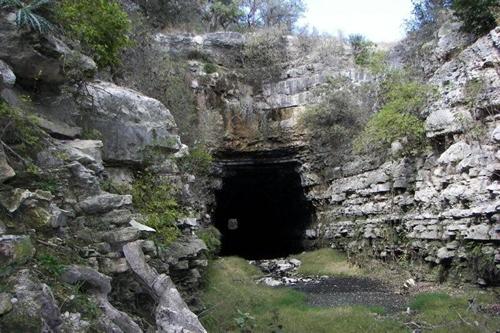
is an historical marker you'll find the hill country's only railroad
tunnel.
The tunnel is still there, all 920 feet of it inhabited, in the fall,
winter, and spring, by millions of bats. The bat flight from the tunnel
at dusk resembles rising smoke. During late spring, summer, and early
fall, it's home to more rattlesnakes than you'll ever want to meet
in one place again.
- From "The
Little Engine that Couldn't" by C. F. Eckhardt |
 |
| Looking
back at Waring
"Hindsights"
by Michael Barr
A visitor to Waring might think the lights are on, but nobody's
home. That's because Waring, near Comfort in Kendall County, is
6 miles north of I-10 and doesn't get many tourists. But Waring
was once a busy place and a popular destination for travelers...
more
|
| Texas
Escapes, in its purpose to preserve historic, endangered and vanishing
Texas, asks that anyone wishing to share their local history, stories,
landmarks and recent or vintage photos, please contact
us. |
|
|
 HOME
HOME

 Texas
Gulf Coast
Texas
Gulf Coast East
Texas
East
Texas Central
Texas North
Central
Texas North Central
Texas South
Central
Texas South Texas
Panhandle
Texas
Panhandle South
Texas
South
Texas Texas
Hill Country
Texas
Hill Country West
Texas
West
Texas Texas
Ghost Towns
Texas
Ghost Towns Texas
Counties
Texas
Counties