|
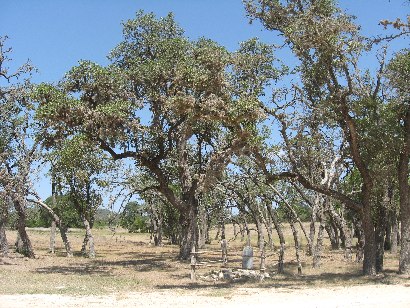
The Bandera Tragedy
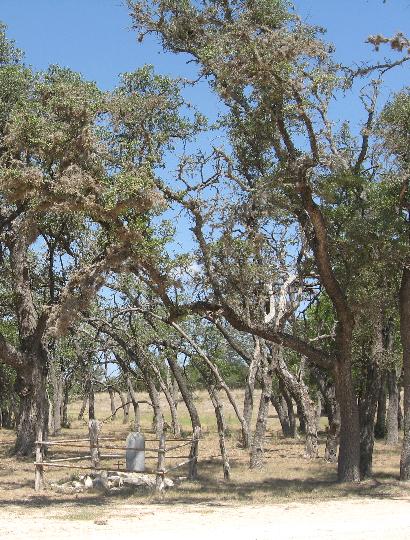
Tree Today
Photo courtesy Irene Van Winkle, July 3, 2011 |
The
tragedy referred to in the tree's name was a multiple hanging. A Confederate
patrol stationed at Camp
Verde during the Civil War intercepted a group of eight well-mounted
and well-equipped Williamson County men about 10 miles South of Hondo.
Thinking they had nothing to fear, they surrendered their weapons
and rode with the soldiers toward Camp
Verde to clear things up with the authorities there.
As civilians, they were, of course, free to travel. They were relieved
of the cash they carried which collectively amounted to nearly $1,000.
This considerable sum may have had something to do with the events
that followed.
While they were camped near this tree on the trip back to Camp
Verde, one or more of the Confederates suggested that the men
should be hanged for "evading Confederate service" (please
see letter
below).
This pretext might have been accepted by the other soldiers or it
is possible that some of them thought it was just a prank. Horsehair
nooses were made and, if it was a scare, the Commanding Officer, one
Major Anderson, turned a blind eye and did nothing to stop the "prank"
once it turned serious.
The men were lynched one at a time while the other victims watched
and waited their turn. One man asked to be shot rather than be slowly
strangled and one of the killers complied. The ramrod was left in
the musket and it pierced the man's body - pinning it to the ground.
When the bodies were found the next morning the ramrod was at first
mistaken for an arrow and the killings were thought to be the work
of Indians. A boy accompanying the men managed to escape, but was
never heard from.
After the war, the atrocity was remembered and referred to a tribunal.
But the soldiers had all left Texas
and none, including Major Anderson, could be located for trial. |
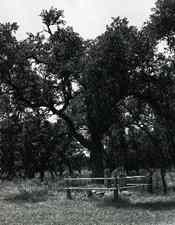
Older photograph
of the Tragedy Tree and marker
Photo Courtesy TXDoT |
Another
killing - of German immigrants from Comfort
by Confederates in 1863 shows that Texas during the Civil War was
indeed a dangerous place. The German men were en route to Mexico to
enlist in Federal service when they were attacked by Confederate cavalry
at the Nueces River near Brackettville.
Today in Comfort,
Texas, the (recently restored) Treue der Union (Loyalty to the Union)
Memorial was erected in 1866. But here in Bandera County, although
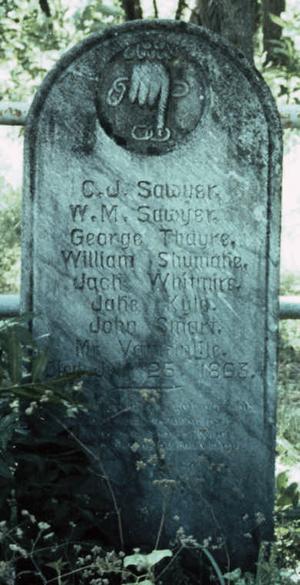
the crime was even more heinous, there is only the tree, the fence
and a simple tombstone inscribed with the victims names.
© John
Troesser |
|
|
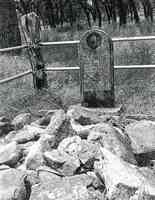
The
marker with the names of the victims
1990s photo courtesy Ralph D. Ellis |
The Bandera Tragedy
Tree and marker
Photo courtesy Irene Van Winkle, July 3, 2011 |
The Bandera
Tragedy Tree Forum
|
|
Announcement:
Bandera Tragedy Tree 150th Anniversary Commemoration
I am the owner of the Hanging Tree Ranch, Bandera. What I have planned
is a commemoration of the 150th anniversary by inviting descendants
of the slain men to attend a gathering on Sunday, July 21. We will
have representatives from Tx., Bandera, Williamson and Kerrville
Historical societies (at least they have been invited). We are
asking each family to have a representative to speak and tell the
story of the mens travels to Mexico and the hanging as it has been
passed down through their family. There are many version of the
events that have been repeated over the years. Not that we are
going to decide which is accurate but it would be helpful to know
what is in each family's story of the event. We have invited people
to come to the ranch at 11:00 a.m. on Sunday July 21, bring chairs
and we will provide a forum for a representative from each family.
The ranch is located on RR 1077, 1.9 miles west of Hwy 173. A chuckwagon
meal and refreshments will be provided for all guests. Families
are invited to bring memorabilia, photos, books which we can put
on display. A videographer will record the story telling and produce
videos for those requesting one, for a fee. I encourage people
to keep updated by checking website for TexasEscapes.com and link
to Bandera Tragedy Tree. You can help by informing all family members
of the event. WHAT WE DO NEED IS AN RSVP FOR EVERYONE ATTENDING
SO WE WILL KNOW HOW MANY MEALS TO PREPARE AND HOW MANY GUESTS TO
EXPECT. People can respond with RSVP to this email address.
- Phil Watkins phil@philwatkins.com
|
Announcement
"For those who read this announcement earlier, the owner of the
Hanging Tree Ranch has had to change the date for the 150th commemoration
of the hanging of the eight men buried there. The day of the event
has been changed from Saturday, July 20 to Sunday, July 21. It will
take place starting at 11 a.m., and a barbecue meal will be provided
to guests by the owner. Also, remember, guests should bring their
own folding chairs, as there is no seating available on site.
Anyone interested in this story -- especially descendants and/or
relatives of the men, and historians -- is welcome to attend. The
ranch is located outside Bandera on Highway 1077. Bring your photos,
stories, memories and family lore -- we want to hear ALL sides of
this tragic story, which has been lost to time. It is relevant to
the Civil War, to Confederate history, to Camp Verde history, to
Hill Country history, and to families of these men. For more information,
please email me at irenebvw@yahoo.com." - Irene Van Winkle, June
03, 2013
Subject:
Bandera Hanging Tree
I'm a graduate student in American History at UT-Austin. I'm researching
the story of the Bandera Hanging Tree and I'd like to contact the
following individuals who have commented on it on Texas Escapes:
Jason Sawyer, James Stewart, Ashley Phillips, and Ralph D. Ellis.
My email address is nroland@utexas.edu. - Regards, Nick Roland,
May 11, 2013
Subject:
Bandera Hanging Tree Tragedy
Thanks so much to Melanie Hester's entry. Her message cleared up
a huge mystery for our side of the Van Winkle family, a puzzle I
have agonized over for years. Turns out, we are nearly 99.99% sure,
that Andrew Jackson Van Winkle was the nephew of our ancestor in
Texas, David Lawson Van Winkle, who came to Hill County in about
1856, and was also a Confederate veteran. We were able to connect
him with Thomas H. B. Van Winkle when we learned they both were
sons of Jesse Van Winkle and Mary Ann Braden, but were very far
apart in age. We don't know if they ever were in touch after they
all left South Carolina. Our family is arranging visits now, and
word is getting out to our kin about this grave. We appreciate this
so much. - Irene Van Winkle, Kerrville
Texas, irenebvw@yahoo.com, July 1, 2011
Subject:
The Bandera Tragedy Tree
I Just discovered your article regarding the Bandera Tragedy Tree,
my relative is Andrew Jackson Van Winkle: Military Service: Co.
D 18th Regt.. Texas Vol Cav (CSA) of Bell County, Texas. Andrew
is the son of Thomas H. Benton Van Winkle and Elizabeth White Smart,
the daughter of John Smart. I believe, Andrew Jackson Van Winkle
and John Smart were victims in your story. Please let the other
families, have my e-mail address m_hester@verizon.net, so that we
can compare notes. Thanks again for your stories, it's great preserving
history! - Melanie Hester, Lexington, Texas, October 20, 2009
Subject:
Bandera Hangings
I recently discovered your article on the Bandera Hanging Tree.
William Martin Sawyer is my ggg-grandfather, and I have visited
the mass grave located on what is now called "The Hanging Tree Ranch"
just outside Bandera.
As a result of a Sawyer reunion in Weir,
Texas, I have been contacted by another Sawyer genealogist who
spurred my interest in the family again, especially since we attended
the funeral of my grandmother's 101-year-old sister Leona (Sawyer)
Hobbs a couple of weeks ago in San
Angelo.
Jason Sawyer's comments at the end of your article were a ray of
sunshine after years of fruitless research. Attached is a photo
I took of the tombstone in the 90s. Online forums such as the one
you provide are GREAT resources for us genealogists, and anything
we can do to "advertise" our kin helps others. - Ralph D. Ellis,
Austin Texas, June
29, 2007
Subject:
Bandera Hangings
Ashley Phillips wrote that she had contacted all of the families
connected with the victims except the Van Winkles. I believe Mr.
Van Winkle was related to John Smart, on Mr. Smart's mother's side.
I am a Shumake descendent, but not direct from the one lynched.
Does anyone know anything about the 13 year old male? - Lois Rodgers,
Cameron, Texas, July 30, 2006, loisrodgers@tlabwileless.net
Bandera
Hangings
I am the great
great great granddaughter of William Sawyer. I have always heard
about this story and was curious to know if they were leaving their
families behind to go to Mexico. I am relieved to learn that it
wasn't the case.
I have had contact with relatives of (I think) all of the other
men, except for Mr. VanWinkle. If anyone knows anything about him
or William's parents, I'd love to know and share some info. - Ashley
Phillips, November 09, 2004
Assistance
please with the Bandera Hanging Tree
I was reviewing your information regarding the Bandera Hanging tree.
I noticed a contribution from Jason Sawyer. It seems he and I have
an ancestor in common. I am the great grandson of William Sawyer.
I agree that Mr. Sawyer was on furlow or leave, and was attempting
to farm near Georgetown
Texas. As I understand it, as related to me by his grandchildren,
Mr. Sawyer was enroute with the other innocent men to Mexico to
attempt to purchase good farm stock, as there was little to be had
in Texas at that time. This is why the men were carrying a large
sum of money.
I wonder also what the fate of Major Alexander was ultimately. Did
he join the union army after the war, as did a goodly number of
officers? If so, he was still no more than a common criminal in
uniform. How many others suffered at his hands directly or due to
his "complacency"? Certainly, the answers to some questions as these
may never be known, but it sure would be interesting to find some
leads to what has been a cold trail. I would at least like to find
Alexander's grave. Maybe I could plant some goatheads on it. - James
Stewart, September 04, 2004
Bandera
Hangings
Your article suggests that the men hanged outside of Bandera
TX, in July of 1863, were going to Mexico
to avoid conscription into the Confederate Army. I would like to
point out that records indicate at least two of the men were in
the [Confederate] army and on a forty-day pass.
William M. Sawyer, my paternal great, great, grandfather, had enlisted
in the Confederate Army July 8, 1862, in Gurly's Regiment, Co. D,
Texas Partisans of the Texas Cavalry (later designated the 30th
Texas Cavalry, C.S.A) His brother, Coston J. Sawyer was also in
the Texas Cavalry, Co. A, of Morgans Squadron.
These men in no way [were] guilty of any wrongdoing. They willingly
gave up their arms and agreed to accompany Major Anderson to Camp
Verde, but were murdered enroute.
Your article also fails to note that on April 24, 1866 the State
of Texas indicted Major Anderson for murder and highway robbery.
Major Anderson had of course long since disappeared.
- Sincerely, Jason Sawyer, December 08, 2003
We thank Jason for his letter and have made appropriate
corrections to the original text. We always welcome corrections
and additional information to any of our articles. - Editor
|
|
|
 HOME
HOME