|
|
THE KILLOUGH
MASSACRE
Page 5
Text & photos
by Janet Gregg |
‹ Previous page
Ultimately,
most of the survivors returned to the settlement. Nathaniel, Eliza
and baby Eliza Jane ended up repairing and living in one of the houses
that had been torched. Reports vary between it being Samuel’s, Allen’s
or his own home.
Narcissus Killough, Samuel’s widow, remained in Alabama for 13 years
before returning to the area. But she did eventually come back to
settle in Larissa
in 1851 with son William Boykin Killough.
Jane Killough, Isaac, Jr.’s widow, returned to her own home.
It is said that one of George and Jane Wood’s sons was adopted by
the Indians and grew up to become their chief. |
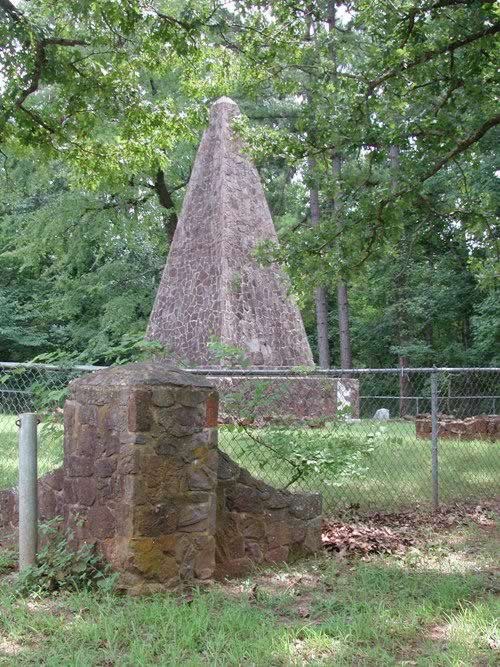
The Killough
Massacre Monument and stone cornerpost.
Photo courtesy Janet Gregg, 2005 |
The
massacre was the largest single Indian massacre in East
Texas and also the last. It led to the expulsion of the entire
Cherokee Indian Nation from Texas.
Approximately
100 years later, during the Great Depression, a stone obelisk was
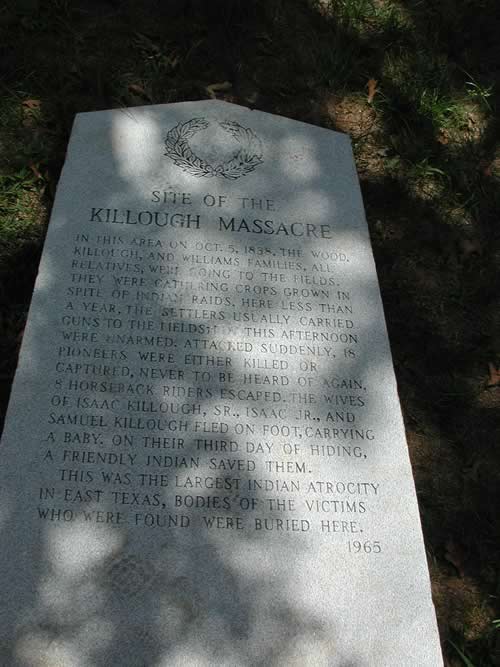
erected by the Work Projects Administration to mark the site. In 1965
a state historical marker was dedicated there. |
Site of The
Killough Massacre historical marker
Photo courtesy Janet Gregg, 2005 |
In
1955, descendents tracked down the site again, which had been left
untended and was overgrown. They formed The Killough Reunion Association
two years later. The company which owned the land gave the burial
site to the Association “in perpetuity” as long as it is maintained
properly. Today, the site is fenced and descendents hold reunions
and cleanups every other year.
The best time to visit
the site is in the winter, when the leaves have fallen from the
trees. Then you can look through their limbs to the little valley
below. You can almost envision the settlers, their daily life there
and even the massacre unfolding. But it’s also a tranquil site, which
gives the visitor a sense of comfort that the victims of the atrocity
are truly at peace. |
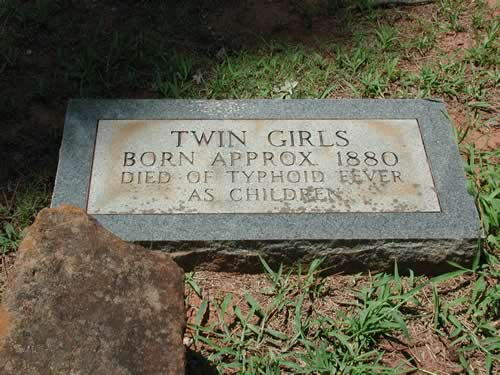
Later interments
Photo courtesy Janet Gregg, 2005 |
Text and photos
© Janet Gregg
November 8, 2005
Writer’s Note: As with many stories handed down
verbally from generation to generation, there are some discrepancies
between the various versions that have been put into writing. I have
taken all available information into account and tried to clarify
and resolve those discrepancies, choosing the most likely scenarios
for this article when a concrete resolution to a specific detail could
not be found. - JG |
Resources:
Jean Cannon
– Tyler, Texas – descendant of Nathaniel Killough.
“The Killough
Massacre” book by Jack Moore.
Killough Reunion
Association web site, including posted articles: “Ferd L. William’s
Story”, “Texas’ Last Indian Massacre”, “Uncle Billie’s Story” and
“”Who Is Buried There?”
Handbook of
Texas Online – posted articles including information on Nacogdoches,
Lacy’s Fort, Killough Massacre and land prices.
Tomatocapital.com
web site posted article on Killough Massacre by Virginia Davenport.
|
| Texas
Escapes, in its purpose to preserve historic, endangered and vanishing
Texas, asks that anyone wishing to share their local history, stories,
landmarks and recent or vintage photos, please contact
us. |
|
|
 HOME
HOME