|
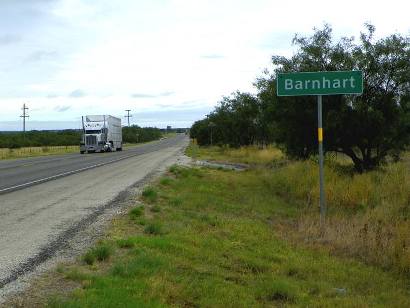
BARNHART, TEXAS
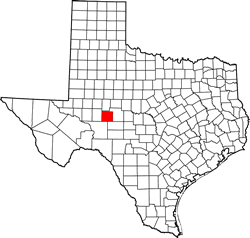
Irion County, West
Texas
31° 7' 58.62" N, 101° 10' 22.3" W (31.13295, -101.17286)
Highways 67 and 163
18 miles SE of Big
Lake
52 miles SW of San
Angelo
ZIP code 76930
Area code 325
Population: 105 est (2017)
160 (2000) 135 (1990)
Barnhart, Texas Area Hotels › San
Angelo Hotels |
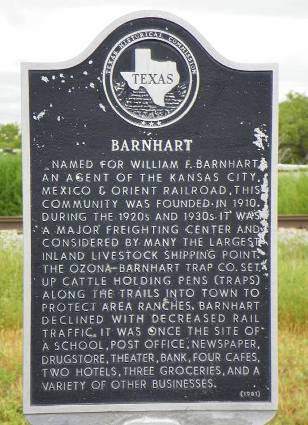
Barnhart Texas
Historical Marker
Photo courtesy Barclay
Gibson, October 2010 |
History
in a Pecan Shell
The town's namesake was William F. Barnhart, agent for the Kansas
City, Mexico and Orient Railway when it arrived in 1910. Two years
later a post office was granted as well as the first school (which
closed in 1969). The Barnhart State Bank (established 1920) moved
to Rankin in 1927.
The town also had their own paper - named the Range.
From only 50 residents in 1915, Barnhart reached its zenith in 1947
with 250 Barnharters. In 1980 there were 74 citizens which has since
increased to 105. |
 |
Barnhart
by Mike Cox ("Texas
Tales" column")
Dust, bawling cattle, hell-raising cowboys and trains a half-mile
long – that was Barnhart in the 1920s and ‘30s.
Once a bustling if miniature version of Fort
Worth, this unincorporated Irion County town is mighty quiet these
days. The population in 2009 was only 169, and Barnhart’s school closed
in 1969. (If you want big city life in these parts, go to the county
seat of Mertzon,
population 800-plus.)
Barnhart began when the Kansas City, Mexico and Orient railroad cut
through West Texas in
1911. The name honored William F. Barnhart, the land agent who obtained
the right of way for the company’s tracks west of San
Angelo.
Because of the Orient’s location between major rail
lines on the north and south, Barnhart quickly became an important
shipping point for the vast chunk of real estate in between. Cattle
and sheep
poured out of West Texas
on trains loaded at Barnhart.
The town had everything the cowboys
and railroaders needed: A hotel, cafes, a bank and a theater. A weekly
newspaper, the Barnhart Range, provided the town with local news.
Given the remoteness of West
Texas, old-fashioned trail drives continued to Barnhart long after
their heyday elsewhere. In fact, all those cattle coming through began
to cause local ranchers problems. To protect their pastures from over-grazing,
ranchers started putting up more fences. That ended what may have
been one of the last semi-free range holdouts in Texas.
To
get around the problem, the Ozona-Barnhart Trap Co. was organized
in 1924. A long, narrow swath of leased or purchased land stretching
34 miles from south of Ozona
to Barnhart became Texas’ last major cattle trail, a corridor one
newspaper labeled “the world’s most unusual highway.” Along it acreage
for a series of six “traps” or pens – as important to cattle movement
in those days as locks are to the Panama Canal – was acquired by the
company and fenced to hold traveling livestock.
The company assessed five cents a head each night for cattle kept
in one of the traps. Sheep, for one cent a head, could also be kept
overnight in the traps. All a trail boss had to do was tell Ted Adkins,
the company’ Barnhart-based weigher, how many animals had stayed in
a trap and pay him for that amount. No paperwork required.
If a sheep shipper needed help getting his animals motivated to board
a train, Adkins could furnish two lead goats – Lou and Whitney. Their
follow-the-leader services cost 50 cents a carload.
Meanwhile, the railroad constructed large holding pens adjacent to
its trackage at Barnhart. With ample infrastructure to serve a rancher’s
needs, sometimes as many as three trail drives a day hit town while
trains with as many as 75 cattle cars hauled West
Texas livestock to distant markets.
Prosperity
brought its problems. In April 1934, the town’s former postmaster
pled guilty in federal court to “conversion of funds.” Barnhart, stuck
pretty much out in the middle of nowhere, definitely lacked in the
law and order department.
At some point in 1934, the town solicited assistance from the brother
of one of the state’s best known peace officers, Texas Ranger Capt.
Frank Hamer, to pacify its lawless element. That man was Harrison
L. Hamer, a former ranger and just about as quick on the trigger as
his older, more famous sibling. Frank Hamer had presided over the
bloody demise of the outlaw couple Bonnie
Parker and Clyde Barrow that May, but brother Harrison had laid
low a badman or two himself.
“Harrison is doing quite a bit of cleaning up in our town among the
trash,” wrote his sister Alicia Cumbie to their mother on Aug. 20,
1934. “And they sure are getting hostile. This place sure needs someone
to clean it up but he is sure up against a tough dirty bunch. He has
a bunch of them in jail now.”
The bad guys may have been “a tough dirty bunch,” but Hamer, who apparently
only stayed in Barnhart a short time before returning to his home
in Del Rio, lived
to old age and died of natural causes. Though what Hamer did in Barnhart
seems to have generated practically no newspaper coverage, he evidently
prevailed in restoring order.
Crime was not Barnhart’s only problem in 1934. While that year the
Associated Press declared Barnhart the busiest livestock shipping
point in the nation, not every outbound train held jostling beeves.
At the depth of the Depression, the federal government had begun buying
cattle and having them shot to reduce supply, hoping to revive a market
that had practically dried up. Ranchers got paid on the number of
cowhides they shipped out and sheep skinners made good money turning
their knives on dead cattle.
The Atchison, Topeka & Santa Fe eventually bought out the Orient,
but Barnhart continued to flourish as a cow town through the 1940s.
The advent of better roads and the widespread use of cattle trucks
signaled an end to Barnhart’s era as a major shipping center and 20th
century Dodge City.
"Texas Tales"
column © Mike Cox
Related Topics:
Texas Ranching - Ranching,
Cattle Drives, Cowboys & more |
Barnhart, Texas
Landmarks
Photo Gallery
|
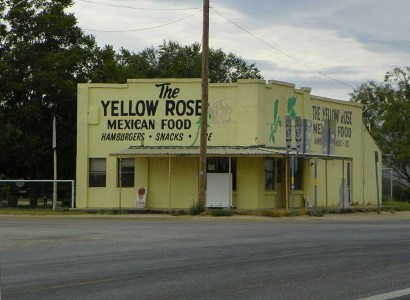
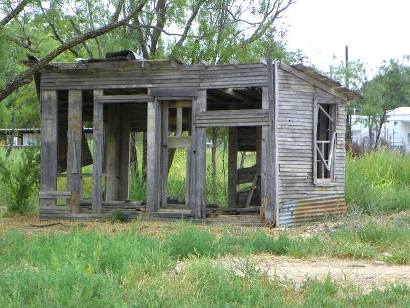
The Yellow Rose
Mexican Food
Photo courtesy Barclay
Gibson, October 2010 |
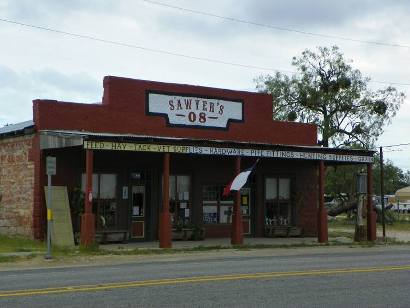
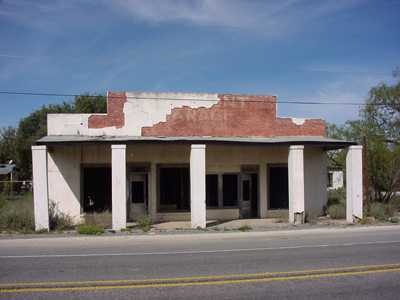
"My great
grandma's grocery store. It was the Red and White and closed sometime
in the 1950s." - Lauren Miles.
Photo courtesy Erik
Whetstone, 11-04 |
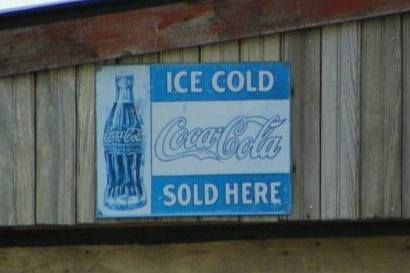
Ice
Cold Coca-Cola Sold Here
Photo courtesy Barclay
Gibson, October 2010 |
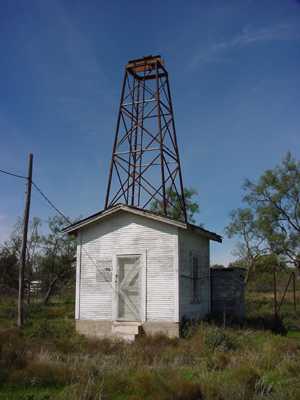
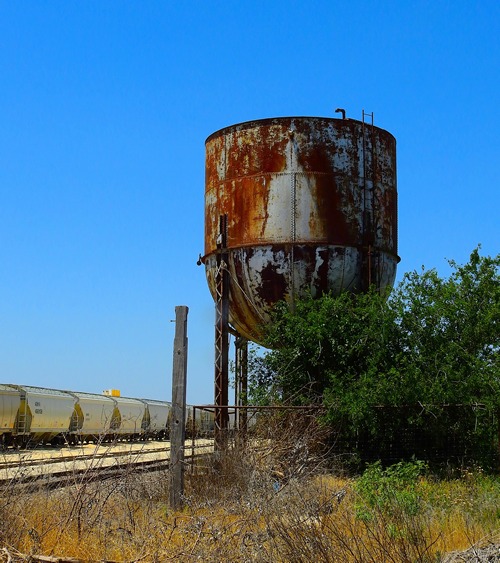
Railroad water
tower on US Highway 67 in Barnhart
Photo
courtesy Allen Waters, May 2017 |
Barnhart, Texas
Forum
Subject:
Old Railroad Water Tower in Barnhart, TX
I wrote last June sending a photograph of an old water tower (for
steam locomotives) in Dryden,
TX from an earlier 1994 trip. Today (27 May 2017), we left Marathon
for a day's run to Abilene
after a stay in the Big
Bend Country before leaving DFW for the return trip to our home
in Virginia Beach, VA. We passed thru Barnhart approx. noon today
on US Highway 67 and spotted the water tower (again, a relic from
the days of steam) in the attached photograph still standing between
the highway and the railroad tracks. Many of these towers have long
vanished from the American landscape, so I was surprised to see
this one still standing. We passed through Dryden and Sanderson
earlier on this trip and the water towers I'd seen in those places
in 1994 are no longer standing. - Best Regards, Allen Waters, Virginia
Beach, VA, May 27, 2017
Subject:
Water Tank in Barnhart
Did you know that Barnhart was the world's biggest livestock place
to take your animals on the train? If you go down there you will
see the water tank that used to give water to the steam engines.
I got all of this from my grandma. She was there. - Lauren Miles,
June 01, 2007
Subject:
Summers in Barnhart
My uncle Lloyd Chambers worked for the Santa Fe and lived in Barnhart.
He had four children. Janet, Betty and twins Steve and Cleve. During
the 1960's my brother and I would visit Barnhart for two weeks every
summer. It was the greatest place to spend a summer. There were
dances at the old school on Saturday and going swimming at Buck
Owens' stock tank. It reminded me of the town in "To Kill a Mockingbird."
Everyone knew everyone and they weren't afraid for their kids to
go see the neighbors. We had the run of the town and had lots of
fun. - Richard Chambers, Snyder, Texas, June 11, 2006
Branhart - Texas Escapes' 1,000th Town, first published
November 16, 2004
|
| Texas
Escapes, in its purpose to preserve historic, endangered and vanishing
Texas, asks that anyone wishing to share their local history, stories,
landmarks and recent or vintage photos, please contact
us. |
|
|
 HOME
HOME