|
|
 |
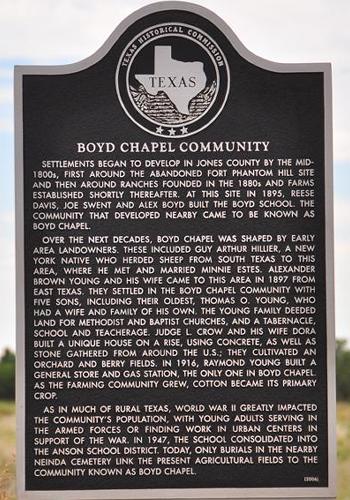
Historical Marker:
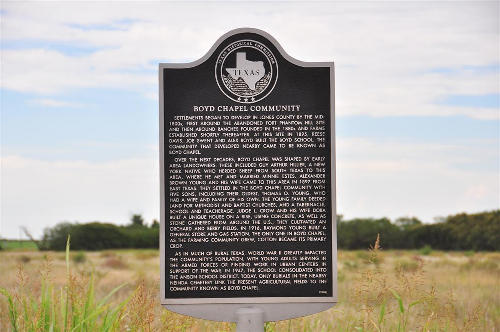
Boyd Chapel
Community
Settlements began
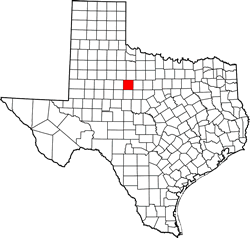
to develop in Jones County by the mid-1800s, first around the abandoned
Fort Phantom Hill site and
then around ranches founded in the 1880s and farms established shortly
thereafter. At this site in 1895, Reese Davis, Joe Swent and Alex
Boyd built the Boyd School. The community that developed nearby came
to be known as Boyd Chapel.
Over the next decades, Boyd Chapel was shaped by early area landowners.
These included Guy Arthur Hillier, a New York native who herded sheep
from south Texas to this area, where he met and married Minnie Estes.
Alexander Brown Young and his wife came to this area in 1897 from
east Texas. They settled
in the Boyd Chapel community with five sons, including their oldest,
Thomas O. Young, who had a wife and family of his own. The Young family
deeded land for Methodist and Baptist churches, and a tabernacle,
school and teacherage. Judge L. Crow and his wife Dora built a unique
house on a rise, using concrete, as well as stone gathered from around
the U.S.; they cultivated an orchard and berry fields. In 1916, Raymond
Young built a general store and gas station, the only one in Boyd
Chapel. As the farming community grew, cotton
became its primary crop.
As in much of rural Texas, World
War II greatly impacted the community's population, with young
adults serving in the Armed Forces or finding work in urban centers
in support of the war. In 1947, the school consolidated into the Anson
school district. Today, only burials in the nearby Neinda Cemetery
link the present agricultural fields to the community known as Boyd
Chapel.
(2006) |
 |
| Texas
Escapes, in its purpose to preserve historic, endangered and vanishing
Texas, asks that anyone wishing to share their local history and vintage/historic
photos, please contact
us. |
|
|
 HOME
HOME

 Texas
Gulf Coast
Texas
Gulf Coast East
Texas
East
Texas Central
Texas North
Central
Texas North Central
Texas South
Central
Texas South Texas
Panhandle
Texas
Panhandle South
Texas
South
Texas Texas
Hill Country
Texas
Hill Country West
Texas
West
Texas Texas
Ghost Towns
Texas
Ghost Towns Texas
Counties
Texas
Counties