|
 |
History
in a Pecan Shell
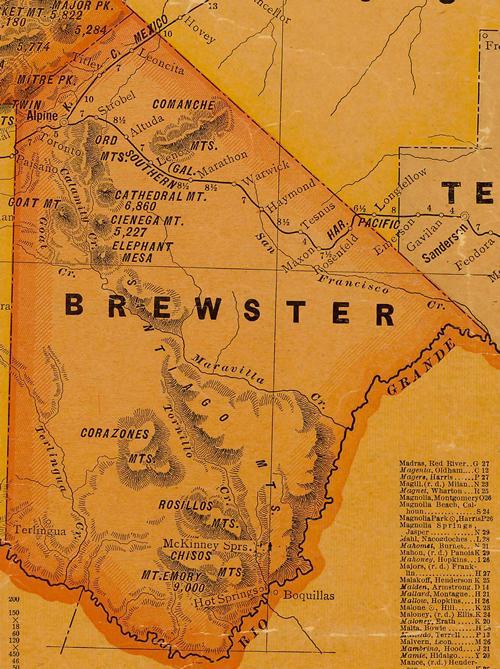
Terlingua started as a simple Mexican village on Terlingua Creek
just North of the Rio Grande. The name Terlingua is a corruption of
Tres Lenguas or three languages (tongues) that were spoken
by the inhabitants of the village.
When mercury-bearing ore was discovered in the 1800s, a mine
was opened and the tent village of the laborers and miners appropriated
the name Terlingua. The village became known as Terlingua Abajo,
or "Lower Terlingua".
At the turn of the century there were about 300 workers and they had
their own post office.
By 1905 the population was over 1,000 and when the mine closed in
1910, the post office moved 10 miles East, keeping the name Terlingua.
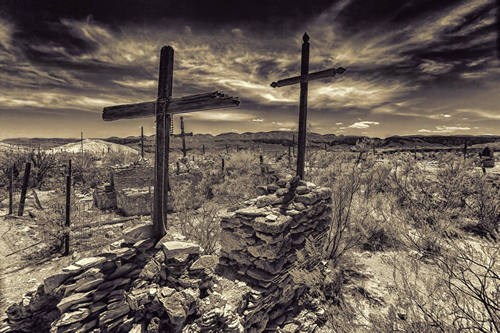
The cemetery at Terlingua is still maintained (somewhat), although
the miners buried here are probably mostly forgotten to their families.
Its primitive and barely decipherable system of grave identification
and handmade markers make it a rather picturesque photo opportunity
for some people. Frequent mowing is not a problem in Terlingua.
In the 1920s, Terlingua produced 40% of the Quicksilver produced
in the U.S. The town was split along ethnic lines with the Mexican
laborers living on the East side.
A school was built in 1907, but it was only a tent-like structure.
It wasn't until 1930 when the permanent school - named after mine
owner Howard Perry was finally opened. |
Terlingua became
a household word due to a war of words between Dallas Morning
News Columnist/ Chili gourmet Francis X. Tolbert (the
X, like the S in Harry S. Truman, stands for nothing) and a columnist
for Holiday magazine. The barbed words led to a challenge
which lead to the first big chili cook-off back in the early
60s. The Holiday critic who had written such scathing articles about
chili in, ended up retiring in
Terlingua a few years after his visit there.
Tolbert wrote A Bowl of Red in 1962. This ode to chili
stirred up an renewed interest in the under-appreciated and nearly
(at one time) omnipresent Texas dish. (See The
Naming of Chili by Luke Warm)
Shortly after the book's success, Mr. Tolbert founded the Chili
Appreciation Society International. Fellow columnist Wick
Fowler became a charter member and helped spread CASI. He even
opened a Chapter in Vietnam in 1969. Fowler shared his particular
recipe in the form of a kit he first marketed in 1964. It's still
sold today.
CASI is an organization that uses its love of Chili to raise funds
for a variety of charities and worthy causes through regional cook-offs
and competitions.
|
 |
by Byron
Browne
Terlingua is a town resolutely opposed to any inclination towards
modernization. It is a place that offers few outward indications of
its reluctant progression into the 21st century: the post office,
with its dark brick walls and smoked glass, is clearly a recent addition
to the landscape; the gas stations advertise $2.20 a gallon prices.
Wait, I have that wrong. Suggesting that Terlingua has more then one
gas station is incorrect. There is another however, it is 5 miles
down the highway, 5 miles closer to the dark silhouettes of Mexico's
mountains, in Terlingua's sister village, Study Butte. The only other
stations are either 80 miles north in Alpine or 95 miles northwest
in Marathon.
My wife and I left Austin for Terlingua the first weekend of November,
the same weekend as the International Chili Cook-Off... next
page |
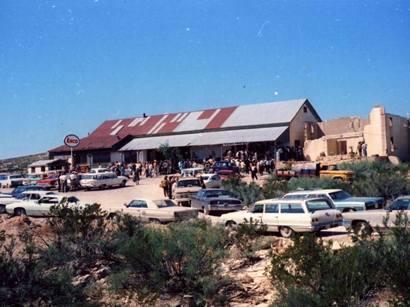
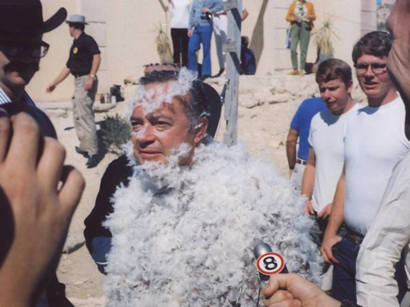
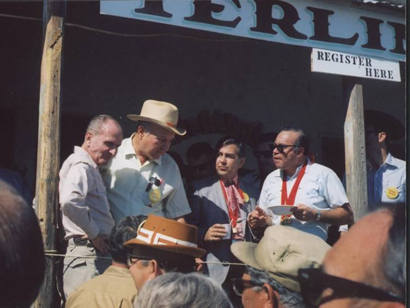
Terlingua Chili
Cook Off
1969
|
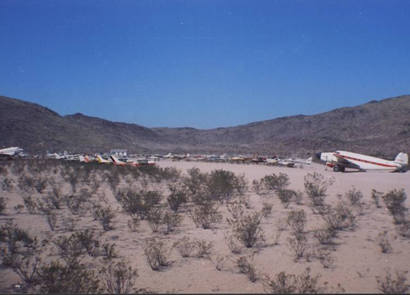
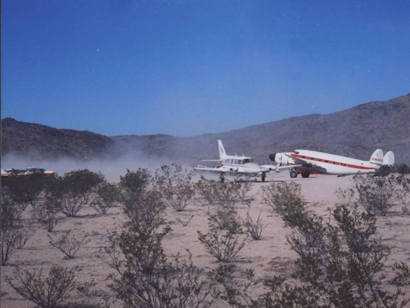
| "Note the
dirt air strip with the old DC3 and Lodestar. Ran the tail number
on the Lockeed and it is still flying." - Barclay
Gibson, February 25, 2009 |
|
|
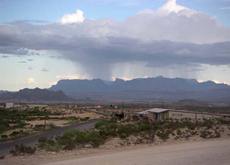
Storm
over Terlingua
Photo
courtesy Richard Berger, 2004 |
|
|
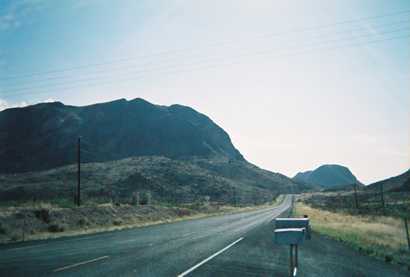
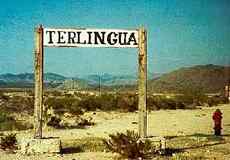
A
representative view of Terlingua
TE Photo, 2000 |
Barton Warnock
Environmental Education Center
HC 70, Box 375 Terlingua TX 79852
432/424-3327
http://www.tpwd.state.tx.us |
 |
Terlingua,
Texas Forum
Study Butte
and Terlingua
As is often the case, I found your site while searching Google--this
time for information on Study
Butte and Terlingua. Your description of Study
Butte, comparing and contrasting it with Terlingua, is *FABULOUS*
and right on the mark. ... Thanks for the laughs, the information
and the great photos. - King Douglas, January 12, 2005
Study Butte
and Terlingua
... I was planning to stay one evening in Terlingua or Study
Butte in Brewster County before going into Big Bend National
park for a couple of days. Can you hear me laughing with embarrassment
from there. I have a 1996 Rand McNally Travel Atlas and it shows
Mentone and
Terilingua as in the same population symbol as Gladewater,
Texas (the town I grew up in about 6000 people). I also have
a 1997 Texas Road Map and it shows all three towns. It uses the
25,000 and under population size marker for all three towns. It
never occurred to me to verify how many people were actually in
the town. After reading your site I read the population counts on
the Texas Road map: Mentone
has 50 people Terlingua has 25 people Study
Butte has 120 people. .. I enjoyed your Texas
Ghost town site. - Alvin Bittner, December 20, 2001
|
| Texas
Escapes, in its purpose to preserve historic, endangered and vanishing
Texas, asks that anyone wishing to share their local history, stories,
landmarks and recent or vintage photos, please contact
us. |
|
|
 HOME
HOME

 Texas
Gulf Coast
Texas
Gulf Coast East
Texas
East
Texas Central
Texas North
Central
Texas North Central
Texas South
Central
Texas South Texas
Panhandle
Texas
Panhandle South
Texas
South
Texas Texas
Hill Country
Texas
Hill Country West
Texas
West
Texas Texas
Ghost Towns
Texas
Ghost Towns Texas
Counties
Texas
Counties