|
|
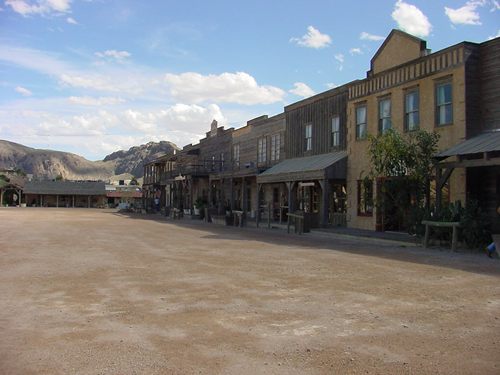
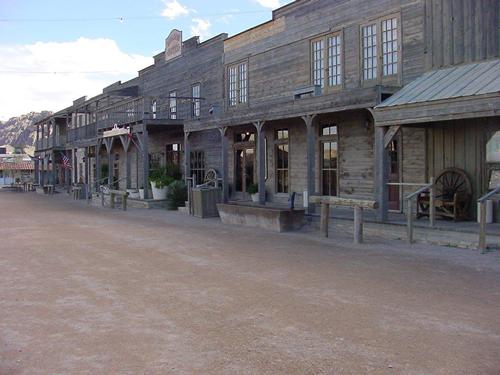
Main Street
Photo courtesy Tom Hosier, 2006 |
History in
a Pecan Shell
The name is said to mean "little flat rocks" in Spanish. Early inhabitants
were driven out by Apaches and Comanches. Anglo settlement began in
the middle part of the 19th Century.
When mercury was discovered nearby in Terlingua,
the region experienced a minor boom. The influx of miners increased
businesses between Mexico
and the U.S. and by 1900 the town had become an official port of entry,
complete with a customhouse.
Farmers moved in to plant crops in the floodplain of the Rio Grande,
creating a need for a school. The ford of the Rio Grande was lined
with rock, making it the best crossing between El
Paso and Del Rio.
The most influential resident of Lajitas in its infancy was a man
named H. W. McGuirk. The overworked McGuirk tended bar, operated the
store and still found time to help manage the mining operations in
Terlingua. Through his
efforts, the Lajitas post office was opened. McGuirk also paid the
costs for a school and church to be built before selling out to Thomas
V. Skaggs.
In 1916 incursions by elements of Pancho
Villa’s forces necessitated the establishment of a cavalry post.
The post office closed in 1939.
In 1949 the settlement was purchased by Rex Ivey, Jr., who brought
electricity to the town (via a generator). After the mines at Terlingua
closed, Lajitas was left with a population estimated at four.
In the mid 1970s Lajitas was bought by a Houston Corporation and most
of the surviving buildings were restored.
In the 1980s Lajitas became a resort – with 50 permanent residents,
most of them employed at one of the three motels, restaurant or golf
course. The old trading post was complemented by an RV park, and visitors
who didn’t want to take the long drive could fly into the resort’s
airfield.
Book Hotel Here > Lajitas
Golf Resort And Spa |
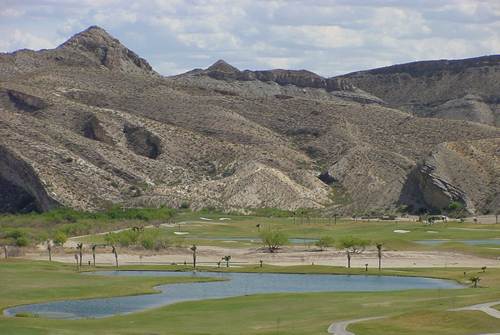
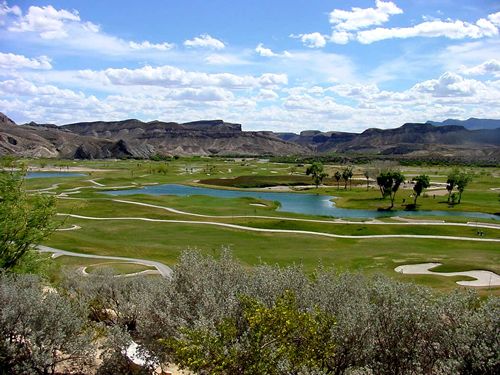
Contrast on the
Border: The Lajitas Golf Course
Photo courtesy Tom Hosier, 2006 |
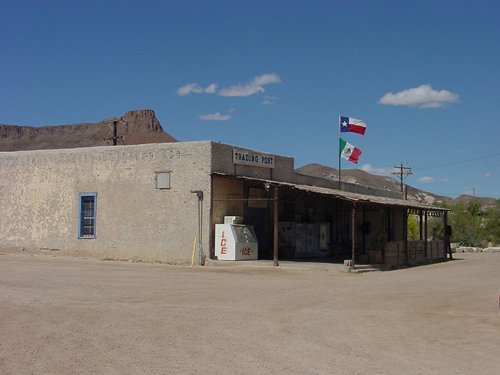
The original
trading post
Photo courtesy Tom Hosier, 2006 |
Another view
of Main Sreet
Photo courtesy Tom Hosier, 2006 |
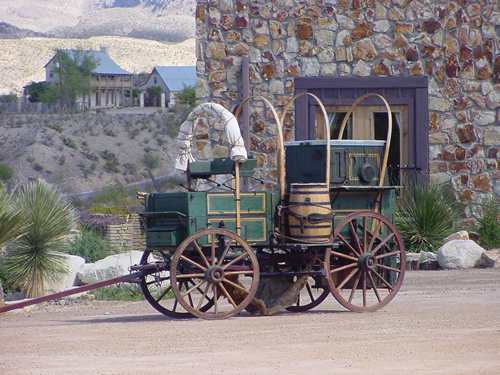
Restored Chuck
Wagon
Photo courtesy Tom Hosier, 2006 |
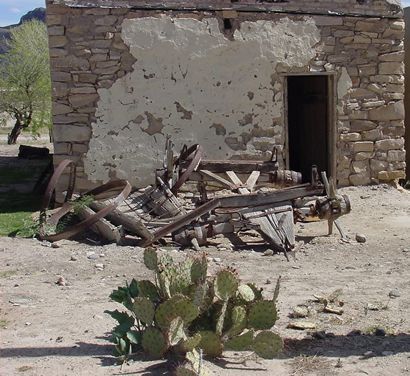
The next restoration
project
Photo courtesy Tom Hosier, 2006 |
More of the
golf course.
Photo courtesy Tom Hosier, 2006 |
| Texas
Escapes, in its purpose to preserve historic, endangered and vanishing
Texas, asks that anyone wishing to share their local history, stories,
landmarks and vintage/historic photos, please contact
us. |
|
|
 HOME
HOME

 Texas
Gulf Coast
Texas
Gulf Coast East
Texas
East
Texas Central
Texas North
Central
Texas North Central
Texas South
Central
Texas South Texas
Panhandle
Texas
Panhandle South
Texas
South
Texas Texas
Hill Country
Texas
Hill Country West
Texas
West
Texas Texas
Ghost Towns
Texas
Ghost Towns Texas
Counties
Texas
Counties