|
Camp Barkeley
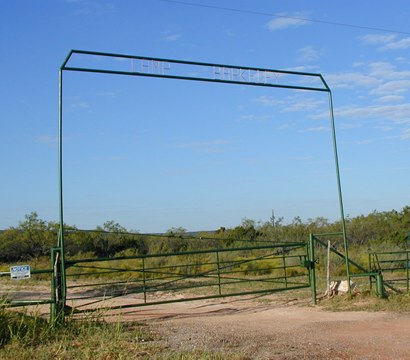
Gate
Photo courtesy Mike
Price, 2007 |
During
World War II,
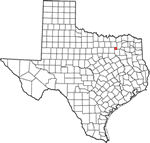
this camp (originally meant to be temporary) enclosed 77,000 acres
and included 1/9th of Taylor
County's land.
The camp was named (on January 10th 1941) by the War Department to
honor David Bennes Barkley,
winner of the Congressional Medal of Honor for his sacrifice in World
War I. The discrepancy in the spelling of the Camp's name has
been attributed to a misspelled document. |
Construction
of the camp began in late1940. The estimated cost to be around $4
million. It was completed in July of 1941 at a cost of $7 million.
Home to the 45th Infantry Division, the camp was also the temporary
home of cartoonist Bill Mauldin, who later became famous for his cartoon
featuring cynical Infantry privates "Willie and Joe." The unshaven,
cigarette-smoking characters were frowned upon by the brass, but so
popular with the enlisted ranks that calls to remove the cartoon from
the Stars and Stripes worried officials that it would negatively
affect troop morale.
Other
units at Camp Barkeley included the 90th Infantry Division and the
Eleventh and Twelfth Armored divisions. The Army's Medical Administrative
Officer Candidate School was established at Camp Barkeley in 1942
and they even found room for nearly 900 German POWs. To the embarrassment
of the MPs, twelve prisoners escaped from Camp Barkeley shortly after
their arrival, although all were soon recaptured.
The
camp was deactivated in April of 1945 and dismantled in September
of that year. The cost to the government was over $27 million for
66 months of service. Leased land reverted to its original owners.
See Camp Barkeley Historical Marker |
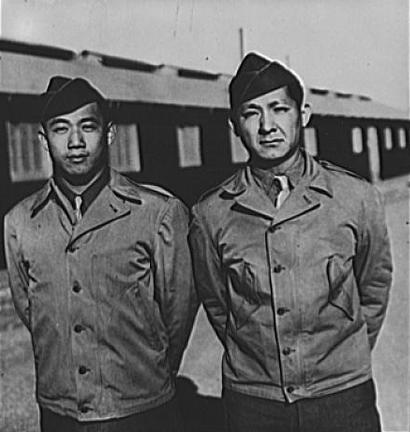 |
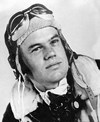
2 Lt. Calvin
S. Chin, 28 NYC
2 Lt. Anthony Loo Wung Wong of Honolulu
These two Chinese-American Officers were the first graduates of the
Army Medical Corps Officer Candidate School.
Photo courtesy Library of Congress |
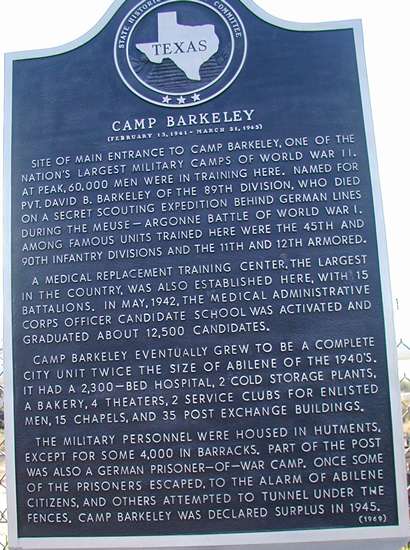
Camp Barkeley
Historical Marker
Photo courtesy Mike
Price, 2007 |
Historical Marker
(On Highway 277 about 8 miles South of Abilene):
Camp Barkeley
Site of main entrance
to Camp Barkeley, one of the nation's largest military camps of World
War II. At peak, 60,000 men were in training here. Named for Private
David B. Barkeley of the 89th Division, who died on a secret scouting
expedition behind German lines during the Meuse-Argonne Battle of
World War I. Among famous
units trained here were the 45th and 90th Infantry Divisions and the
11th and 12th Armored.
A medical replacement training center, the largest in the country,
was also established here, with 15 battalions. In May, 1942, the Medical
Administrative Corps Officer Candidate School was activated and graduated
about 12,500 candidates.
Camp Barkeley eventually grew to be a complete city unit twice the
size of Abilene of
the 1940s. It had a 2,300-bed hospital, 2 cold storage plants, a bakery,
4 theaters, 2 service clubs for enlisted men, 15 chapels, and 35 post
exchange buildings.
The military personnel were housed in hutments, except for some 4,000
in barracks. Part of the post was also a German prisoner-of-war camp.
Once some of the prisoners escaped, to the alarm of Abilene
citizens, and others attempted to tunnel under the fences. Camp Barkeley
was declared surplus in 1945. |
Camp Barkley
Update:
Correction:
"Camp Barkeley was 9 miles south east of Abilene
and is NOT where Dyess AFB is currently located.
Camp Barkeley was an ARMY base and was focused on the training and
well being of the soldiers.
North of the site of Barkeley there was an Army Air Field -- known
as Tye Army Air Field then Abilene Air Field - that was used to train
pilots. That runway is now part of the (current) Dyess runway.
Before the base was officially named it was known as Abilene Air Force
Base, later to be named for William Edwin Dyess, an Air Force Pilot
from Albany who was killed in 1943.
Much of the Camp Barkeley property was bought by a dentist from Abilene
and now used the property for his church camp. He is very interested
in the history of the camp. Just so you can let people know it is
NOT public land any longer.
As a historian I just feel the need to help you get your history correct."
- 12th Armored Division Museum, March 18, 2016 |
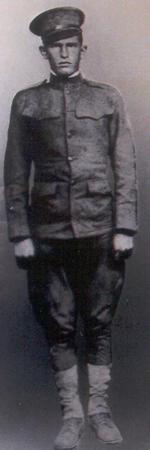
Private David
Barkley's Story
A
native of Laredo,
Barkley enlisted in the Army while still in his teens. His family
stated that he hid his Mexican heritage because he felt it would impede
his assignment to the front lines. He succeeded in making it to the
front and volunteered for a mission to swim the Meuse River to gather
information on German troops. While he and another volunteer accomplished
their mission, Barkley contracted cramps on his return across the
river and drowned. His death came just two days before the armistice.
Barkley was one of three Texans awarded the CMH in WWI.
An elementary school in San
Antonio was named for him in 1921 and he lay in state at the Alamo,
the second person to have that honor. He was interred at San
Antonio's National Cemetery. |
|
|
L- This picture
of Private Barkley hangs in the new Barkley/Ruiz Elementary School
in San Antonio.
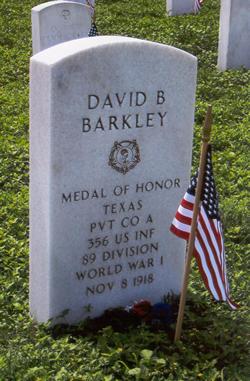
R- Gravesite of Private Barkley at the San Antonio National Cemetery.
Photos courtesy Terry
Jeanson, May 2007 |
A Visit to
Camp Barkley in 2007
|
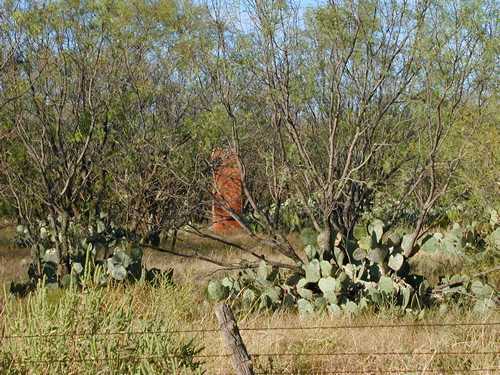
Cactus in Camp
Barkeley
Photo courtesy Mike
Price, 2007 |
Photographer's
Note:
"Very little remains visible from the roads of the camp. There's
a series of brick structures like the one shown. Have no idea what
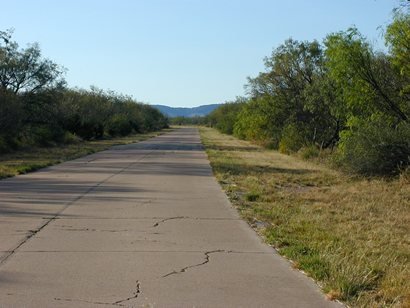
they were. There's a lot of concrete roads, but not open for access.
The sign is over the one part that is used, the rife and pistol range
used by the National Guard and by Dyess MP's(?). The hillside behind
the range is littered with what is probably millions of spent bullets
that have eroded out of the ground. As a teenager I could sit on the
ground and pick up more than I could hold within a space you could
reach without moving.
Satellite photos show how large it was in the built up area. The rest
stretched for miles, and up until the late 50's or 60's there were
roadside signs warning of unexploded munitions. I believe it was in
the 70's that a ranch hand was killed by one he picked up." -
Mike
Price, October 15, 2007 |
One of the many
roads in Camp Barkeley
Photo courtesy Mike
Price, 2007 |
| Texas
Escapes, in its purpose to preserve historic, endangered and vanishing
Texas, asks that anyone wishing to share their local history, stories,
landmarks and recent or vintage photos, please contact
us. |
|
|
 HOME
HOME