|
There
are four faces of old Lobanillo, which straddles East
Texas’ oldest highway less than 20 miles from the Texas-Louisiana
border.
But overriding the name is the fact that the site is considered to
be one the oldest places continuously occupied in East
Texas.
First, of course, was La Lobanillo, the pueblo of Gil
y' Barbo, where his mother and other refugees remained when Spain
evacuated colonists from western Louisiana and East
Texas in 1773.
When Lobanillo exchanged hands, it was known as Shawnee Village
and later as Jimtown, a name shaped after the first names of
Jim Halbert and Jim Willis.
And, finally, along came Geneva,
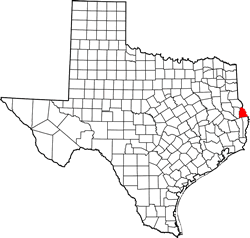
today’s name for the town at the intersection of El
Camino Real (Texas Highway 21) and Farm Road 330 in northwestern
Sabine County.
To tell the town’s story, you have to reach back to when Gil
y' Barbo was born at Los Adaes, Louisiana, then the provincial
capital of Spanish Texas, in 1729. His parents were colonists sent
to Texas the same year from Andalusia,
Spain.
At Los Adaes, Gil
y' Barbo married Maria Padilla and they settled on Lobanillo Creek
in what is now Sabine
County. They called their place Rancho Lobanillo.
When Spain recommended the abandonment of its missions and forts in
East Texas, Ybarbo became
the leader of the displaced persons of the area, who were given the
choice of settling at San
Antonio or the Rio Grande River.
When Gil
y' Barbo petitioned Spanish authorities to let the settlers return
to their homes in East Texas
in 1774, they were allowed to travel as far east as the Trinity River,
where they founded the town of Bucareli in present-day Madison
County.
But Gil
y' Barbo and his fellow settlers soon abandoned Bucareli and went
to what is now Nacogdoches,
where he is credited with laying out the town. He died at his home
on the Attoyac River near Nacogdoches.
|
 |
Lobanillo apparently
did not have a post office during the Republic of Texas years, but
on July 23, 1884, a U.S. post office was established with the name
Geneva and
William W. Johnson as the first postmaster.
In the latter part of the 1800s, Geneva
began to grow and soon had a population of 150. It acquired several
cotton gins, a gristmill, a hotel, two churches, a livery stable and
at least five stores.
Sabine County’s
first independent school district was organized at Geneva
in 1904. During the 1934-1935 school year, the community had 351 students.
The town lost its post office and the last cotton gin in Sabine
County was operated by Joe Harris at Geneva
until it went out of business in 1959.
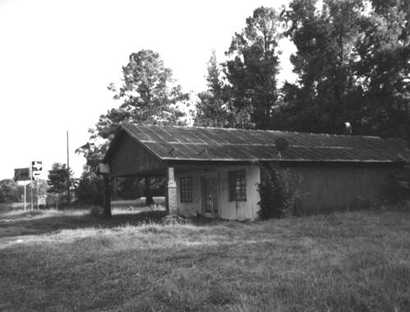
Today’s Geneva has
only one store, a cluster of homes at the intersection of its two
highways, and a number of collapsed buildings.
All
Things Historical September
29, 2008 Column.
Published with permission
A weekly column syndicated in 70 East Texas newspapers |
| Texas
Escapes, in its purpose to preserve historic, endangered and vanishing
Texas, asks that anyone wishing to share their local history
and vintage/historic photos, please contact
us. |
|
|
 HOME
HOME

 Gulf
Coast
Gulf
Coast East
Texas
East
Texas Central
North
Central
North Central
South
Central
South Panhandle
 South
Texas
South
Texas Hill
Country
Hill
Country West
Texas
West
Texas Ghost
Towns
Ghost
Towns COUNTIES