|
|
Texas
Independence Day is special to the citizens of our state because Texas
has been a full-fledged, independently functioning country before
becoming a part of the federal union.
After the arrival of Europeans in the New World, Texas
became a part of the Spanish empire and remained so until Mexican
nationalists established a republic in 1821 with Texas
a part of Mexico.
At the end of Spanish control and throughout the early years of Mexican
independence, American adventurers and settlers arrived in Texas,
first illegally, and then as part of the empressarial system of legal
immigration until 1830.
These American immigrants were only a generation removed from the
American Revolution, and they came with the spirit of independence
and liberty as part of their cultural baggage. The clash of cultures—religion,
concepts of citizenship, economic aspirations—produced tensions that
led to Mexican attempts to close off American immigration by the Law
of April 6, 1830, which in turn led to the Disturbances of 1832 in
Anahuac, Velasco,
and Nacogdoches,
where a battle of sorts was fought in the summer of that year.
Through conventions in 1832 and 1833 the Texans tried to explain their
continued loyalty to the Mexican Constitution of 1824 by their defiance
of political leaders they believed were violating the state’s rights
aspects of that document by the passage of the Law of April 6, 1830.
Petitioning the government was considered a fundamental American “right,”
but not so in Mexico;
their petitions were rebuffed and their messenger—Stephen
F. Austin—jailed. |
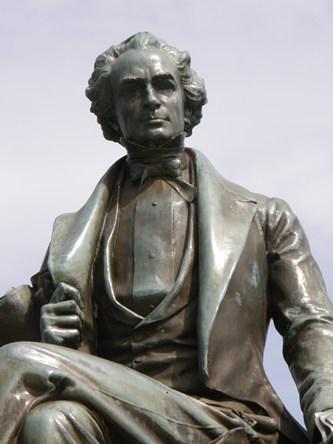 |
While Austin
remained under arrest, few Texans protested for fear their actions
would result in harm for him, but after his release resistance sparked
in Gonzales in October
1832, leading to the Texans’ capture of San
Antonio in December.
Meanwhile, a Consultation of Texans met in San
Felipe on November 3, and those present prepared for war but
were not quite ready to take the bold step of independence. But the
Battle of San Antonio (December 5-10), the ineffectiveness of an interim
government under Henry
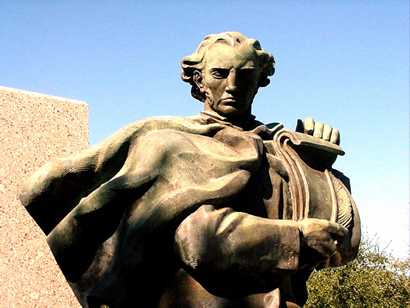
Smith, and the march northward in January 1836 of General Santa
Anna’s forces, provided the difference. |
 |
When the Consultation
met again, this time at Washington-on-the-Brazos,
on March 1, independence was the only option discussed. The following
day, March 2—thereafter Texas Independence Day—George
Childress produced a document that declared Texas
forever separated from Mexico.
Childress
followed the pattern of Thomas Jefferson in composing his document.
The first section argues the “right of revolution,” the second lists
specific grievances against Mexico,
and the concluding section pledges the signer’s mutual efforts to
establish Texas’ independence.
More war followed to determine if the declaration would work, and
the Texan’s
victory at San Jacinto insured at least the opportunity.
Ironically, after nearly ten years as a Republic and fifteen more
as a state of the Union, Texans again chose March 2 as the official
date of their exit from the Union to join the Confederacy.
Texas was readmitted to the Union after
the Civil War in 1870. For years March 2 was celebrated as an official
holiday, and still is by some state agencies. Holiday or not, it is
an important date in the history of our state; it reminds us of our
independent past, and also our binding tie as Americans.
© Archie
P. McDonald
All
Things Historical March
3, 2008 column
A syndicated column in over 70 East Texas newspapers
(The East Texas Historical Association provides this column as a public
service. Archie P. McDonald is director of the Association and author
of more than 20 books on Texas. ) |
|
|
 HOME
HOME


