|
The
countryside around Montalba,
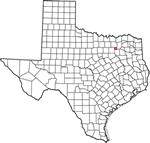
north of Palestine
in Anderson County,
is among the most beautiful in East
Texas with its small mountains, winding roads and scenic streams.
Visiting the area, you can easily understand why three families named
Fitzgerald moved here in the 1840s and purchased land along Mound
Prairie Creek.
The area soon became known as Fitzgerald and, as the years
passed, the community’s people built a school, a church, a post office,
a cemetery and likely a store or two.
The
church was named Concord Baptist Church for a community in
Louisiana, where some of the Fitzgeralds had lived. A wooden building
served the settlement from the early 1900s until 1940 when it was
destroyed by fire. A brick building was soon built.
The first burial in Concord Cemetery was Joel P. Kelley, who
was born in North Carolina in 1825. Joel was a Baptist preacher and
had given the land for the cemetery a year before he died in 1872.
Joel’s family moved to Texas in 1869, along with his brothers and
sisters. After they crossed the Sabine River, Joel’s brother, Jack
and his family, left the caravan and were never seen again by the
family.
Some of the Fitzgeralds, William and his family, left Anderson
County in the 1860s and moved to Coleman
County, Texas. A family story says that on the night that William’s
wife was giving birth to a son, the family’s cabin roof was shot full
of arrows by Indians.
Understandably William moved his family back to Concord, where the
Indians were friendlier.
When the Civil War erupted in the 1860s, many of Concord’s men marched
off to war. Some returned; some didn’t. Several Confederate veterans
were buried in Concord Cemetery when they died.
One such veteran was Clayton Alexander Fitzgerald, who was born in
1846 in San Augustine
County. He and his parents, Michael and Matila Fitzgerald, came
to Concord in 1850.
Clayton fought with Bates’ Regiment of the 13th Texas Infantry. A
private, he served from the spring of 1864 to the end of the war,
and was later transferred to the First Texas Artillery, which was
stationed at Sabine
Pass.
Clayton died on Christmas Day, 1929, at the home of his son Hugh,
and his grave in Concord Cemetery is one of two with a Confederate
marker.
Concord has some 200 marked graves, but many other graves are marked
only with rocks.
© Bob
Bowman
Bob Bowman's East Texas
November 29, 2009 Column
A weekly column syndicated in 109 East Texas newspapers |
|
|
 HOME
HOME