|
In
the 1940s East Texas sawmills
and paper mills lost many of their loggers to the armed forces fighting
during World War
II.
The problem was solved with a unique exchange.
German soldiers who had been captured in Europe were brought to the
U.S. and conscripted as loggers.
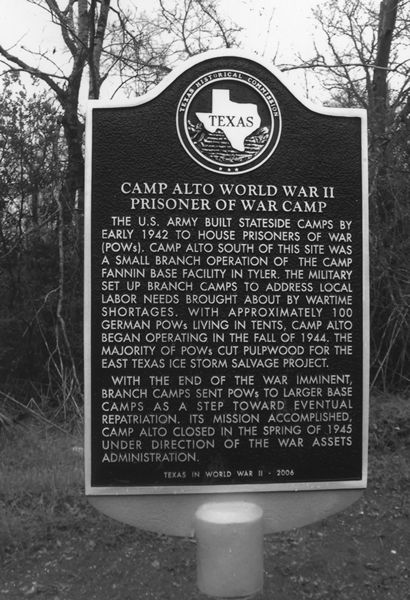
Today, the unusual trade is remembered by seven Texas historical markers
placed near German POW camps at Alto,
Center, Chireno,
Huntsville, Lufkin,
San Augustine
and Tyler.
|
| A Texas State
Historical marks the site of Camp Alto, one of seven German prisoner-of-war
camps in East Texas during
World War II |
The Germans came
to East Texas through the efforts of companies like Southern Pine
Lumber Company of Diboll, Frost Lumber Company of Nacogdoches,
and Angelina County Lumber Company of Keltys, near Lufkin.
History, regrettably, doesn’t record many of the names of the German
soldiers who came to East
Texas, but most of them worked hard in the woods, felling trees,
cutting them into pulpwood or lumber logs and shipping them on railcars
bound for the sawmills.
Some Germans, however, deliberately slowed down their work, believing
that shortages of lumber would hurt the American war effort.
While East Texans struggled with the notion that the German POWs would
escape and commit all kinds of atrocities to their families, there
were few such events. The Germans simply did their jobs and most were
returned to Germany after the war. Some remained in East
Texas; one even became the president of the chamber of commerce
at San Augustine.
A few of the Germans escaped, but became lost and eventually wandered
back to their logging camps.
When a prisoner escaped at the Chireno
camp, guards found him in a cow pasture holding a little girl, and
the mother was deeply upset. The guards discovered, however, that
the girl had wandered into the pasture, where there were some bulls.
The escapee scooped up the child and when the guards raced toward
the POW, he and the little girl were talking to nearby cows. The little
girl told the guards. “He nice man. He show me cows.” |
Author
Mark Choate chronicled the story of the Germans in his excellent 1989
book, “Nazis in the Pineywoods.”
Except for the historical markers, little remains of the old POW camps.
In Lufkin, a stone
gate bears an inscription scratched into the stone: “Rothhammer, 1944,”
a reminder of a German POW who lived there.
Bob Bowman's East Texas February
2, 2009 Column.
A weekly column syndicated in 70 East Texas newspapers |
|
Forum:
Subject: Mistake in Bob Bowman's otherwise excellent
column
Mr. Bowman repeats misinformation about Nazi POWs who stayed behind
in San Augustine. He writes that an anomymous POW stayed behind (which
wasn't allowed), married a local gal, and became the SA Chamber of
Commerce President and then a state rep. This article
on the Hemphill Daily News web site offers a different set of
information. A U.S. Army sgt named George Goetz came to SA to work
as a translator. When the camp closed, he stayed behind and married
a local girl. Thanks for your attention. - Roy Bragg, March 16, 2023
|
|
|
 HOME
HOME