|
|
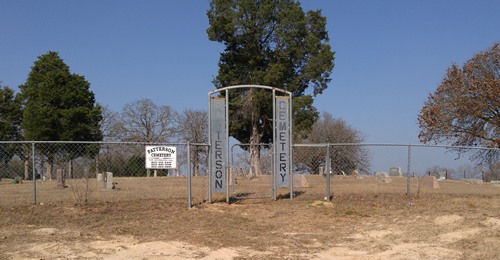
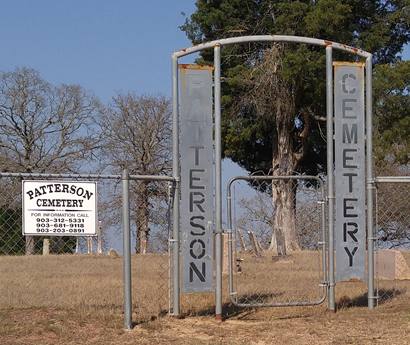
Patterson Cemetery
in Science Hill
Photo courtesy Dustin
Martin, February 2017
|
Science Hill
By Bob
Bowman
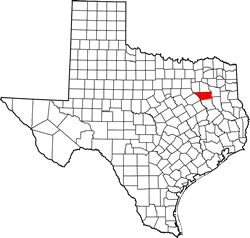
Sitting atop a scenic hilltop in southwestern Henderson
County, Science Hill lasted only a few decades, but its reputation
as a center of education is well-remembered by descendants of its
founders and builders.
So is its violence in the early days of the Civil War.
The earliest settlers arrived at the hill in 1846. D.M.Thompson and
J.D. Jaggers built the community’s first industry, a cotton gin, and
carried the cotton as far away
as Navasota
and Calvert.
But the town’s greatest step forward was the establishment of the
Science Hill Academy in 1848 through the efforts of Andrew J. Fowler,
Robert Hodge, John Tanner and other members of the Science Hill Masonic
Lodge.
Located on the lodge’s ground floor, the academy was ahead of its
time for the 1850s with courses that included orthography, Latin,
Greek and natural sciences.
Four well-known ministers lived at Science Hill, using their leadership
skills and intellect to shape the community. They were Hezekiah Mitchum,
who organized the First Methodist Church of Henderson
County in 1852; Robert Hodge, who organized the First Presbyterian
of Henderson County
in 1855; Harrison Rushing, another Methodist minister; and Wes Jackson,
a Baptist preacher.
Science Hill Academy lasted only until 1872, the result of the Civil
War and its aftermath.
With the eruption of the war, the town found itself caught up in issues
such as slavery, which in the 1860s provided the labor on East
Texas cotton plantations. As
the war exploded, the plantation owners saw their prosperity facing
extinction.
As fires erupted in a number of East
Texas cities and communities at the peak of the Texas
secession crisis, a violent mob rode into southwestern Henderson
County and killed three men suspected of being involved in a conspiracy
against Science Hill.
It was reported that a slave named Bob belonging to a slaveowner was
meeting with two men from Tennessee Colony, who had been harboring
escaped slaves and selling liquor to them.
During a community “inquiry,” Bob supposedly said the two white men
had supplied him with poison and phosphorous matches and told him
the time had come for the blacks to “rise up against their masters.”
Bob was quickly found guilty in a hastily-arranged trial and hanged.
The two other men suffered the same fate.
Following the Civil War, Science Hill’s fortune skidded. Its post
office, established in 1859, was closed in 1866.
Science Hill’s families began moving away from the hilltop. By 1936,
there was nothing left to identify the site of Science Hill except
for Patterson Cemetery, which was organized in 1861 on a plot
of land owned by John Patterson.
See Science Hill historical marker
› |
 |
|
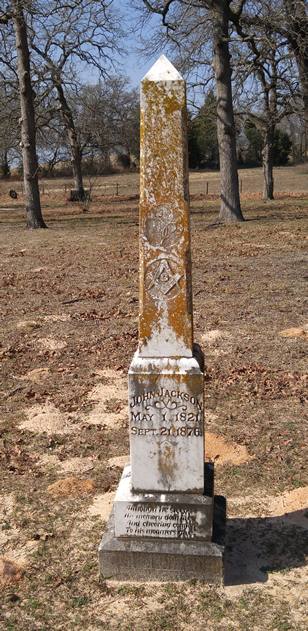
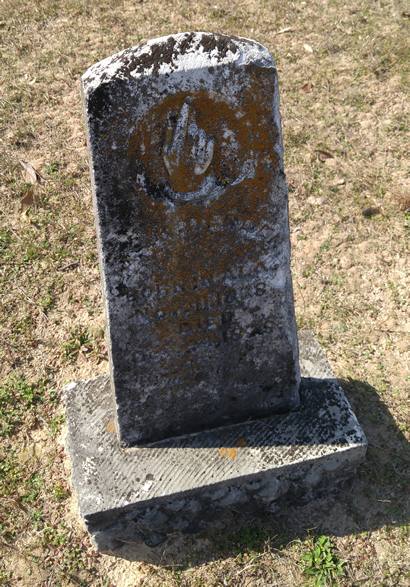
John Jackson
tombstone
born May 1, 1821, died Sept. 21, 1876
Photo courtesy Dustin
Martin, February 2017
|
|
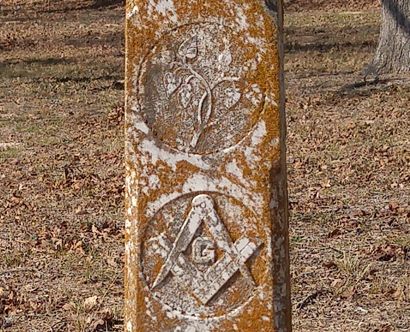
Masonic sign
on tombstone
Photo courtesy Dustin
Martin, February 2017
|
|
James K Derden
tombstone
born in Ala. Nov. 11, 1838, died Oct. 24, 1879
Photo courtesy Dustin
Martin, February 2017
|
|
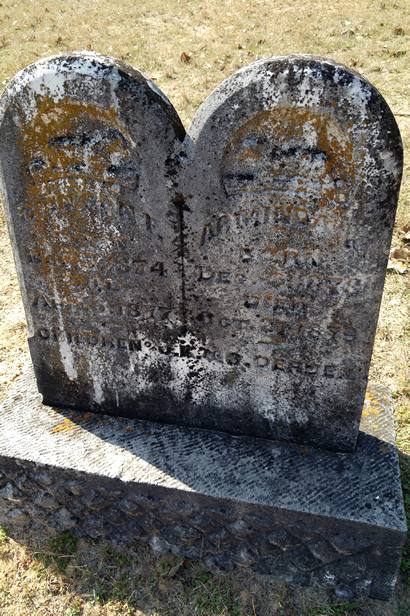
Clinton K Derden,
born Nov. 7, 1874, died Apr. 5, 1877;
Arminda K Derden, born Dec. 6 1878, died Oct. 27, 1879
(Children of James K Derden)
Photo courtesy Dustin
Martin, February 2017
|
|
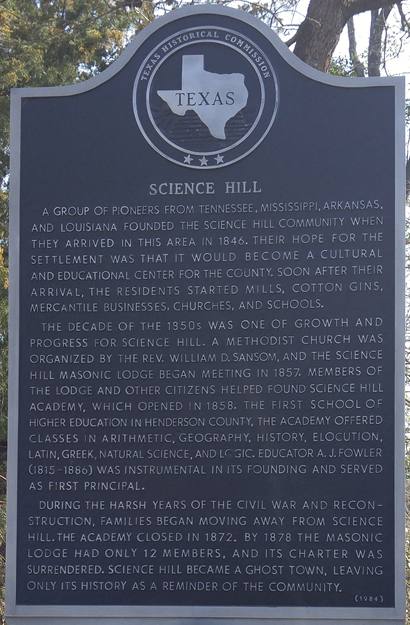
Science Hill
historical marker
Photo courtesy Dustin
Martin, February 2017
|
| Texas
Escapes, in its purpose to preserve historic, endangered and vanishing
Texas, asks that anyone wishing to share their local history, stories,
landmarks and recent or vintage photos, please contact
us. |
|
|
 HOME
HOME