Books
by
Byron Brown
Order Here |
|
| He
was only trying to return home, to New Spain, by a short cut. However,
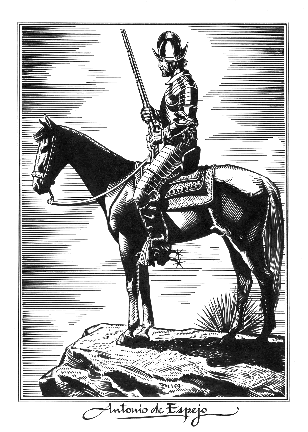
Don Antonio de Espejo’s venture through Texas
has warranted his inclusion within the history books (the Texas
ones in particular) alongside other explorers and conquistadors such
as Coronado
and Cabeza
de Vaca. |
Artist: Tom Lee
Courtesy Carl Hertzog Collection, El Paso, 1947 |
As every schoolboy
knows the Spanish and French had set longing eyes and hearts along
the Gulf coast in the sixteenth century. The desire for “souls and
gold” burned hot with the Spanish in particular. Cabeza
de Vaca’s determination to continue exploring after shipwreck
and years of imprisonment was so successful that, by journey’s end,
he was being followed everywhere he went by, literally, thousands
of Native Americans. While the stories of he and his small company’s
divine, almost apostle-like healing powers may be slightly exaggerated
(long ago a friend, now a professor of ancient Greek, informed me
that the art of history writing, from Herodotus to Churchill, involves
the enhancement or overstatement of figures. The over-valuing of numbers
of men, armies, size of countries, amount of land seized, etc. is
as integral a component of the genre as a good topic sentence.) there
is no doubt that his expedition achieved much more than anyone had
hoped and brought himself and his family well deserved rewards.
Coronado’s
entrada was equally successful but more brutal in its execution.
It seems whatever Coronado
wanted, Coronado,
Caesar-like, took. In fact, as Espejo ventured west from the Rio Grande
into New Mexico, the inhabitants of many pueblos withdrew into the
surrounding mountains as he and his party approached. The Indians
remembered what had happened the last time, forty years previous,
a Spaniard entered their lives and they weren’t eager to witness another
such event. |
Antonio
de Espejo (Espejo is ‘mirror’ or ‘looking glass’ in Spanish)
came to Mexico, or New Spain, in 1571 as part
of a contingent of a new arm of the Inquisition. Espejo accompanied
chief Inquisitor Pedro Moyas y Contreras and through his and
the King’s influence, soon became wealthy buying land and stocking
it with cattle. However sometime in early 1581 Espejo and his
brother Pedro were involved in the killing of one of their
employees. Some accounts identify the victim as a “vaquero”, others
call him a “servant” and one article describes how the brothers, “killed
a man in a brawl”. Whatever the circumstances and whoever the victim,
both Espejo brothers were convicted-Pedro to imprisonment and Antonio
to pay a hefty fine. Rather than pay the damages Antonio de Espejo
decided to leave the territory and head a little farther north to
Nueva Vizcaya; the present day states of Chihuahua and Durango.
While there Espejo met the remainder of the Rodriguez-Sanchez expedition.
This party had been on a converso (conversion) mission and
had had two of its members decide to remain in the New Mexican territory
after the group returned to their base in Santa Barbara. Upon their
arrival the expedition determined to return for the two brothers,
Fray Lopez and Fray Rodriguez, unaware that the very Indians that
they had wanted to convert had already killed them. A new expedition
led by another Franciscan brother, Fray Bernardino Beltran,
gathered for the rescue effort. To assist in this, and certainly seeing
an opportunity for gaining wealth, notoriety in Spain and distance
between himself and his legal troubles, Antonio de Espejo joined the
group and paid for the inclusion of soldiers, horses, cattle and supplies.
They set out for New Mexico on November 10, 1582.
The
expedition first followed the Rio Conchos downstream to the
Rio Grande. Next the group headed west, along the Rio Grande,
to New Mexico. Even though Espejo later would write about the
ten months the group spent on this entrada, his accounting was directed
to the Spanish king and therefore an epistle of obsequious, anemic
facts dripping with pleas for more opportunity (for himself) in the
region and more financing of further expeditions.
Another man however wrote a different accounting of the trip. Diego
Perez de Luxan covered the journey with a manuscript entitled,
Expedition into New Mexico made by Antonio de Espejo 1581-1582.
Luxan’s writing is a day-by-day accounting that lists, of course,
the different pueblos and tribe names but also describes, more fully
than Espejo’s, the countryside and the activities of the party. When
remembering that most of these Spanish conquistadors employed scribes,
reporters as it were, (Bernal Diaz’s brilliant journal of Cortez’s
conquest of Mexico is a fine example of this) one can easily imagine
that Espejo had hired Luxan for just such a purpose. I have always
marveled at these men’s wise and prescient behaviors; realizing at
the present that their future would warrant close observation and
chronicling, that what they were embarking upon could be of use or
simple interest for the distant future. Maybe there’s a certain degree
of hubris involved, maybe the seed of greed germinates well in the
black soil of conquest and control. But it would be a rare man who
could resist the temptation for relatively easy subjugation coupled
with the subsequent tribute. |
Espejo’s entrada
was, by standards, a pretty calm affair. By his own account the only
violence or, the few times that flared tempers produced loaded guns
and drawn bows, was when particular Indian tribes killed some of the
party’s horses. Apparently a few different tribes at varying times
did this either as a show of force or an act of subdued aggression.
According to Espejo envoys sent by himself usually mollified the situations
and the opposing parties became amicable. One contemporary writer,
on the other hand, describes events after Espejo discovers the tribe
of Indians responsible for the Franciscan brother’s deaths. He writes
that during this portion of the journey, “Espejo’s expedition is marked
by his violent attacks on Indians at Puaray and Tiguex in which dozens
of inhabitants were executed and their pueblos burned.” The message
was clear: personally, there is room for negotiation and compromise,
religiously, the rules are absolute and enforced.
The Texas
portion of Espejo’s trek begins after he and the party have a disagreement
about whether to continue the journey or return home. The Franciscans,
after learning of their comrades’ deaths, saw no reason to keep on.
Espejo, never truly concerned with anything other than exploring for
gold and silver and, ostensibly, for the Crown, kept on the march
until he came to an area near what is now Flagstaff, Arizona.
According to his report to the king in 1583, Espejo did in fact discover
several mines that produced silver ore and even a couple of small
gold mines. Most of the Indians however were not interested in metals
and subsequently simply kept pointing Espejo and what was left of
his train, west.
Just
under the ten month mark Espejo began his return to Mexico. He followed
the same path as that they had entered the territory until he reached
what is the New Mexican-Texas border. Somewhere near the Pecos
River Espejo came upon a few Indians hunting and “by signs” allowed
the Indians to understand what he was doing and where he was headed.
These Indians told Espejo of a short cut back to the Rio Grande through
the desert and over mountains. He took it. At this point the Indians
led the Spanish past Toyahvale,
down Wild
Rose Pass and through Limpia Canyon; the same trail that every
cattleman, cavalryman and original settler of the Fort
Davis area would take in the coming centuries. According to the
records of Espejo and Luxan the group even camped one night in exactly
the site where Fort
Davis would be established two hundred and seventy two years later. |
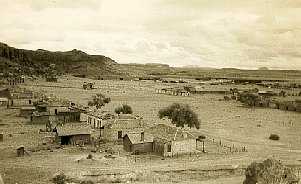 |
Fort Davis and
its Buildings c. 1950
Photo
Courtesy TXDoT |
The Indians guided
the Spanish group back towards the Rio Grande. There they parted ways.
Espejo followed the river to the Conchos and then back home where
they rejoined the others arriving on September 10, 1583, exactly ten
months after they had set out.
The expedition, as far as Espejo was concerned, was a success. He
had explored the area he had intended and come away with those items
he had hoped to find: silver and gold ore and established, permanent
pueblo settlements that converso missions could work with. In his
letter to the king of Spain Espejo was also able to describe things
heretofore unheard of. Turkey, tamales, maize and blankets created
from agave plant fibers would brightened the interest of several other
Spanish explorers in the coming decades. These discoveries would also
ensure Espejo’s place within the new territories. Sadly, he died at
Havana, Cuba in 1585 as he was trying to return to Spain
to gather new materials (the king’s permission and financing chief
among them) for his conquest. What is interesting is that the short
cut he took on the return paved the way for most future exploration
and settlement in the area; a route and result that would have great
effect for future generations, of which Espejo would never know.
© Byron Browne
July 27,
2011 Column
Byron Browne can be reached at Byron.Browne@gmail.com
More Notes From Over Here
More
Columns
People |
|
|
 HOME
HOME