|
|
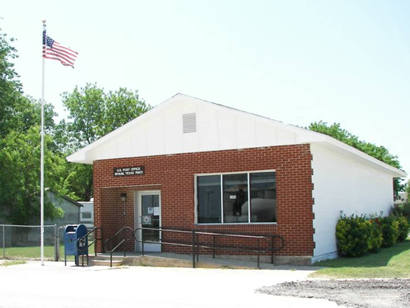
The US post office
in Bynum, TX 76631
Photo courtesy Barclay
Gibson, April 2006 |
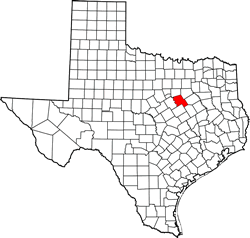
History in
a Pecan Shell
The town which
was settled on an Indian burial ground was named for a pioneer settler.
In 1882 a post office named Hanover was established. The post
office and a store both closed two years later. A second store opened
in 1890 and storekeeper Henry M. Mucklevane applied for a post office
under the name of Bynum. Within two years Bynum had a population of
150 and all essential businesses as well as two doctors and The Bynum
String Band.
With the arrival of the Texas and Brazos Valley Railroad in 1904,
the town shifted a half mile to be alongside the rails. The town took
the unusual step of buying a farmer's land for the new location. When
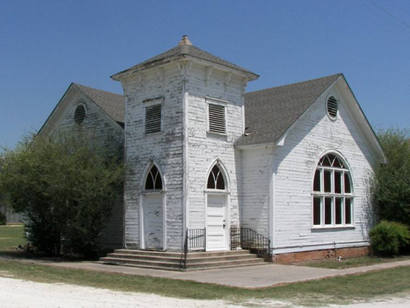
the lots went on sale the town had a population of 163. Three churches
were moved from the former town site and in 1905 a brick two-story
school was constructed.
In the mid 1920s, with the population around 350, Bynum experienced
a business district fire but soon rebuilt the damaged stores. A second
disaster in the form of a tornado destroyed downtown Bynum again in
1930. Between the cotton crop being infested by the boll
weevil and the onset of the Great Depression, Bynum was hit hard.
The railroad was jokingly referred to as the "Boll Weevil" route.
Sold to the Burlington-Rock Island Railroad in 1930, the rails between
Hillsboro and Hubbard
were closed as a cost-cutting measure in 1935. Highway 171 which connects
Hillsboro and Mexia
was built about this same time period.
Bynum was still recovering after the end of WWII.
When the Gilmer-Aikin
Laws forced smaller schools to consolidate with larger districts,
Bynum received a shot in the arm when schools in the nearby communities
of Brandon, Davis, Grove Creek, Malone,
Prairie Valley, and Watson had their schools merge with those in Bynum.
By the 1980s Bynum was left without a single business. Even the bank
had moved to Hillsboro.
The population was a mere 130 in the early 1970s which has since increased
to the present 225. |
 |
| Texas
Escapes, in its purpose to preserve historic, endangered and vanishing
Texas, asks that anyone wishing to share their local history, stories,
landmarks and recent or vintage photos, please contact
us. |
|
|
 HOME
HOME

 Texas
Gulf Coast
Texas
Gulf Coast East
Texas
East
Texas Central
Texas North
Central
Texas North Central
Texas South
Central
Texas South Texas
Panhandle
Texas
Panhandle South
Texas
South
Texas Texas
Hill Country
Texas
Hill Country West
Texas
West
Texas Texas
Ghost Towns
Texas
Ghost Towns Texas
Counties
Texas
Counties