|
|
 |
|
History in
a Pecan Shell
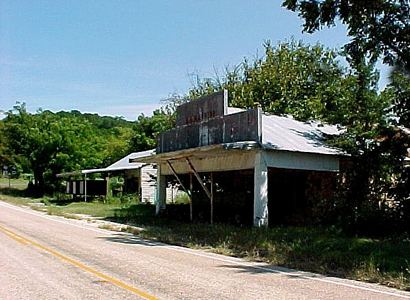
The application for a post office had been filled in with the name
Swayback, for nearby Swayback Mountain. A misspelling resulted
in "Wayback" when the office was granted in 1884. The townspeople
lived with this until 1890, when it was re-named after Pearl Davenport,
the SON of a store keeper.
Pearl had three doctors in the early 1900s. The rivalry resulted
in a price war for services and as a result, the cost of delivering
a baby was $2.50. Telephone service arrived in 1908 although subscribers
had to buy their own equipment, including wire, and posts. They
also had to string the wires.
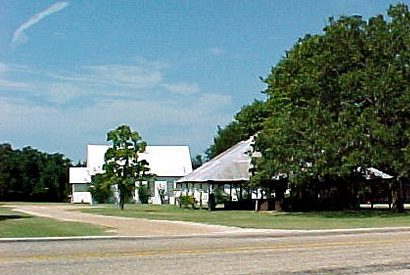
In 1875 Ellen Reily deeded land for Cowhouse School. By the 1890s,
the name was changed to Sweet Home School. In 1917 a four-room brick
school was built and named Pearl School. The building is now the
Pearl Community Center.
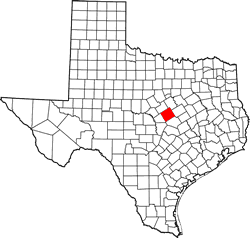
The population of Pearl peaked in the 1970s with 220 people.
|
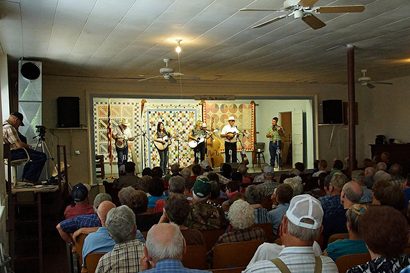
The Pearl
Bluegrass Jamboree
Photo courtesy Michael Barr |
Pearl,
Texas – The Sound of Music
"Hindsights"
column by Michael Barr
“We get started about noon,” Medart said. “We schedule 45 minutes
for each band, but you know how bluegrass musicians are. There are
jam sessions going on all over the place. Bluegrass lovers come from
all over the country. We never know exactly who is going to show up.
Many of them bring their own instruments and sit in. It’s a family
thing. We officially close about midnight, but people play out under
the trees and in the RV park until 2 or 3 in the morning.”... more
|
|
Comanche
Raids in Coryell County
"Texas
Tales" column by Mike Cox
The Army, both in its absence and its presence, has had a big impact
on Coryell County over the years.
The establishment of Fort Gates on the Leon River in 1849 is what
helped stimulate settlement of the area as folks in Bell, Burleson,
Milam and Washington counties began to move into the eastern and
southern parts of Coryell County. Hostile Indians wisely steered
clear of the vicinity.
The military abandoned the stockaded garrison (one of the few Hollywood-style
military posts ever actually built in Texas) in March 1852, but
the settlers drawn by the protection it had offered did not. By
the 1860s, some of the county’s early settlers had moved westward,
building cabins near what soon became the community of Pearl.
With the soldiers gone, and most of Texas’ fighting men tied up
in the Civil War, the Comanches felt free to raid all along the
state’s western frontier. Texas’ Confederate state government fielded
companies of Rangers to patrol the outlying counties, but they couldn’t
be everywhere at once.
That’s how things stood on April 26, 1863 when a Comanche raiding
party came up on a settler named Steven Williamson, who lived several
miles southeast of Pearl.
When Williamson didn’t come home that night, worried family and
friends went looking for him. They found his arrow-studded body
lying near a large tree that he may have tried to use for cover.
The Indians had scalped him and then pinned his thighs together,
a sign that he had defended himself gamely. Likely he wounded or
killed some of his attachers before they overpowered him.
His family carried his body home in the back of an ox-drawn wagon,
built a coffin, lined it with black calico and took him to the southern
part of the county near the community of Eliga for burial.
Years later, Gordon Shook, Williamson’s great-grandson, could still
find what was left of the liveoak where his relative’s body had
been left by the Indians and posed for a photograph there. Charles
E. Freeman used the image in his book, “A History of Pearl, Texas.”
Gordon Williamson’s grandfather, J.W. Shook, in 1875 had settled
the land where the attack had occurred.
Freeman also included in his book a couple of accounts from Coryell
County oldtimers who lived through those bloody days... more
|
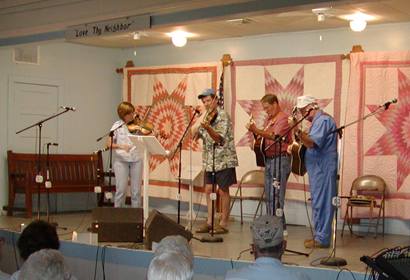 |
Saturday afternoon
bluegrass in the old school building
Photo courtesy Ken Fortenberry, July 2006 |
Pearl, Texas
Forum
Subject: Pearl,
Texas
Dear TE, The Pearl Blue Grass Jam is every first Saturday of the month,
except for September when it's the second Saturday. All bluegrass
performers are welcome to come and play and the public is invited
to come join the fun and enjoy a great afternoon of music. The ladies
of the community fix wonderful food and sell it at reasonable prices.
It's worth a trip to spend a nice Saturday afternoon listening to
some "downhome" music. - SAMANTHA AND JASON STRINGER, May 18, 2008
See Music in Texas |
| Texas
Escapes, in its purpose to preserve historic, endangered and vanishing
Texas, asks that anyone wishing to share their local history, stories,
landmarks and vintage/historic photos, please contact
us. |
|
|
 HOME
HOME

 Texas
Gulf Coast
Texas
Gulf Coast East
Texas
East
Texas Central
Texas North
Central
Texas North Central
Texas South
Central
Texas South Texas
Panhandle
Texas
Panhandle South
Texas
South
Texas Texas
Hill Country
Texas
Hill Country West
Texas
West
Texas Texas
Ghost Towns
Texas
Ghost Towns Texas
Counties
Texas
Counties