|
|
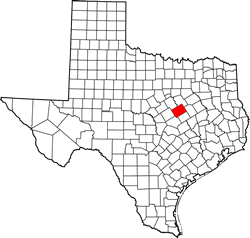
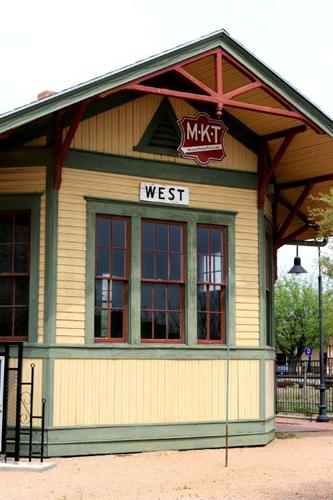
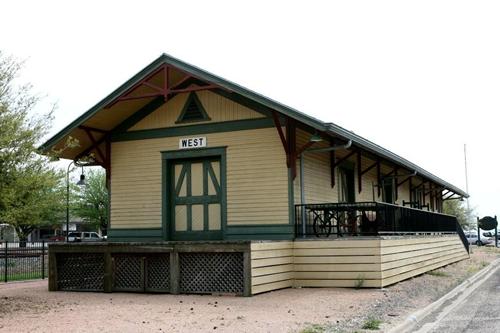
West, Texas
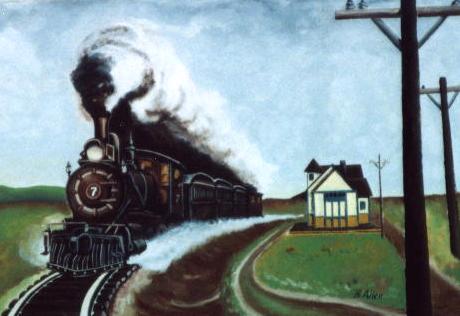
- Missouri, Kansas and Texas Railroad Depot
Photo courtesy Stephen
Michaels, April 2008
|
History in
a Pecan Shell
Dating from a settlement
called Bould Springs (after founding settler Carey Boulds) in 1852,
a post office opened that same year. Four years later the Bennett
family relocated here – becoming the town’s first permanent residents.
The town reported an estimated population of just over 300 for 1860.
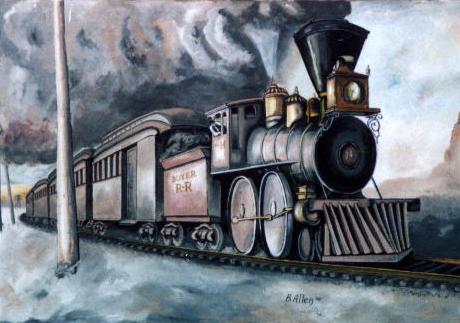
West (as it appears today) came to life in 1881 with the arrival of
the Missouri, Kansas and Texas Railroad. It was platted on
a quarter section of land belonging to Thos. M. West, landowner, storekeeper
and postmaster. The West post office opened in 1852 and was followed
by the store (a reversal of how most post offices were opened in Texas)
the following year.
The town incorporated in 1892 and by 1900 the population was estimated
at 2,000. The town had duplicates of all essential businesses and
became a stop on the Texas Electric Traction Railway – an Interurban
line that once connected Waco
with Dallas. Primarily an
Anglo community during it’s early years, Czech and German immigrants
began arriving around 1900. Cotton
and cattle ranching
were the regions economic engines, supplemented by a textile mill
and a sausage factory. The West ISD was formed in 1923.
Over the years West has become established as the center for Texas-Czech
culture despite the fact that it is on the northern extreme of Czech
settlement which stretches from west of Austin
to Colorado
County to the east and as far south as DeWitt
County. |
| West, Texas Photo
Gallery |
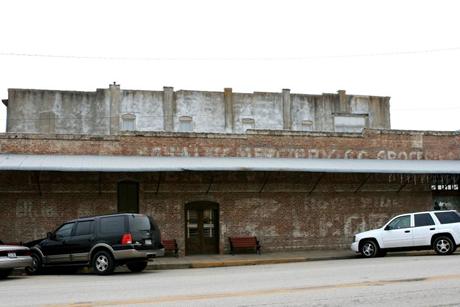
West Texas'
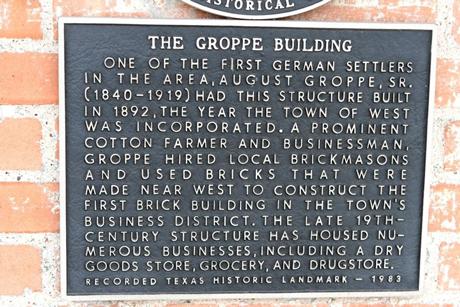
Historic Landmark: The 1892 Groppe Building
Photo courtesy Stephen
Michaels, April 2008
|
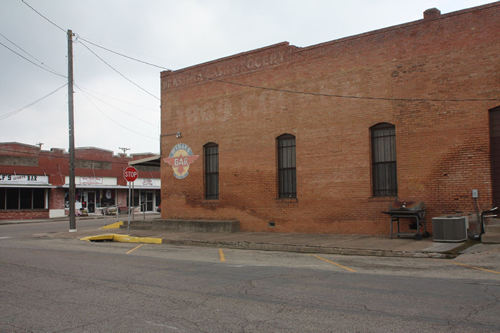
Ghost signs
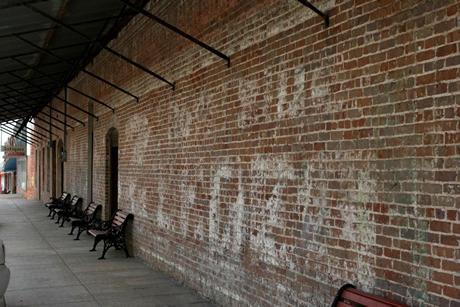
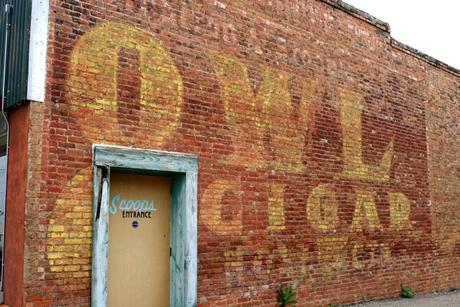
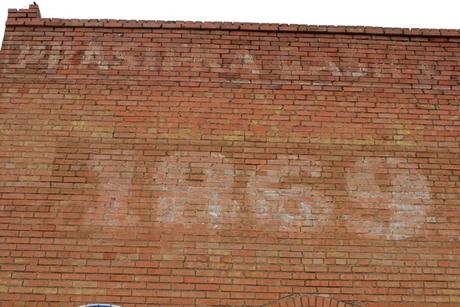
on the historic 1892 Groppe Building
Photo courtesy Stephen
Michaels, April 2008
|
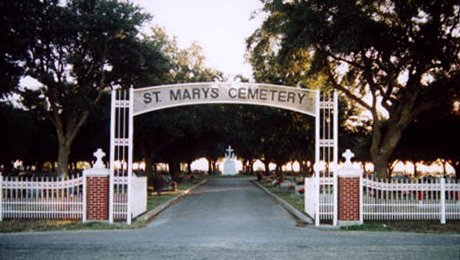
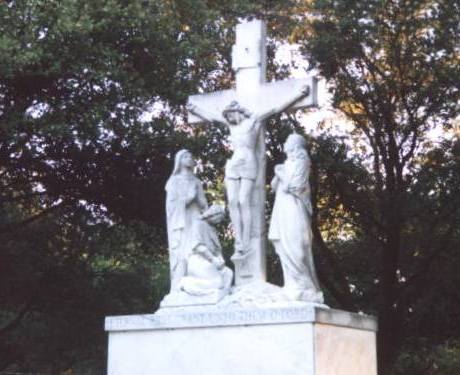
St. Mary's
Cemetery
Photographer's Note:
Speaking on graveyards, I came across one just south of West, off
I-35. St Mary's Cemetery took my breath away. It was so peaceful,
well attended too, and beautifully layed out that I really did not
want to leave. That is saying something about a cemetery. I don't
know if it was because of the early morning mist, the quietness or
just the overall feeling of being in a place that so respected their
dead. I just can't explain how I felt. I even went out of my way to
go back again, later. - Barclay
Gibson |
| Texas
Escapes, in its purpose to preserve historic, endangered and vanishing
Texas, asks that anyone wishing to share their local history, stories,
landmarks and recent or vintage photos, please contact
us. |
|
|
 HOME
HOME