|
|
 |
|
History in
a Pecan Shell
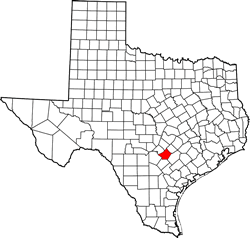
Settlement began in the early 1850s. During the Civil
War a Confederate training post (Camp Edward Clark) was in
operation here. In 1867 a water-powered cotton gin was set up which
later served as a grist mill and sawmill.
Col. John Douglas Staples established a store here in 1871 and in
1879, a post office was granted. The community was named Staples
Store until 1891, when the word “store” was discarded. In 1890
the Staples Water Power Company began construction of a wooden water
tower. From a population of about 40 residents in the mid 1880s,
Staples grew to 125 residents by 1892. Four years later it had risen
to 150. In 1896 the community had 150 people and its own cemetery
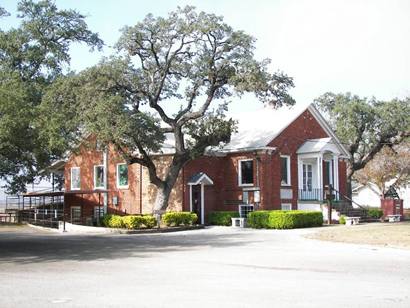
In 1913 both a new schoolhouse and a new metal water tower were
completed.
The Handbook of Texas in their town history of Staples tells of
the goring of Mrs. Tom Anderson by her cow. The woman, who was forty-nine
when the unfortunate incident took place in 1912, was totally disemboweled.
She was taken to the doctor who cleaned the wound with tap water,
rearranged her entrails, stitched her up, and told her family to
get her affairs in order. “Granny” Anderson outlived her doctor
by 20 years and died at the age of 105 in 1968.
Staples’ elementary school merged with San
Marcos in 1949. The 1993 population of 75 has increased to 350
for the 2000 Census.
|
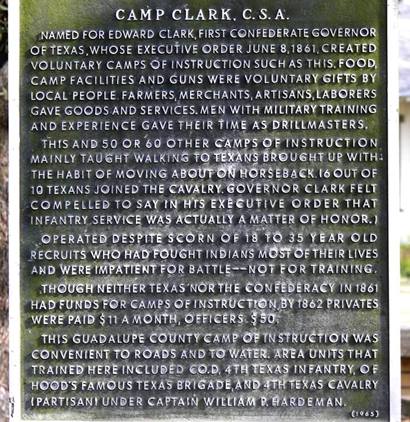
Camp
Clark Historical Marker
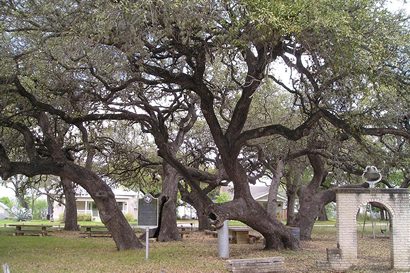
On Hwy 621, Staples city park
Photo courtesy Sarah
Reveley, October 2007 |
Historical
Marker
Camp Clark,
C.S.A.
Named for Edward
Clark, first Confederate Governor of Texas, whose Executive Order
June 8, 1861, created voluntary camps of instruction such as this.
Food, camp facilities and guns were voluntary gifts by local people.
Farmers, merchants, artisans, laborers gave goods and services. Men
with military training and experience gave their time as drillmasters.
This and 50 or 60 other camps of instruction mainly taught walking
to Texans brought up with the habit of moving about on horseback.
(6 out of 10 Texans joined the Cavalry. Governor
Clark felt compelled to say in his Executive Order that infantry
service was actually a matter of honor.)
Operated despite scorn of 18 to 35 year old recruits who had fought
Indians most of their lives and were impatient for battle-- not for
training.
Though neither Texas nor the Confederacy in 1861 had funds for camps
of instruction, by 1862 privates were paid $11 a month, officers $50.
This Guadalupe County camp of instruction was convenient to roads
and to water. Area units that trained here included Co. D, 4th Texas
Infantry, of Hood's famous Texas Brigade, and 4th Texas Cavalry (Partisan)
under Captain William P. Hardeman. |
 |
| Texas
Escapes, in its purpose to preserve historic, endangered and vanishing
Texas, asks that anyone wishing to share their local history
and vintage/historic photos, please contact
us. |
|
|
 HOME
HOME

 Texas
Gulf Coast
Texas
Gulf Coast East
Texas
East
Texas Central
Texas North
Central
Texas North Central
Texas South
Central
Texas South Texas
Panhandle
Texas
Panhandle South
Texas
South
Texas Texas
Hill Country
Texas
Hill Country West
Texas
West
Texas Texas
Ghost Towns
Texas
Ghost Towns Texas
Counties
Texas
Counties