|
|
 |
History
in a Pecan Shell
Charles Coffin
Watterson, and his wife Martha are credited as being the first settlers
here. The Wattersons arrived in the early 1850s and were soon joined
by Samuel and Caroline Wolfenbarger and others.
These settlers were mostly farmers who raised livestock.
The community was officially using the name Live Oaks and a
post office was granted under that name in 1878 (with Charles Watterson
as the first postmaster).
Watterson had to have been held in high regard by his neighbors, for
in 1891 they honored him by renaming the town for him.
The community had a population of 100 by the mid 1890s with the residents
being served by a cotton gin, gristmill and a general store.
Two local schools (Lentz Branch and Hilbig) merged with the Watterson
school in 1900.
The Watterson post office closed its doors in 1904. The community
doesn’t seem to have suffered any disasters and made it through the
Great Depression, although it’s hard to measure the economy due to
lack of population figures.
The larger farms in the region had broken into smaller plots by the
1960s and many of the area’s residents are direct descendants of the
town’s initial settlers.
Photographer’s Note:
“My mother, Josephine Metcalfe, taught at the school in the 1930s.”
- Francis Smith
Watterson Remembered >
Watterson Today > |
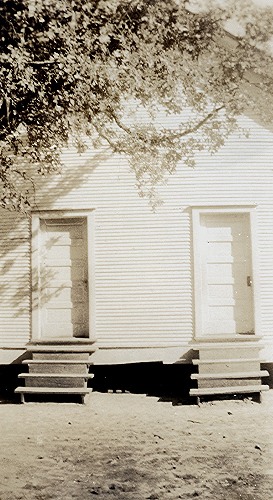 |
Front of Watterson
School, 1937
Photo courtesy Josephine Metcalfe Smith |
Watterson Remembered
Rail
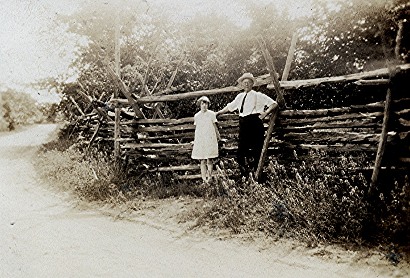
Fence -
Somewhere in Watterson is this real, handmade rail fence, set up as
our grandfather remembered them in Tennessee. He wanted a snapshot
taken before it should disappear. The year is about 1929. The man
is Dr. T. B. Taylor, medical doctor, Bastrop; the girl became a teacher
at the school in 1937.
Front of Watterson School -
Watterson School building, 1937, front entry into the building, Smith,
2009. The two doors are probably from the days when boys and girls
entered separately! This was also the community church building (1937)
with removable interior wall to provide two classrooms, two teachers:
lower grades in first room, upper grades in second.
There were no convenient buses; students and teachers came on foot
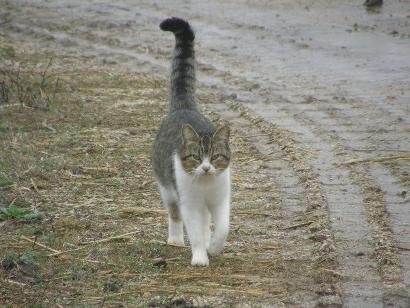
or horseback. Compare TE photo of cat on rutted road with the paved
one in Smith photo, 2009. In 1937, when it rained, only horses and
people a-foot could get about. No one could come in to us; no one
could get out. But Watterson people have endured from 1850 to a new
millennium. That's Texas.
- Sincerely, Josephine Metcalfe Smith, 2010 |
 |
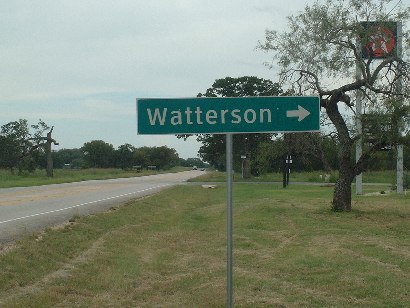
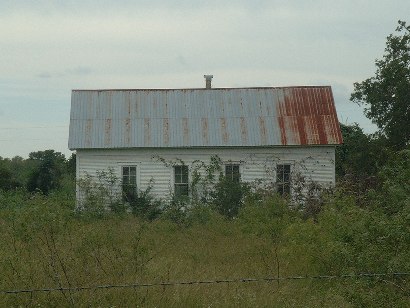
The way to Watterson
Photo courtesy Francis Smith, 2009 |
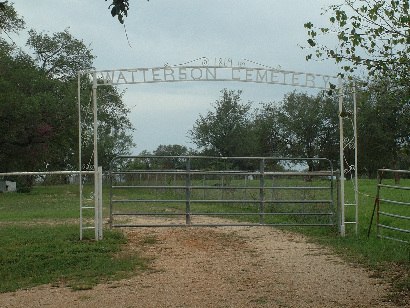
Watterson Greeter
TE photo, April 2010 |
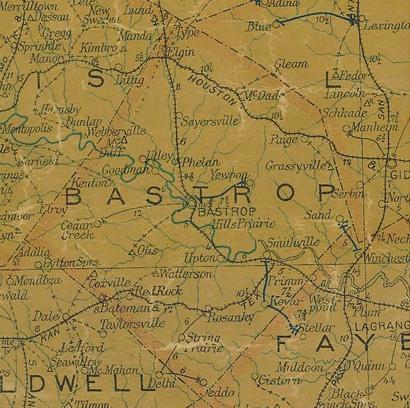
Bastrop
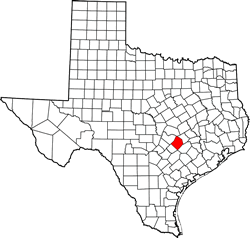
County 1907 postal map showing Watterson
near Red Rock
From Texas state map #2090
Courtesy
Texas General Land Office |
| Texas
Escapes, in its purpose to preserve historic, endangered and vanishing
Texas, asks that anyone wishing to share their local history, stories,
landmarks and vintage/historic photos, please contact
us. |
|
|
 HOME
HOME

 Texas
Gulf Coast
Texas
Gulf Coast East
Texas
East
Texas Central
Texas North
Central
Texas North Central
Texas South
Central
Texas South Texas
Panhandle
Texas
Panhandle South
Texas
South
Texas Texas
Hill Country
Texas
Hill Country West
Texas
West
Texas Texas
Ghost Towns
Texas
Ghost Towns Texas
Counties
Texas
Counties