|
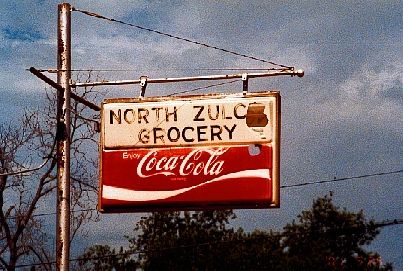
North Zulch Grocery
sign
TE Photo, 2001 |
History in
a Pecan Shell
Settlement began
in the late 1830s when the first homestead was established in what
had been Grimes County. Sometime around 1850 Julius Zulch, a German
immigrant recognized the potential of this place that was known as
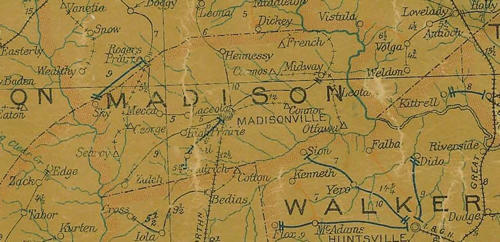
Willow Hole. It had spring water and was halfway between Midway
and Boonville
- the perfect place to open a store.
Zulch opened his store and in 1859 the Willow Hole post office operated
within the walls of Zulch's store. The settlers (mostly from southern
states) weren't settling fast enough for Julius, who wanted a broader
customer base. He started placing ads back in the old country - even
fronting interested immigrants their passage money.
In the early 1880s, "considerable numbers" of Germans arrived - either
sharecropping for Zulch or others in order to get a grubstake for
their own farms. Willow Hole soon had a respectable population of
150 - growing to around 500 by 1890.
Julius Zulch built a Lutheran school which doubled as a church. In
1893 the Bethlehem Lutheran Church was built on property donated by
Zulch. The town was renamed Zulch in 1906 and the postal authorities
authorized the change of the post office's name.
That same year the Houston and Texas Central Railroad on its way from
Navasota
to Mexia bypassed
Zulch by building to the west.
Then in 1907, the Trinity and Brazos Valley Railway built a spur parallel
to the Houston and Texas Central tracks. When people moved North to
the railroads - North Zulch came into existence and plain Zulch
shrank. The post office closed in 1920 and the school managed to hold
on until a consolidation in the early 1940s.
By 1949 Zulch was down to only 50 people and by the 60s, only the
Willow Hole Church and Cemetery remained.
A historical marker on Farm Road 39, (half a mile west) serves as
tombstone for the town. |
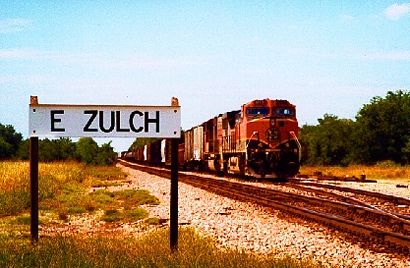 |
East Zulch sign
TE Photo, 2001 |
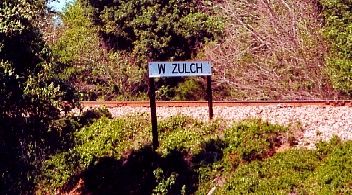
West Zulch sign
TE Photo, 2001 |
| Texas
Escapes, in its purpose to preserve historic, endangered and vanishing
Texas, asks that anyone wishing to share their local history, stories,
landmarks and recent or vintage photos, please contact
us. |
|
|
 HOME
HOME